A cherished 28-foot sloop is blown ashore in a freak gale
Issue 24 : May/June 2002
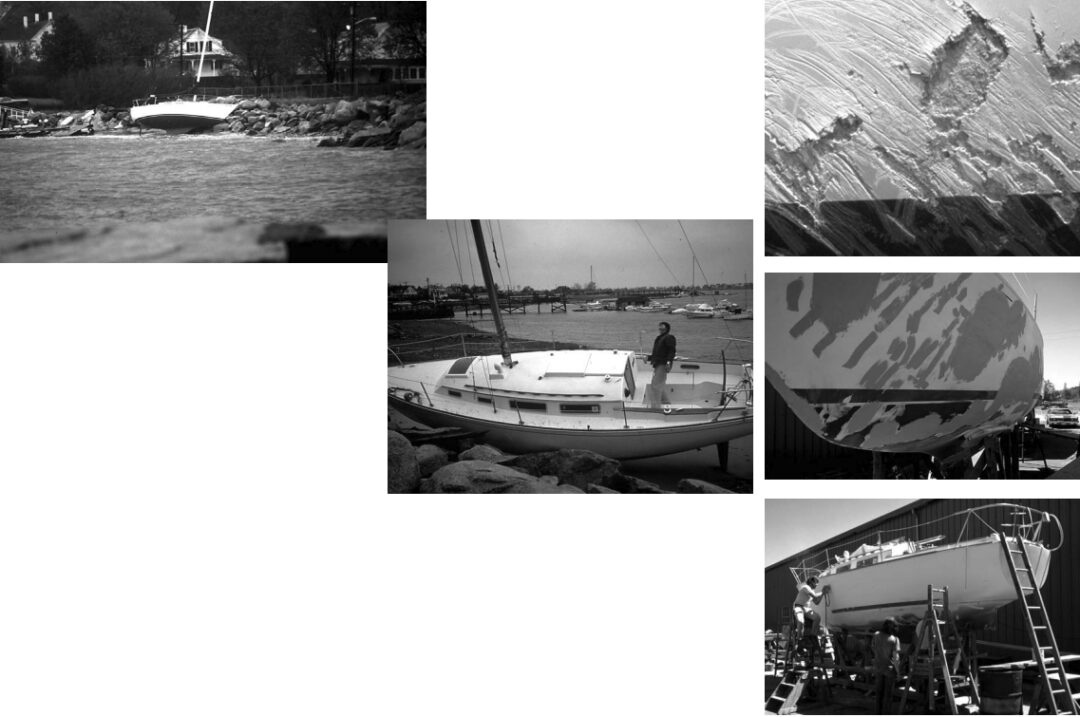
Weatherman Don Kent, of Boston’s WBZ-TC, called the easterly gales of May 9 and 10, 1977, a “historical storm.” Record amounts of snow, along with sleet, heavy rain, and high winds, broke power lines, downed trees, closed schools, and washed ashore or sank at least 37 boats in the harbor of Marblehead, Mass. Ten boats were also beached in the harbor of Scituate, Mass. during the freak blow that the Scituate Coast Guard reported as gusting at 65 to 70 miles an hour, even in the protected confines of the harbor. One of the 10 was our Sabre 28, Serena.
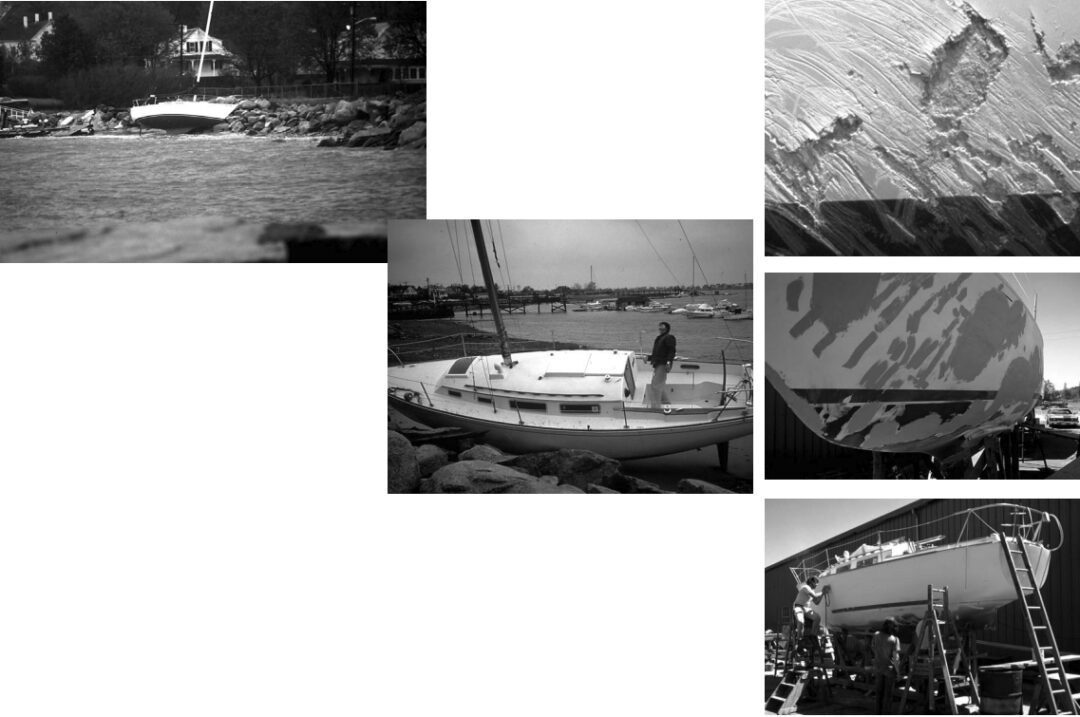
After a sleepless night spent listening to the intensifying winds and fearing for the safety of Serena, my husband, Warren, rose at dawn on May 10 and drove to Situate Harbor. A wrenching sight greeted him: Serena was being driven onto the rocks on the breakwater at the Scituate Waterfront Club, having chafed through her new 1-inch manila mooring pendant and chafing gear during more than 20 hours of galeforce winds.
Early that morning, still buffeted by a wind of 40 knots, Serena was being rolled and ground continuously into the rocky breakwater. Powerless to do much beyond trying to steady our vessel and prevent further broaching and grinding, Warren scrambled aboard, retrieved her anchor and 200 feet of anchor line, and proceeded to “lace” our boat fore and aft to the rocks and stumps of the shoreline. The tide was high, and the seas pounded Serena’s exposed starboard side, her keel and spade rudder now burying in the sand.
Salvage crew
When the tide receded, the damage had been done. A badly gouged, scraped, and cracked port topsides; a holed stem at the forestay; her new bottom paint beaten off her hull; and a potentially weakened keel. Knowing Serena couldn’t survive the afternoon high tide, Warren was fortunate to secure the services of a salvage crew, who arrived later that morning with a 100-foot crane, trucks, and cradles.
Next, Warren drove to the Scituate yachtyard where Serena was stored during the winter, to alert its owner that the salvage crew would be along shortly to pick up Serena’s cradle. “I’m afraid we’ve lost her,” he admitted to me sadly as we were returning to the harbor later that morning. “No boat could take that kind of pounding and ever be the same.”
How vulnerable Serena looked, wedged against the rocks, when we arrived. Like a filly, I thought, injured through no fault of her own. While awaiting the arrival of the salvage equipment, Warren and I removed the cotter pins in preparation for unstepping the mast. Then we took off the sail cover and removed the mainsail and boom.
The wind and rain continued all day through each step of Serena’s salvaging. She was lifted off the beach by the crane (at which point, surprisingly, the section of her hull that had appeared to be crushed the worst “popped back out” as one onlooker had predicted). She was lowered slowly onto her cradle. The cradle and boat were hauled to her yachtyard.
Tales of storms
After we had done what we could to ready Serena for the ministrations of the salvage crew, we stood around with other yachtsmen and spectators, waiting, watching, lending a hand where we could, and listening to many a story and observation. There were tales about other storms and beached boats that were either restored or declared ruined. Predictions about the fate of our own vessel ranged from the gloomy: “That boat will never sail again!” to positive: “They do wonders with fiberglass these days. She’ll be as good as new when they finish with her. Better!”
Our own feelings were very much a mix. Fortunately, no life had been lost nor person injured. We were warmed, too, by the appearance of many of our boating friends with offers of practical help and demonstrations of moral support: a friendly arm around a shoulder, a sympathetic smile, or simply being there in a sad hour was the best sort of balm to our heavy hearts.
Certainly, Serena’s trial-by-storm was not the kind we had foreseen, and we couldn’t help but feel that the weather bureau had goofed on this forecast. No one, including the forecasters, had expected a winter storm in May with gales lasting for two days. Since there wasn’t adequate warning and because the storm intensified during the night, most of the damage had been done by the time gale warnings were posted. That Serena had come ashore at dead high tide was fortunate, for the tide soon began to recede, beaching her. But that the wind increased at night was unfortunate, in that we couldn’t get out to her.
Never looked better
We were grieved, too, by the violation of our vessel’s perfection. Only the Sunday before we had been congratulating ourselves on Serena’s appearance. Sanded, painted, waxed and oiled, she had never looked better, not even when new. She was sporting new curtains and a new anemometer, which we had given each other for Christmas; she had been in immaculate condition and tuned to a “t” with everything done to ready her for the spring. Now, how disheveled and unkempt she looked. Her port side was fractured. Her rigging was dirty, sandy, and spattered with blood from knuckles my husband had scraped. We were saddened and frustrated that our winter of dreams, plans, and new purchases and our early spring of hard work had ended in this.
Yet on balance we counted ourselves lucky. If chance had not dictated that Serena make her way down the length of Scituate’s inner harbor, there to embed herself without damage on a mudbank (as it had for one vessel moored close by her), neither had it crushed her like an egg, as was the fate of a brand-new Cape Dory, owned a week, or bitten off half her hull, as had happened to another boat, leaving a gaping hole suggestive of a visit by the shark in Jaws. Serena had not been totaled. Her damage was confined to her port side, which was repairable. The transducer on the starboard side had not been touched. Nor had there been any damage to the propeller, which was tucked neatly up out of the way when Serena beached. In addition to a tear here and there in the vinyl lining belowdecks, the port shelf in the V-berth had been knocked out, and the port main cabin bunk back had been dislodged from the side of the hull with the cabinet shelf above it broken. On the other side of the harbor, Serena’s dinghy had been washed up on a dock. In any case, there was no use in second-guessing or indulging in “What-ifs?” We had to go on, as one always must, from where we were.
The healing starts
The wheels to restore Serena were set in motion. The next morning Warren notified the insurance company. (The surveyor was appointed by the insurance company, while the yachtyard where the work was to be done was our choice.) The surveyor and the yachtyard owner met and agreed on the kind and value of the repairs to be made (this estimate was later revised upwards by many thousands of dollars). My husband suggested a fiberglass man of whose work he had had good reports, to which the yachtyard owner agreed. The following Friday, Warren filed his “master’s protest” with the surveyor.
On May 18, there came an after-shock and the reason for the revising of the initial estimate. Repairing Serena, it seemed, would not be a matter of a few weeks as we had hoped, but would require 30 to 45 days, as the damage to her hull was worse than had at first appeared. The whole port side would have to be re-gelcoated to properly match her distinctive eggshell color. As there were dozens of other damaged craft, we had to wait our turn for the “fiberglass magicians.”
To active, independent people, waiting on the work of others is always painful. Now began the most discouraging part of the salvaging of Serena. There were delays of workload, weather, poor communication. There were the other boats to be attended to at the yachtyard, not only those damaged by the storm but the usual complement of vessels awaiting spring commissionings.
Missing gelcoat
The fiberglass company doing the work at the yard had ordered and received, directly from Sabre, the cloth, the rubrail, and half of her cream-colored gelcoat hull mixture. They were told that the other half of the formula was out of stock and back-ordered. Two weeks went by and no missing gelcoat arrived. Warren wrote to the sales manager of Sabre Yachts to see if he could expedite the order. He discovered that the fiberglass people had been in possession of the correct mixture all the while, although their ignorance of it was no fault of their own.
In minutes of pique, we almost felt as if it would have been better if Serena had been a total loss. Though a new Sabre would not have been available, we could have used the money to buy a good used boat for the season. And my husband was dogged by doubts. He worried whether a restored Serena would prove to be as seaworthy. Would she look as good? Would she prove salable when the time came for us to buy another boat?
Though I was more optimistic, these were troubled days and nights for both of us. People were kind. One sailor even offered the use of his large ketch free of charge for two weeks. Touched by his generosity, we nonetheless declined. Sailing someone else’s boat, we felt, just wouldn’t be the same. To keep from “climbing the walls,” we kept busy. Never had our yard received such scrupulous attention. Or odd jobs around the house been attended to so quickly. We scanned the movie listings and the television page, and we became reacquainted with the library. Every social invitation was accepted. There was a hole in our lives, and her name was Serena.
Magicians at work
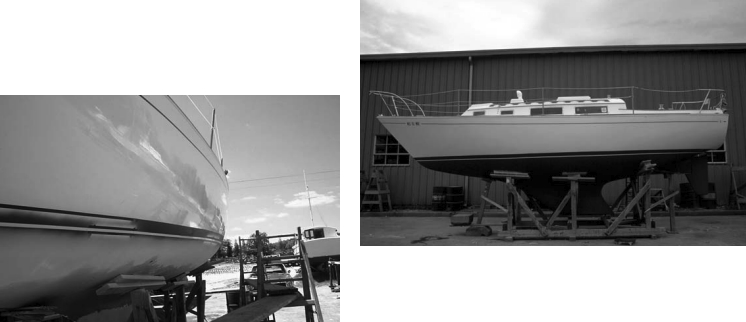
On the evening of July 6, we were cheered by one of the prettiest sights we had ever seen — Serena on her cradle, her hull completely restored and waxed to a fine gleam, her bottom freshly painted. For seven weeks those “magicians” had indeed been at work on her. After removing all damaged shelves, berths, vinyl lining, and necessary teak trim on the port side of the hull (in order to obtain access to the damaged areas of the hull and for later replacing of the damaged woodwork), these Merlins had cut out and ground down all broken and fractured fiberglass and all delaminated areas on the inside and outside of the hull.
Next, they had built forms and templates and made fiberglass layups with mat and woven roving. After reconstructing the port side of the hull, they had sanded, filled, and shaped it. All stress cracks in the keel had been ground out, and the keel and rudder had been removed, reglassed, and replaced. They had replaced the teak toerail and the rubber gunwale molding. Minor gouges on the transom and starboard side had also been attended to.
What a happy hour it was for me, standing there with the surveyor and watching the hull, now smooth as an egg, being sprayed with new gelcoat. I was even invited to take a turn with the spray gun and was responsible, unfortunately, for an unsightly glob. “The only streak,” the fiberglass man later reported to my husband, “was the one your wife put in it!” (Later this was sanded out.)
Because of its reinforcing and because Serena’s cracks hadn’t been longitudinal, her hull, the surveyor assured me, would be stronger than when new. As soon as the coating had cured, the hull was sanded and buffed to its original high-gloss finish. The boot top had been re-gelcoated and finished in the same way. The boat was cleaned and waxed. Among the final touches in the renaissance of Serena had been the relettering of her transom and bow and the addition of a new cove stripe. Her bottom was sanded and painted, and Serena was prepared for launching.
Daily trips
To keep from being discouraged (and out of the workmen’s way), we had mostly stayed away. But now we made daily trips in the evening to check on Serena’s progress. On July 7 we found her in the water, her mast stepped, her rigging in place. With her exterior stronger than ever and bright as a shiny new toy, our thoughts turned inboard to an engine that was running a little ragged because of disuse, to doors that needed planing, to carpentry work still to be done here and there. Inspecting the boat from stem to stern, we left a list of jobs to be completed by the yard. By the next evening they were all done.
On July 9 we began our spring cleaning. Never was energy expended more happily by the captain and first mate than in scrubbing Serena inside and out, in oiling her interior teak, in attaching her main, affixing her tiller. Her dishes were carried back aboard, her sleeping bags, cushions, and supplies. Curtains were rehung, the water tank drained and refilled. “She’s the best looking boat in the marina,” Warren pronounced at the end of a day of glorious labor.
Both of us were now a little wiser. We invested in better, longer chafing gear that would go around the stem of our boat and not just through the chocks. We would use a double bridle hereafter instead of a single one. And we would pray for better weather forecasting. Had the spring gale that beached Serena been adequately predicted, we would have been aboard her and taken whatever steps necessary to ensure her safety. A new confidence in fiberglass, the toughness of which had deeply impressed us, had been a gift of the experience, which had also reconfirmed our belief in full insurance coverage. Of the great cost of Serena’s repairs, we would have to meet only a small deductible.
As I looked at our lovely sailboat, restored to her pre-storm condition, I couldn’t help but think back to the morning we had found her on the rocks and to a dinghy washed up close by amidst the other debris with the name Well Done on her stern. What had been an ironic note for me had changed to one of triumph when I considered Warren’s quick efforts on May 10 plus the good work of the salvage crew he had summoned. This surely had prevented Serena’s total loss on the afternoon tide. That was followed over the weeks by the truly miraculous reconstruction of her hull effected by the fiberglass people, the solid contribution made by the yachtyard in overseeing her resurrection, and in recommissioning and refinishing our vessel. Not forgetting Serena herself, who had weathered the ordeal and come through, as the optimist on the beach that day had predicted: “Better than new!” Well done, indeed!
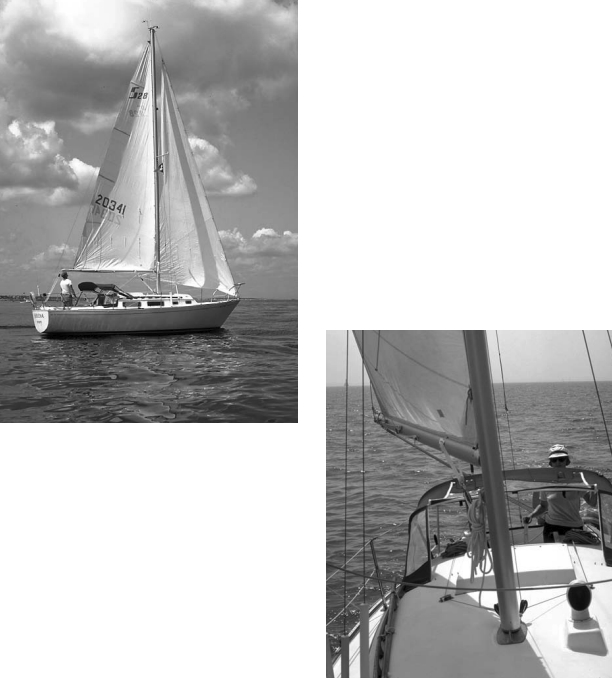
But the proof of Serena’s salvaging was in the sailing, and sail she did — superbly — back to her mooring in Scituate Harbor, on July 10, two months to the day since she had come ashore.
Thank you to Sailrite Enterprises, Inc., for providing free access to back issues of Good Old Boat through intellectual property rights. Sailrite.com