Defeating the feathered menaces that alight in your rigging
Issue 24 : May/June 2002
How many times have you scrubbed your deck only to notice, scant minutes later, a juicy purple Rorschach pattern violating its hard-earned shine . . . or visited your boat after several days away, to find your deck, cockpit, and canvas resembling the morning-after site of a bacchanalian bachelor party?
Bird do-do is a no-no for gelcoat and canvas. Ignored for even a short while, the acid eats into the pores and leaves a determined stain.
After a few repeat encounters, many sailors succumb emotionally. Their degenerating cycle is easily recognized — rescrubbing for the umpteenth time, ostentatious fist-waving, bucket-kicking, and paint-peeling profanity directed at their attackers, safely tail-dipping on the neighbor’s spreaders.
Ramblings about “12-gauge justice” give way to hushed mumblings about divorce and boat sales as they invariably transfer their anger to the closest innocent bystander, often The Wife! Realizing they were safer yelling at the birds, they give up. Soon their boats look like advertisements for Wonder Bread.
Another favorite defense is hiding the target under tarps. But now they’re beating themselves! They may have kept the birds from visiting the boat, but they won’t be visiting it much either. Who wants to barbecue or savor an evening drink in a tarped-over cockpit?
There is a much simpler and more effective solution. And certainly more aesthetically pleasing . . . trip wires on the spreaders and along the boom.
Many don’t know
This isn’t a new idea, but it’s surprising how many sailors either don’t know about it or botched their first attempt and no longer believe in it. Installation can be a humorously rewarding learning curve if you can suppress your anger. I got lucky on the first attempt by using parallel strands of fishing line on my spreaders. The seagulls gave up instantly. But two days later the crows regrouped — all along the boom!
Rushing to duplicate my success, but too lazy to cut the lure and swivel off my fishing rig again, I smugly strung a thin cord from mast to topping lift. The crows swarmed to the adjacent neighbors to analyze the situation. The swallows suffered no such indecision, however, and happily moved from the too-rigid and boring lifelines to the exhilarating gaiety of this trapeze-like offering, which sagged and swung under their combined weight.
After butchering my reel, again, to replace the swallow swing, I went through a week of victorious immunity . . . until I discovered discarded mussel shells scattered along the boom cover. The crows were back — partying under the wires! I solved that by tying another piece of line to the parallel originals, immediately abaft the mast, taking it under the boom and back to the horizontal lines, thereby tensioning and lowering them to three inches above the surface. Success.
For simplicity, I tied a small snap at each end of the line, and one near the mast. Snap it to the topping lift tang, run it once around the mast, and run it back to the tang.
Two secrets
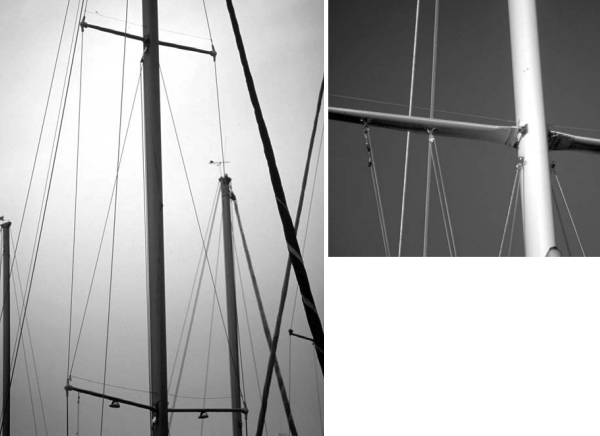
There are two secrets to the successful functioning of these wires. They must be placed high enough above the spreader’s surface to avoid being pressed down onto the spreader by the birds’ landing weight, yet low enough to deter the persistent ones from sliding under. Three inches seems about right. Secondly, where narrow, round spreaders may be adequately protected by a single strand, the flat wing-like structures need a parallel installation about an inch apart.
There are many simple ways to attach these lines. The bigger hurdle is hanging from the bosun’s chair at the upper spreaders of a double spreader rig, while the world sways to a passing wake. Tie a bucket or duffel bag to your bosun’s chair and load in the fishing line, a knife, your cordless drill, 5⁄64 bit, 12 one-inch-long pliable plastic tabs, with holes in either end, and 14 stainless metal screws. You only need 8 of each. The rest are for dropping. And advise your partner on the winch to stand clear and avoid staring. Remind your partner that you might have a screw loose! Don’t forget a screwdriver that matches your screw heads. If you’re like me, the first hole you drill should be through the screwdriver handle, so you can affix a lanyard.
Once you’re up there, drill one hole in the center of the port and starboard sides of the mast, three inches up from the spreader. Screw in two folded tabs, with all four holes aligned, with one screw. Repeat on the other side. Tie (you pick the knot; I’m not going on the hook for that one!) one end of the line around the tab farthest from you. String it to the shroud, wrap around with two half hitches (a clove hitch), and back to the tab immediately in front of your eyes. Cut and tie off. Repeat.
If you have a double-spreader rig, start at the top and work down to avoid stepping on your handiwork. Once you’re safely back on the stable deck, admiring your effort, you can give some thought to the one flaw in this grand plan . . . how do you keep them off the Windex? When you figure that out, let me know.
Thank you to Sailrite Enterprises, Inc., for providing free access to back issues of Good Old Boat through intellectual property rights. Sailrite.com