Things you need with you when you get away from it all
Issue 24 : May/June 2002
Successful cruising is largely about independence — not in the sense of being indefinitely self-sufficient, but in that the boat and her crew can deal with most eventualities unaided, or at least put up with the consequences. Many things contribute to this independence, including properly maintaining the boat and her equipment while in port so problems during the cruise are less likely. Another important factor is avoiding complexity in vital systems. Perhaps most important is carrying sufficient spares, supplies, and tools to be able to deal with reasonably foreseeable situations. Things do go wrong.
No one can anticipate all eventualities, and few can afford the money, weight, or storage space to carry spares or backups for everything, so we all have to make our own decisions about what extra gear to load on board — just in case. Let’s look at a few examples.
Navigation
Even in this GPS age, safe navigation close to land still largely depends on chart and compass. Since charts are relatively expensive, the temptation is to economize where possible, buying only those you expect to use and only relatively small-scale charts of coasts that you don’t expect to approach closely. The best-laid plans, however, have a tendency to get altered, if not by whimsy then by adverse weather or other factors beyond the crew’s control. It is only prudent to carry safe landfall and harbor charts for alternative destinations and large-scale charts and/or cruising guides for any coast you might find yourself looking for refuge along. On international voyages, your choice may be limited to official ports of entry, but additional charts should nonetheless be carried along.
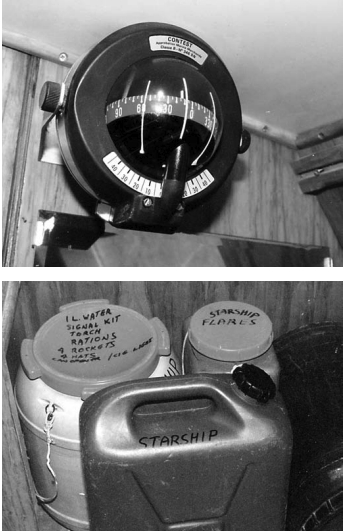
A surprising number of yachts have only one compass suitable for steering the boat and only one suitable for taking bearings. Compasses are relatively delicate devices and are usually treated and protected as such, but accidents do happen. A front-reading compass, mounted below in a bracket, can serve routinely as a telltale, but is always available as a back-up steering or bearing compass or for dinghy navigation.
DC electricity
The critical components in most DC electrical systems are the alternator and the battery system. It’s possible to carry spare brushes, bearings, and regulators for the alternator, but bearing replacement is fiddly and requires appropriate tools. Carrying a complete spare covers all eventualities, including broken mounting feet. Alternators that suit the more common mounting arrangements can usually be picked up from auto-wreckers for a moderate price.
Keep an eye on battery electrolyte levels and density on a regular basis (monthly at least) — a hydrometer costs only a few dollars and can also be used to dole out squirts of distilled water. The hydrometer reveals a failing cell even when the overall voltage of the battery may seem OK. Having two permanently mounted alternators allows the starting battery and circuit to be completely separate from the domestic batteries, without the complication, inefficiencies, and opportunities for a flat starting battery associated with diodes, by-pass switches, and so on. Separate systems make it most unlikely that any single battery problem or electrical switching oversight will prevent the engine from starting.
Engines
Major engine troubles scupper many cruising plans. Most problems with engines relate to the cooling system or contaminated fuel. Rubber components such as hoses should be periodically replaced (and spares carried) because even a minor leak at sea may go unnoticed until the engine begins to cook. Cooling failures often result in head-gasket problems, so it’s worth carrying a spare gasket, even if you would employ a mechanic to install it. In addition to instruments, a loud alarm for excessive head temperature and another sensing the temperature of the exhaust after it has supposedly been cooled by mixing with water, are well worth installing.
Daily checks of oil level will also alert you to water or fuel contamination of the sump, and checking the coolant level provides an early warning of leakage. Spares for the engine should definitely include several raw-water-pump impellers, and perhaps even a spare pump (store the spare with impeller removed and cover off). A complete spare for the engine coolant circulating pump is also a more reliable solution than trying to repair a leaking seal using a kit. The same applies to the fuel-lift pump. Obviously, spare drive belts, engine and gearbox oils, and a pump to remove oil from the pan should be carried. Given their cost, it’s probably not worth carrying spares for the fuel-injection system unless the engine has had a hard life. Even then, problems are most likely to result from contaminated fuel, so good filtering and water-removal systems, and plenty of spare filters are the keys to avoiding trouble. Fuel bugs are so common these days that routine dosing of fuel, despite the cost, is probably a wise precaution.
Another significant source of serious engine problems involves flooding one or more cylinders with cooling water via the exhaust system. Relatively few sailboats have the recommended high exhaust loop before the water injection point, so many are vulnerable to water entry under the wrong combination of heel, loading, and sea-state if the siphon-breaker in the water line sticks closed. The vents from siphon-breakers should be piped to the bilge or the cockpit to avoid accidentally spraying the engine electrics with hot salt water.
The other main area of engine vulnerability involves the starter motor. Poor contacts at battery or motor connections are common problems, but solenoids do sometimes stick, and old starters may develop commutator or brush problems. Flooded starters taken apart, rinsed in fresh water and dried in an oven will probably work, but the best insurance is a spare.
The freshwater part of the engine’s cooling circuit should always contain the recommended concentration and brand of additive. As well as being an anti-boil/ anti-freeze agent, these coolant additives inhibit corrosion, helping to avoid rust (which can eventually block parts of the circuit) and to prevent the thermostat from sticking. Spare additive, a thermostat, and a pressure cap are worth carrying, as are zincs for the engine — and of course zincs for the propeller shaft and hull.
Head
Plumbed marine toilets are not indispensable and were absent on many smaller cruising boats in years gone by. However, the alternatives of a bucket or the stern rail have such practical and social drawbacks that most sailors would rate a functioning head as very important — essential even. Legislation regarding holding tanks has complicated the plumbing itself, but there is still a great variation in the simplicity and maintainability of toilets. Depending on an electrical pumping system that doesn’t have a mechanical backup is an obvious vulnerability but, with the exception of some cheap double-acting systems (that literally wear out), toilet mechanisms are repairable. It’s just a matter of carrying the spares, suitable tools, and rubber gloves. Blockages in the discharge lines are often due to the slow buildup of mineral deposits, which also eventually prevent the proper functioning of one-way valves. Preventive maintenance every few months or so is preferable to being faced with a blocked head at 2 a.m. at sea. Rubber pump valves can be replaced on an exchange basis, with the used set being descaled by soaking a few days in a jar of vinegar.
Domestic water
Water is heavy and bulky but absolutely essential to life. In the past, when boats were generally smaller and slower, onboard showers were a luxury, and cruisers often had to strictly ration water, particularly on long passages. These days, problems with drinking water usually have to do with contamination by seawater or sediment stirred up at sea, tainting, failure of pumps, and sometimes with insufficient reserves.
Having at least two substantial tanks without any connection is a basic precaution, with plastic containers providing an emergency reserve. In-line strainers help to protect pumps, and active carbon filters can remove taint from the drinking outlet. Routine use of water-treatment chemicals may head off biological taint problems, and being able to deliberately sterilize may allow questionable sources such as river water to be used if necessary.
Spare seals and diaphragms should be carried for pumps, but for general convenience and to guard against motor failure, carrying a complete spare pump could be considered, too. The system should include at least one simple manual pump. Having salt water available in the galley can significantly reduce freshwater usage, and a system for collecting rainwater can greatly extend independent cruising duration.
Modern desalinators offer a very convenient source of copious fresh water, but they are sophisticated devices and are highly dependent on a power source — which on smaller yachts is usually electricity. User-maintainable items, such as membranes and chemicals, should be carried, but whether it is worth carrying spares for the high-pressure pump and so forth depends on the skills available on board, how remote the cruising venue will be, and how dependent the boat is on the system.
Cooking
Most yachts using LPG stoves have two storage cylinders, so a problem with one, such as a leaking valve, doesn’t necessarily leave them without fuel. However, on longer cruises one cylinder may already be empty, so carrying a third (perhaps smaller) cylinder as backup may be considered, especially if it also justifies its presence by being a portable supply for, say, a gas lamp or grill. The pressure regulator is a critical component and can fail, so a spare is worth carrying. Thermocouples powering flame-failure cut-outs should last a decade or more (and most stoves have at least two burners), but a spare is cheap insurance. A spare coil for stoves with spark-coil ignition is probably unwarranted because any automotive spark coil can be substituted.
Bilge pumps
A surprising number of boats suffer from serious flooding because they lack an automatic electric bilge pump or because complacency has led the crew to disable the automatic function. Minor leaks are far more common than major ones, but even a minor one can cause extensive damage if it remains undetected long enough to reach the electrics or the engine. Monocoque metal or GRP yachts should not leak (except perhaps a weep from the stuffing box when motoring) so the automatic operation should also trip an alarm, loud enough to be heard over the engine. Spare packing or replacement face seals should be carried for stuffing boxes.
Radio communications
Although their potential emergency role is never forgotten, radio transceivers are far more often used for routine purposes, particularly for communication between vessels. All cruisers should carry at least a fixed marine VHF. Barring electrical spikes or lightning pulses, these are generally very reliable units, but an additional handheld does provide a backup and allows for communication with the dinghy crew or even from a life raft. Conventional cell phones are no substitute for VHF, although they can sometimes provide an alternative.
Despite the trend toward additional satellite-based communications in larger craft, HF radio is still the least expensive and most widely used long-distance communications system for yachts. Marine and ham HF are pretty reliable, but their high-current power supplies, grounding systems, and large external antennas are all vulnerable to poor contacts and corrosion. Periodic inspection and cleaning of these and ensuring that full voltage reaches the transceiver during transmission will do much to prevent problems from developing.
Emergency packs
Most crews put together some sort of “grab bag” with the idea that in an emergency it might be all they have time to take with them into the life raft or dinghy. Plastic canisters with sealing screw lids make a lot of sense in this application, with lines attached for lashing. The canister may contain extra reserves of the things already in a life raft pack, such as flares, rations, flashlights, fishing gear, hats, knives, and so on. But they might include additional items such as reading glasses, vital prescription medicines, an EPIRB, strobe lights, a handheld VHF, a notepad, and so on.
Based on frustrating experiences with letting off flares in controlled situations, my own pack also includes a couple of butane-fueled cigarette lighters for reluctant starters and a pair of pliers for triggering rockets if the flimsy mechanism fails. Once packed, these contents should not be forgotten — batteries, foods, even fishhooks, will need replacing fairly regularly if they are to be relied on. If you’ve ever inspected the contents of a life raft you’ll be aware how little drinking water they carry, so unless you wish to invest in a hand-powered desalinator, a few strategically stowed plastic jerry cans also make a lot of sense. A balance must be found between what might be useful, what things cost, and what you might have a reasonable chance of getting off the boat in time.
Anchoring
In this department, the two most likely problem areas are a fouled anchor or an inoperable anchor winch. In many circumstances a trained person with scuba or hookah gear may be able to recover the anchor along with at least some of the anchor chain. However, darkness, currents, depth, water temperature, sharks, or lack of visibility may prevent a diver from being the solution. Buoying the crown of an anchor is a good precaution in some situations, but inadvisable in others. Especially when anchoring among other boats, a grapple can sometimes help extract an anchor that has fouled a cable.
Even if all this gear is carried, a cruising yacht may find herself without her main anchor and with shorter than usual chain. Few boats carry a spare main chain, but if the same calibration of chain is also used for generous leaders for stern and secondary anchors, they can be shackled together to restore most of the main scope. A spare main anchor should always be carried and on smaller boats may be light enough to also serve routinely as the stern anchor.
Electric anchor winches are affected by many problems in the boat’s electrical system, and their motor or switching circuits are vulnerable to failure. Appropriate circuit breakers may protect against overloading, but there should be a backup on any boat where the crew cannot haul the whole weight of chain and anchor up from deep water unaided. The manual backups built into many electric winches are difficult and slow to use and might not generate sufficient pull to recover the gear from deep water. It’s possible to improvise a hauling system using a sheet winch (via block-and-tackle reduction if necessary) attached to the chain via a rolling hitch with another line to take the strain while the tackle is opened out to take another bite. However, on a pitching deck on a dark and windy night you might appreciate a pair of proper chain hooks or claws to provide a quick and secure grip on the chain.
Sails
With luck and a little stitch-in-time maintenance, Dacron cruising sails should last a decade, provided they are religiously protected from sharp objects and from the sun when not in use. Chafed seams are the most likely source of routine problems for which hand sewing is often the only practical remedy. A sewing machine is useful for repairs but a sewing-machine needle mounted into a handle allows two persons working on either side of the sail to mimic the results of a machine and is quicker and less damaging than the traditional triangular canvas sail needle and palm, although this definitely has its uses, too. Adhesive sail cloth is a useful way to limit temporarily the spread of a tear or to protect a seam from further chafe. UV-inhibited sail thread is cheaper when bought in bulk on a spindle and can be used for many other applications. Adhesives or double-sided sticky tape can be useful in holding sail cloth in place while it is being sewn. Spray sailtrack lubricant, spare nylon sail-track sliders, and suitable lashing material should always be carried.
The rig
Many modern rigs have little or no built-in redundancy — the failure of any one critical component can bring the lot down. There’s no substitute for frequent careful visual inspection of the mast and rigging, but this simply won’t happen unless there is a practical method of going aloft in port to look. If something is found to be failing, such as a shroud with fractured wires, proper cable clamps and lengths of flexible wire rope will allow a fairly strong jury repair to be made.
Tool kit
Tools are heavy, and some cruisers probably carry more tools than are likely to be needed, but nothing beats the right tool for the job. My own suggestion for a comprehensive cruising tool kit would be to include the following:
Hand tools: Locking tape measure, steel rule, square, hammers, small pry bar, bolt cutters (big enough to cut the rigging), oil can, screwdrivers, range of adjustable wrenches, Uni-Fit wrench, pipe wrenches, pliers, box and open-ended wrenches, a ratchet socket set, files, hacksaw and plenty of blades, stainless wire brush, center punch, drift, cold chisel, set of Allen wrenches, Easy-Outs, feeler gauges, pop-rivet gun, twist-drill bits, countersink bit, hand drill, brace, and a rechargeable drill. Most carpentry work can be tackled with items from the above kit, plus a cross-cut saw, a tenon saw (or Japanese fine draw-saw), a jack plane, a set of chisels, and a range of C-clamps.
Electrical tools: Multimeter, 30-watt 12-volt soldering iron, rosin-cored solder, non-corrosive flux, a reel of insulated tinned wire, spade and ring terminals, PVC and amalgamating-rubber insulating tape, cable ties, wire cutters and, of course, bulbs and fuses.
Power tools: Even if there is no AC-generation capacity on board, power is available at marinas and at least a sturdy 3⁄8-inch variable-speed drill should be carried. An orbital sander and, if the boat is metal, a 4-inch grinder, would also be high on my list.
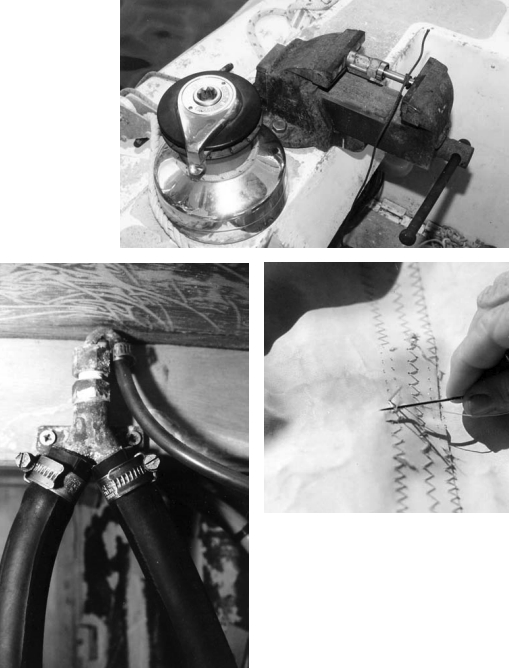
Special tools: If you ever have to do serious work on the engine, such as replacing a head gasket, you’ll need a torque wrench. A gear/wheel puller may prove essential for some jobs, including removing bearings from auxiliary equipment. A metal-working vice that can be mounted in the cockpit is often a boon. A set of taps and dies for making or restoring threads can be very useful. If needed for an anchor winch, engine, or stern bearing, there is no substitute for a grease gun. A magnet on a string and a remote claw grabber can be invaluable in recovering small components from holes or crevices.
Consumables: Loctite 242, epoxy, contact and PVA adhesives, Super Glue, silicone sealant, gasket sealant, Teflon thread tape, grease, WD-40, hose clamps, a range of stainless-steel threaded fasteners and self-tappers, pop rivets.
Thank you to Sailrite Enterprises, Inc., for providing free access to back issues of Good Old Boat through intellectual property rights. Sailrite.com