A system for cruisers that steers better than any crew and doesn’t drink your beer
Issue 24 : May/June 2002

The wind is blowing 30 on your quarter, and the rain is coming in sideways. The seas and your stomach churn as if Hurricane Hugo’s up ahead. The batteries are dead, or your autopilot just can’t handle the conditions. You and your seasick crew are six hours from home. As a coastal cruiser, you thought you didn’t have a need or use for a self-steering windvane? Think again.
If you regularly make weekend or longer coastal cruises, sailing four, six, 10 or more hours at a stretch, a self-steering windvane can make your trip safer and a lot more pleasant. For most cruisers, hand steering gets boring after about 20 minutes. On a cruise of several hours, some type of self-steering is a godsend, a convenience that approaches a necessity, especially for a short-handed crew.
Of the two major types of self-steering — electronic autopilot and windvane steering — you’re probably most familiar with the autopilot. Chances are you have one. Autopilots are nifty devices, easy to understand and use. After the initial installation, you just plug it in, turn it on, and go. They will steer a course as straight as an arrow (as long as it’s not too rough). They are especially handy when motoring, particularly in light-air conditions where a windvane won’t work at all.
If you have an autopilot, why would you want a windvane system? Because the windvane has several advantages. They are more effective for one thing. The stronger the wind and faster the boat speed, the faster the windvane responds and the more effective it becomes. This is a big advantage over the autopilot because autopilots consume lots of power and work very hard in these conditions. Most auto-pilots are too slow to keep up with the rolling and yawing of the boat, especially with the wind or waves on the quarter. They often over-correct their steering while being pushed around by the wind and the waves and so begin zigzagging a wild course. A servo-pendulum windvane actually helps prevent the boat from yawing when sailing downwind.
Follow the wind
Windvanes are more efficient, too. Rather than following a compass course, they follow a course relative to the wind. The sails remain properly set, and boat speed stays consistent and optimal. You are not constantly trimming and re-trimming the sails. Because they use no electricity, a commodity in short supply on a cruising sailboat, you can keep the beer cold longer without charging the batteries. When the batteries do go dead, the windvane still works.
Windvanes also improve safety. With the boat sailing relative to the wind, the risk of an accidental jibe or backwinding the sails is minimized. Safety is also improved because if you and the crew don’t have to hand-steer in rough weather, you arrive at your destination rested, more alert, and better able to handle whatever comes up.
In addition, windvanes respond more quickly to course deviations than autopilots do. And they also respond more accurately to wind shifts than even the best helmsman does. Since windvanes have no electronic parts to fail from saltwater corrosion and require no electricity, they are more reliable and longer-lasting than autopilots.
So how do you choose a windvane system? First, figure out what type you want: a trim-tab on the main rudder; a trim-tab on an auxiliary rudder; a servo-pendulum oar controlling the main or auxiliary rudder; or servo-pendulum/trim-tab on a rudder. A review of the ads in sailing magazines and a search on the Internet simplifies things. The flagship system for all major manufacturers is the servo-pendulum, specifically, the servo-pendulum-to-main-rudder system. It won’t work well on all boats, but if it works on yours it is probably the best choice. (See sidebar on Page 49 for alternatives.)
Most effective
The servo-pendulum is the most efficient of all of the windvane steering systems available today. It uses the boat’s own rudder to steer the boat. That’s what the rudder was designed to do. But even though the servo-pendulum system is the most widely used windvane system, it is usually the least understood.
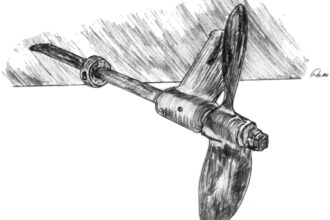
A vane sticking up in the air gets blown out of position by the wind when the boat sails off course. The movement of the vane turns an oar dragging in the water, which then moves to one side or the other. This movement pulls on a rope attached to the tiller or wheel, bringing the boat back on course. (See illustration on Page 45.)
What contributes to the confusion is that the vane doesn’t rotate (twist) on a vertical axis. It moves instead on a horizontal axis. Instead of turning the vane like the wind indicator at the top of your mast, the wind knocks the vane down sideways when the boat sails off course. This is a much more powerful motion.
As the vane is blown over, a gear or a rod turns a small oar in the water (the servo-pendulum). The water rushing past the turned oar causes it to move sideways, like a rudder, but because it is fixed to a hinge at the top, the bottom of the oar swings sideways and up, as if it were the pendulum of a grandfather clock. As the oar swings sideways, a line connected to it pulls the tiller or turns the wheel.
When the boat turns back on course, the vane faces straight into the wind and stands up again because the wind is no longer pushing it from the side. This causes the pendulum to return to center, pulls the rudder back to center, and the boat is on course again.
More force
The harder the wind is blowing, the more it pushes on the vane and the more twist it gives the oar. The oar thus generates more sideways force. Even greater force results from the increase in the speed of the boat through the water. These forces added together cause the vane to work very fast and exert a strong force on lines controlling the tiller or wheel. This is the secret and power behind the effectiveness of the servo-pendulum windvane.
To help you understand how this works, the next time you’re rowing your dinghy, put an oar in the water with the flat part of the blade parallel to the flow of water. Nothing much happens, and the dinghy continues moving forward. But if you twist the oar so the flat part is against the flow of the water, the dinghy will immediately start to turn. The more you turn the flat part of the oar against the water, the faster the dinghy will turn. You can feel the force of the water against the blade increase as you twist the oar. Also, the oar will try to go deeper in the water or come up out of the water depending on which way you twist the oar. The same forces are at work on the windvane oar.
Windvanes that use an auxiliary rudder — such as a trim-tab on an auxiliary rudder — are often considered to be safer because they can be used as an emergency rudder if something happens to the boat’s main rudder. If you have a pendulum-type windvane, do you lose that safety margin? In theory, yes, but in practice, probably not. The boat’s main rudder is much stronger than any auxiliary rudder, so if anything breaks, it will probably be the auxiliary rudder rather than the main rudder. It is rare that the main rudder breaks, but it does happen. You should have a plan for this, especially if you sail offshore. Several manufacturers of servo-pendulum windvanes offer an optional emergency rudder kit that works with their windvane systems.
Modifiable?
All windvanes work best if mounted on the center of the transom. But with the popularity today of scoop transoms and stern-mounted swim ladders, this is often not practical. Will a windvane work if mounted off-center? Yes, but not as well on certain points of sail. If you sail close-hauled on port tack and mount your vane on the port side of the stern, much of the pendulum oar will be out of the water due to the boat’s heeling. The effectiveness of the vane will be greatly reduced. To compensate for this, some manufacturers offer an option of a longer (deeper) oar. Even so, you want to mount the vane as close to the centerline as you can (within 16 to 18 inches) to keep as much oar in the water as possible.
If you want it both ways — your transom swim ladder and your vane mounted on the centerline — Monitor has a new $1,500 option called the SwingGate. This modified mounting system allows the entire windvane to swing to the side, out of the way of the swim ladder when anchored or at the dock.
If you have a hydraulic steering system, you have additional problems to work out. There is slippage in the system and usually too many turns lock-to-lock. Fortunately, several windvane manufacturers work around the problems by installing a bypass valve. Check with the windvane manufacturer for recommendations for your particular steering system if you have hydraulic steering.
An interesting variation combines an autopilot with a windvane. This gives you the best of both worlds. The autopilot connects to the windvane instead of to the tiller or wheel and it controls the steering oar. Since the forces needed to control the oar are so light, you need only the smallest (and cheapest) cockpit autopilot to control a windvane, even on the largest boats.
Windvanes come in two basic flavors: stainless steel and aluminum alloys. The manufacturers who use stainless steel tout the strength and corrosion resistance of stainless. Those who use aluminum alloys tout the superior strength (pound for pound) over stainless, lighter weight, and high-tech properties. Both have long track records over the past 20 to 30 years, and the warranties are similar. The bottom line is it’s your choice.
Now you’re down to a handful of servo-pendulum windvanes. Each has advantages and disadvantages. All have completed many successful circumnavigations and weathered storms and rough oceans. Each will provide many years of good service. As long as you get the proper size for your boat, you cannot go too far wrong whichever one you choose, so the quest is to get the one that’s right for you and your boat.
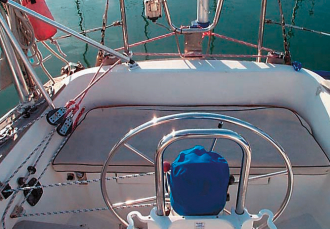
Aries — The Aires has been in production since 1968 and, except for adding stops to limit the oar swing, remains basically unchanged since its original design. At 75 pounds, it is the heaviest of the servo-pendulum vanes, and this weight translates to great strength. Many of the original Aries vanes are still in use today. Formerly made in England, they are now made in Denmark.
Auto Steer — These aluminum vanes have been in production for 30 years, and many of the original vanes are still in use. With the improvements in aluminum alloys and manufacturing techniques over the years, the models made today should be around for a long time. One of the advantages of the Auto Steer is that the unit can be quickly and easily removed for storage or security when in port. Made in England.
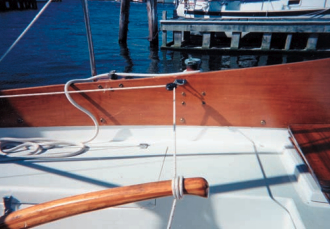
Cape Horn — Don’t like all those lines strung across the cockpit? Take a look at the Cape Horn. This system operates through a tube in the transom and can run the lines directly to the steering quadrant. That allows the Cape Horn to be used on center-cockpit boats and boats with hydraulic steering. The Cape Horn has suffered knockdowns, rollovers, and dismastings in the Southern Ocean yet kept on steering under jury rig. The Cape Horn comes with two vanes. One is very light, made of spinnaker cloth over 1⁄8-inch wire. This makes it very sensitive in light air, such as when sailing downwind. The other vane, made of aluminum, is used when it’s time to reef. The Cape Horn warranty covers 28,000 miles or one circumnavigation. Made in Canada.
Fleming — Made of duplex stainless-steel alloy 2205, the Fleming is investment-cast and has no structural welds to corrode. (The welds are the parts most vulnerable to corrosion.) The 2205 alloy is reported to be stronger, lighter, and less corrosive in salt water than other grades of stainless steel. Another nice feature of the Fleming is that the servo-oar swings 150 degrees in one direction, and 90 degrees in the other, for extra protection of the oar in the event of overload. Most vanes limit the swing of the pendulum to about 30 degrees in either direction before it hits a cage or frame that stops its motion. (The reader is cautioned here. One manufacturer considers limited travel to be a feature. -Ed.) With 29 years in the business, Fleming gives you the longest warranty in the business. The castings are warranted for life, the vane for 10 years, and the bearings for five years. Made in Australia.
Monitor — The Monitor is made of welded stainless steel and has an oil-rig-like mounting system providing plenty of strength. The servo-oar is stainless steel and has an efficient foil shape, giving it less drag and greater power and sensitivity. Also, the Monitor has an impressive track record in long-distance singlehanded racing. Coastal cruising may not be as grueling as sailing the Southern Ocean, but that kind of proven strength and durability can put your mind at ease. Made in the U.S.A.
Navik — The Navik is specifically designed for smaller boats of 20 to 30 feet. Made of stainless steel and injection-molded Lexan, it weighs only 30 pounds. This unusual air vane does not control the servo-oar, but instead controls a trim-tab connected to the trailing edge of the servo-oar. This makes it more sensitive to airvane movement and gives it better performance, especially in light air. The Navik is made in France and imported by Scanmar International.
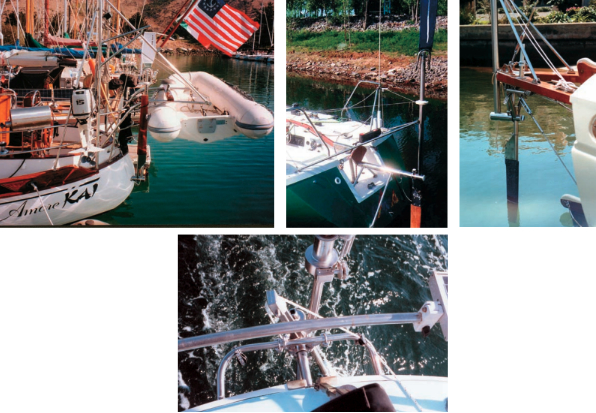
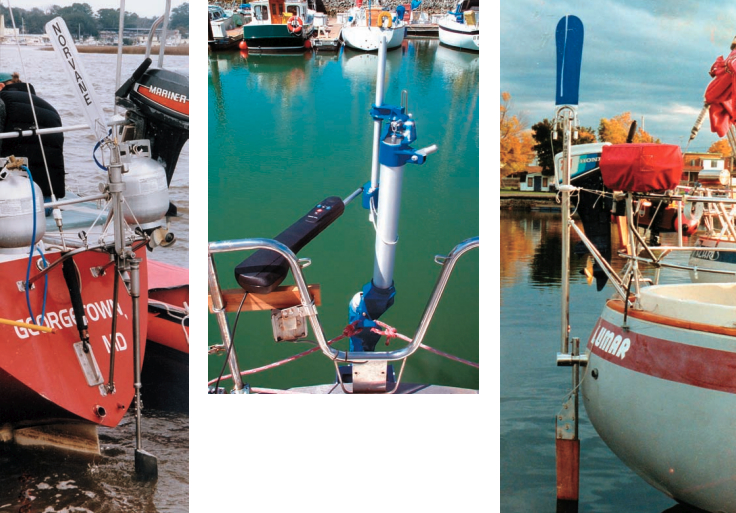
Horn installations, on facing page above. The first, on a Tayana, shows the creativity necessary to integrate a windvane on a very busy stern. The second, on a Kirby, shows the modifications to make a vane fit with a stern cutout. The third, on a Bristol, shows the modifications to fit a windvane with a boomkin. On facing page at bottom: looking down at a Norvane windvane.
Norvane — With the lowest price and second-longest warranty at five years, the Norvane is a good buy. Made from investment-cast 316 stainless steel and duplex stainless steel, the Norvane should be corrosion-and maintenance-free. The Norvane comes with two airvanes made of polycarbonate, a larger one for light air and a smaller one for stronger winds. Also, the vane has a built-in square-socket drive to allow it to be used as an emergency rudder. Made in the U.S.A.
Sailomat — Founded in 1974, the Sailomat has a couple of unique design features worth noting. The first is the swing angles of the servo-pendulum. The Sailomat will swing 140 degrees in one direction and 170 degrees in the other. Both are way out of the water. Because of this design, Sailomat reports that they have never had a servo-pendulum oar shaft or blade mechanical failure since the system was introduced in 1984. Another unique feature is the servo-blade. Angled back 34 degrees, this aids toe-in adjustment and improves sensitivity and performance. It also allows the oar to rid itself of any seaweed or other fouling that may wrap around the oar and reduce performance.
Made in the U.S.A. and Scandinavia. What is all of this going to cost? Anything for a sailboat is automatically expensive. A servo-pendulum windvane will set you back about $2,000 to $3,500 compared to electronic autopilots which cost between $500 and $5,000, depending on the size of your boat and type of steering. But remember that last storm you were in: still hours from home, a seasick crew, and you had to hand-steer? What would you have paid for a windvane then?
Thank you to Sailrite Enterprises, Inc., for providing free access to back issues of Good Old Boat through intellectual property rights. Sailrite.com