A well-built racer/cruiser with emphasis on racer

Issue 65 : Mar/Apr 2009
On August 29, 2005, Hurricane Katrina lifted Duet II out of her slip at the Fairhope (Alabama) Yacht Club, carried her across Bayou Volanta, and deposited her amid the jumble of sailboats on the north shore. Damage to her was so extensive the insurer considered her a total loss and paid off her owners, Bob Hasewinkle and his wife, Jeanne O’Connell.
Bob and Jeanne had used Duet II, a C&C 29, for racing and short cruises along the Gulf Coast and wanted to replace her with a boat of similar size and capabilities. After an appropriate grieving interval, and armed with their insurance check, they went shopping. They reviewed the various listings, talked to brokers, kicked keels, and eventually found their new boat conveniently close to home in Pensacola, Florida. Duet III is a Tartan 3000, built in 1984 by Tartan Marine of Fairport Harbor, Ohio. For more about Tartan Marine’s history, see the November 2003 issue of Good Old Boat.
Design
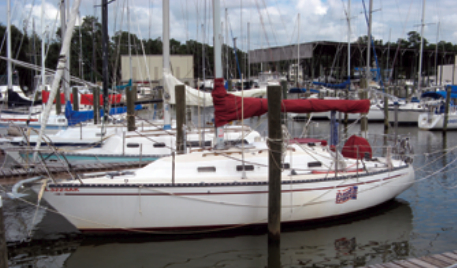
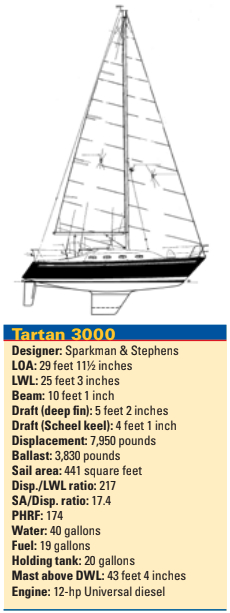
Tartan Marine introduced the Tartan 30, designed by Sparkman & Stephens, in 1971, and its popularity helped establish the relatively new company. Ten years later, when it became time to replace the aging 30, the company commissioned S&S to design its successor, the Tartan 3000. According to company literature, the Tartan 3000 is faster and easier to sail, has more sail area than the original 30, is drier on a beat, has fuller sections aft to induce surfing on wave faces, and is more comfortable on deck and below. It is moderately light, and has a relatively low displacement/ LWL ratio of 217.
The fin keel/spade rudder design was offered in two versions. To optimize lift when sailing to weather, the standard keel is based on a NACA foil section and draws 5 feet 2 inches. For those sailing in thinner water, a 4-foot 1-inch Scheel keel was available.
Tartan offered three versions of the 3000 and each could be purchased with either keel option. The cruise model featured wheel steering, hot and cold pressure water, a stove with an oven, and a bow roller for the anchor. The race model emphasized performance with tiller steering, a bendy double-spreader rig, cockpit-led halyards, a spinnaker package with extra winches, and a folding propeller. The custom model allowed the buyer to combine preferences from columns A and B of the menu.
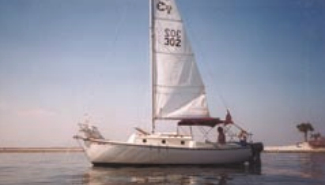
Although introduced 28 years ago in 1981, the Tartan 3000 has a modern look with its flat sheer set off by the sharply raked bow and reverse transom. The beam is generous, tapering sharply to the bow to give a fine entry (the primary goal) but compromising interior volume in the forward third of the hull. The cabin trunk is long and low enough for good appearance while the fairly high freeboard provides ample volume for accommodations. Headroom is a reasonable 6 feet. All eight cabin portlights open, providing good cross ventilation.
Deck features
The cockpit is large enough for a racing crew, provided the “rail meat” doesn’t fill it up when off the wind. The seats and seatbacks are comfortably contoured and 80 inches long, making sleeping under the stars possible. Although the arched helmsman’s seat provides good visibility, it is too sharply rounded for comfort without a cushion. The cockpit’s modified T-shape makes it possible to get around the wheel without climbing up on the seats — a good safety feature. Duet III has Lewmar 43 self-tailing primary winches and no secondary winches. Cockpit stowage is limited even though there are no quarter berths.
The starboard seat locker is mostly taken up by the longish icebox, leaving only the port seat locker for stowage. A hatch in the starboard seat permits easy loading of ice which, judging by the insulation thickness (or thinness), may be more a necessity than a convenience. A heavy-duty line-controlled traveler spans the bridge deck, providing effective mainsail control. Only two cockpit drains are fitted. They are a bit undersized, so the cockpit will drain slowly if the boat is pooped.
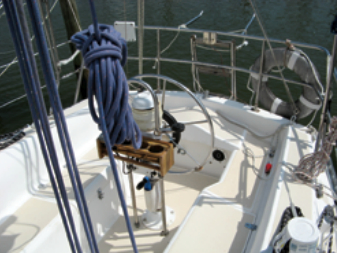
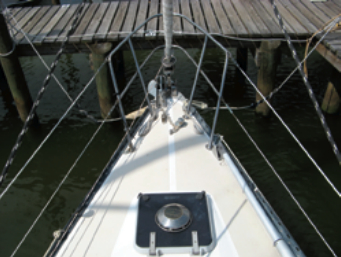
Wide sidedecks allow for safe crew movement. Access forward is further facilitated because the generous beam allows the shroud chainplates to be placed next to the cabin. This also creates a closer sheeting angle. The ventilation hatch for the forward cabin is mounted on the foredeck immediately forward of the cabin trunk. While it’s not directly in the way of foredeck work, the crew must be aware of it, especially if it’s covered by a doused sail. Good-sized track-mounted and multi-part line-controlled genoa cars make sheet lead adjustments possible while under load. The perforated aluminum toerail provides a multitude of attachment points.
Duet III has a keel-stepped, double-spreader mast supported by a forestay with roller furling, an adjustable backstay, single pairs of upper and lower shrouds, and an adjustable babystay. For a family boat, it has above average sail power as evidenced by its sail area/displacement ratio of 17.4. According to Tartan literature, mast and boom sizes and configurations varied according to model. A vang, which controls the rise of the boom when reaching and running, can also be used as a preventer by clipping its lower end to one of the toerail perforations. However, given its attachment point on the boom, an accidental jibe in a fresh breeze might buckle the boom.
Construction
The hull is hand-laid fiberglass, cored for rigidity and weight reduction. (Tartan literature doesn’t specify the core material, but end-grain balsa has long been the industry standard.) The cored deck is bedded in butyl and polysulfide and mechanically fastened to the hull with 1/4-inch stainless-steel bolts that go through the perforated toerail, then the deck, and finally the hull flange. A non-skid pattern is molded into horizontal surfaces. Double-rail bow and stern pulpits and double lifelines are more than you get on most boats this size. My examination of Bob and Jeanne’s boat satisfied me that it is well and strongly built and without evidence of gelcoat cracks or crazing. The decks are solid and do not flex. Bob reports that there is no evidence of gelcoat blistering.
Instead of the usual bonded-in fiberglass headliner, a vinyl material is held in place with battens. This allows tabbing of the bulkheads to the deck, something not usually possible with fiberglass headliners. A couple of zippers provide access to overhead wiring. The cabinets and berths were built in place and tabbed to the hull with fiberglass and resin. This method gives much better access to the inside of the hull than does a molded fiberglass pan in the unfortunate event that repairs are ever needed.
Accommodations
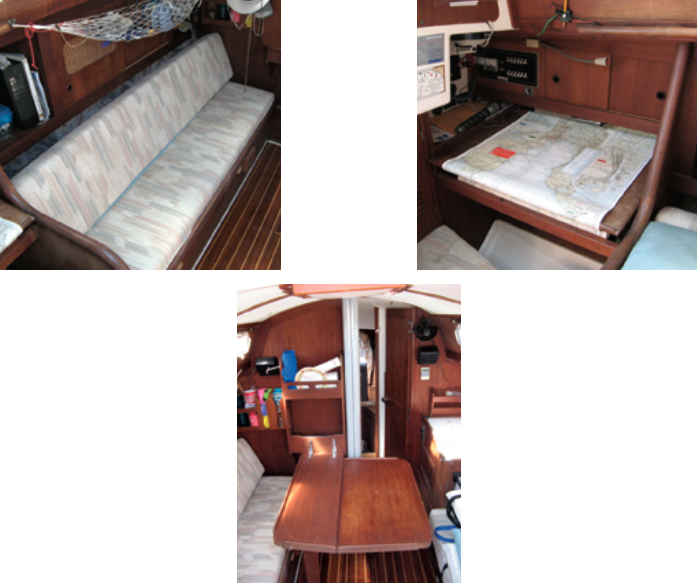
Someone stepping through the companionway and down three steps will first notice a surprisingly large navigation station on the port side. The desktop lifts up to reveal chart stowage beneath and a roomy cabinet outboard of the table has room for bulkhead-mounted instruments and a radio. The electrical distribution panels also are mounted in this space, tucked away where they will stay dry.
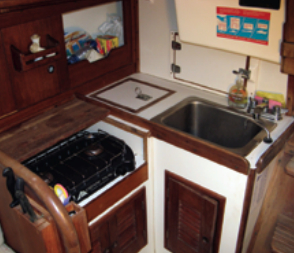
Immediately opposite to starboard is a compact but reasonably well organized galley. The icebox, as previously mentioned, extends quite far under a cockpit seat. Items all the way back can be accessed only through the cockpit seat hatch. A vertical door provides access from the galley. The single-compartment sink is partially tucked under the cockpit, inhibiting access for the dishwashing crew. Counter space is limited. The galley stove was missing — a two-burner propane camping stove had been substituted when Bob and Jeanne purchased Duet III. Overall, galley storage is well-organized and adequate.
Forward of the galley and navigation station are port and starboard settees. The port settee converts to a double berth 75 inches long and 48 inches wide. Above it is an open shelf and a cabinet and beneath it a 40-gallon water tank. The opposite settee makes a single berth of the same length and about 33 inches wide. Duet III’s previous owner built a cabinet on the forward third of this settee in which to house an air-conditioning unit. Consequently, the remainder of the berth is only long enough for a small child. Above this settee is an open shelf with fiddles.
The dining table is attached to and folds up against the bulkhead that separates the main cabin from the head. The table folds in half for storage but opens to a size wide enough to serve diners seated on both settees.
The head is located between the main cabin and the forward cabin and spans the width of the boat. The washbasin with stowage beneath is on the port side and the commode is on the starboard side with shelf storage above. There’s a hand-held sprayer for showers. A small hanging locker is adjacent to the washbasin.
The forward cabin is a 75-inch-long V-berth, which is very narrow at the forward end. Bin storage and a 20-gallon holding tank are located beneath this berth. Bob and Jeanne use the V-berth primarily as a sail locker. Bob has rigged fiddles here to hold a 12-volt refrigerator/freezer chest that supplements the galley icebox.
Access to the Universal M-2-12 diesel engine is excellent. The entire front and part of the top of the engine compartment can be easily removed. All service points can then be reached except the transmission dipstick, for which a panel in the port seat locker must be removed. This panel also provides access to the stuffing box.
Performance
So I could evaluate the boat’s sailing performance, Bob and Jeanne made me skipper for a day during one of our club’s Sunday fun races. Leaving the harbor under power also gave me an opportunity to put the engine through its paces.
By today’s standards, the 12-hp, 2-cylinder Universal diesel is a little undersized. However, at an easy 2,000 rpm, the easily driven hull made about 5.5 knots. Motoring into a chop would slow it down. There was a little more noise and vibration than I care for, some of which could probably be eliminated by careful alignment of the transmission and propeller shaft. The fin keel/spade rudder configuration makes it possible to steer in reverse once enough speed has been gained for the rudder to bite.
On the way out to the starting line, we were beam reaching. The boat felt good, and boat speed was fine; however, I found the steering to be a little twitchy. To stay on course, I had to pay constant attention to the helm. The loads were light, but tracking was reminiscent of driving a car aligned with insufficient toe-in.
It took me a few minutes into the windward leg to find the groove, but then I’m a Nonsuch owner who wonders why anyone has more than one sail. The wind was offshore and shifty at 8 to 10 knots. When I was carefully minding the jib telltales, we made about 5 to 5.2 knots. On this point of sail the boat tracked well with none of the wandering we experienced when beam reaching. The boat tacks smartly, accelerates well, and points quite high.
Our next leg was a broad reach. This was a non-spinnaker race, so we poled out the 145-percent genoa. On this point of sail, there was no evidence of the twitchiness we experienced on the beam reach. Our nemesis reached the weather mark ahead of us (due to the shortcomings of my learning curve and much to Jeanne’s consternation). But little by little we gained on him. After a well-executed jibe by Bob and crew, we were on the next reaching leg of this triangular course and continuing to gain.
Upon rounding the next mark, we hardened up for the beat to the finish. By now, I had settled down a bit and carried out suggestions more skillfully; we finished handily in the lead.
This short race convinced me that Tartan Marine and S&S had placed the emphasis on performance when conceiving and building the Tartan 3000. It is a reasonably comfortable cruising boat, but it shines most brightly on the racecourse. Of course, the design is by now somewhat dated and other newer designs are faster but, when well-sailed, the 3000 can sail her PHRF rating, which averages about 174 in the Gulf Yachting Association. In other fleets, it rates as low as 162. For comparison, the high-performance J/30 rates 144, while the Catalina 30 rates between 180 and 192, depending on the fleet.
Conclusion
The Tartan 3000 is, in my opinion, a fun, good-looking racer/cruiser, with the emphasis on racer. Bob and Jeanne are happy with Duet III and find she’s suited well to their sailing lifestyle of regular weekend racing in club fun races, frequent participation in Gulf Yachting Association-sanctioned regattas on Mobile Bay, and short cruises two or three times a year.
For those with cruising interests exclusively, other boats without the racing outfit of the Tartan 3000 are more suitable, perhaps even the cruising model of the Tartan 3000. However, the quality of the Tartan is considerably above average.
Anyone contemplating a purchase should look for problems common to most aging boats: leaks around portlights and deck hardware, soft decks, bottom blistering, and so forth. Additionally, the rig should be very carefully inspected; most rigging experts believe boats of this age are well past-due for replacement of wire and terminals.
Only 97 Tartan 3000s were built during its production run from 1981 to Therefore, not many can be found for sale. An Internet survey turned up only five, ranging in price from $19,900 for an ’83 and $29,900 for an ’84. The $10,000 difference presumably reflects more than a one-year difference in age. The average price of these five boats was a bit over $25,000.
Paul Ring is a contributing editor with Good Old Boat. He has sailed, repaired, modified, restored, and built boats for the past 42 years. Magnolia, his restored Cheoy Lee Offshore 27, graced the cover of Don Casey’s book, This Old Boat. Paul currently sails his Nonsuch 260 with first mate, Barbara Brown, on Mobile Bay. He has written many how-to articles for sailing publications.
Thank you to Sailrite Enterprises, Inc., for providing free access to back issues of Good Old Boat through intellectual property rights. Sailrite.com