Electronic vapor detectors safeguard you from invisible threats on board
Issue 68 : Sept/Oct 2009
We have all heard these or similar stories about sailors who’ve had lucky escapes when gases or vapors invaded their boats.
Wanting to get a jump on spring commissioning, a sailor fired up his gasoline generator and began laboring away at maintenance projects below-decks. He didn’t realize that carbon monoxide from the generator was drifting into the main saloon where he was working. A fellow sailor seeking to borrow a tool found the owner “asleep.” He immediately turned off the generator, opened all the portlights, and called the rescue squad. This serendipitous happenstance saved a sailor’s life.
After refueling, the owner of an older sailboat equipped with a gasoline engine properly ventilated the cabin and ran his bilge blower for a full five minutes. Assuming all was safe, he turned the ignition key. An explosion erupted from below. The owner was thrown clear and sustained only minor cuts and abrasions. The boat didn’t fare as well. What the owner didn’t know was that a leak in the fuel system was creating new gasoline fumes as fast as the blower cleared them.
On a cold October night, a boatowner left an electric space heater on while he slept aboard. In the cramped quarters, the heater was too close to woodwork and a fire broke out. The owner was awakened by a smoke detector he had installed. He and the boat were saved.
If you don’t wish to become another statistic, there are a few steps you can take to protect your boat and your life. In addition to employing safe practices, using common sense, and performing routine inspections and maintenance on potentially hazardous systems, installing one or more functioning fume detectors can be a lifesaver.
Fume detectors, also called vapor detectors, continuously monitor the concentration of a dangerous gas or gases in the air. When such a device detects a potentially dangerous level, it sounds an alarm. It is then up to you to ventilate the boat, investigate the source, and correct the problem.
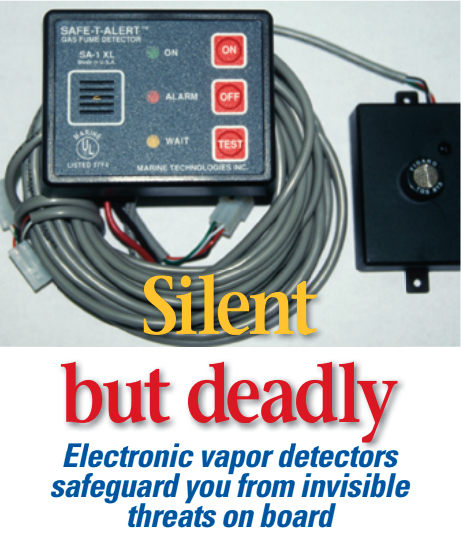
Fuel-vapor detectors
Most fuel-vapor detectors employ a porous, catalytic, “hot-bead,” combustible-vapor sensor that is continuously heated by a small electrical current. In operation, the hot-bead sensor safely “burns” the vapor’s hydrocarbon molecules as they are absorbed by the sensor’s porous surface. In the presence of an increasing level of combustible vapor, the temperature of the sensor rises, resulting in a corresponding increase in electrical resistance. At a preset level of resistance, the detector sounds an alarm.
Most detectors are set to sound off when the concentration of fumes reaches approximately 20 percent of that needed for an explosion to occur. This level is referred to as the Lower Explosive Limit or LEL. Some detectors have selectable sensitivities down to 10 percent LEL. Fuel-vapor detectors will react with a wide array of combustible vapors, including gasoline, propane, butane, compressed natural gas (CNG), and many solvents, even those in some cleaning compounds and paints.
The fumes from gasoline, propane, and many solvents are heavier than air. They accumulate in the lowest part of the boat, where a spark can ignite them. CNG and the vapors of some solvents are lighter than air. For peace of mind, you want to detect both kinds of vapors. You can do this by installing one fume detector low in the boat, and linking it electrically to a bilge blower, and a second detector high up, within 9 inches of the overhead. Some units can monitor more than one area by supporting several remote sensors that can be placed in different locations where combustible vapors might accumulate. Most marine vapor detectors cost under $200 and are easy to install.
Sensors can be affected by humidity, aerosols from paints, and silicone vapors. Gases such as hydrogen sulfide (a common contaminant in propane) can also degrade a sensor’s sensitivity. Immersion in water will cause irreparable damage. To ensure that the detector is functioning properly, periodically perform the built-in self-test. When in doubt, the best way to test the unit is with a calibrated concentration of gas. To have someone perform this check costs about $75, so it may be more economical to replace the sensor element.
Carbon monoxide
Carbon monoxide (CO) is commonly produced when fossil fuel burns and is present in the exhaust of any internal-combustion engine. Gasoline-fired engines are the greatest contributors of CO. Due to their intrinsic efficiency, diesel engines produce far less CO in their exhaust and consequently lessen the chances of CO poisoning.
Because CO is lighter than gasoline fumes, it may miss detection by a low-mounted sensor. It is also odorless and tasteless, so we can’t detect its presence until symptoms of exposure set in, and then only if we recognize them.
The two factors that determine what effect CO has on our bodies are the concentration of the gas in the air and the duration of exposure to it.
CO is readily absorbed into the bloodstream and combines with hemoglobin 200 times faster than oxygen does. Once there, it asphyxiates the blood cells and the victim dies of “suffocation.” Some symptoms of CO poisoning, such as dizziness and nausea, are quite often mistaken for seasickness. While seasickness can be temporarily debilitating at its worst, CO poisoning can be fatal. Mild symptoms of CO poisoning include minor eye irritation, nausea, dizziness, headache, fatigue, and the inability to think coherently. More extreme symptoms include vomiting, seizures, and collapse. Prolonged exposure can result in death.
There is no “safe” level of CO exposure for humans. However, the U.S. Coast Guard has indicated that an “occupational day exposure average” of 50 parts per million (ppm) is acceptable for sea-level conditions.
Effects of CO exposure
- At an exposure level of 50 ppm for a day, a person’s carbon-monoxide/ hemoglobin (COHb) level might reach 10 percent. At this level of exposure, a victim may experience headache, dizziness, and diminished coordination.
- Levels between 10- and 15-percent COHb cause nausea.
- Levels as high as 40-percent COHb are associated with collapse.
- Levels greater than 60-percent COHb are usually fatal.
Acute exposure to CO is a medical emergency. If you suspect someone is suffering from CO poisoning, take no chances. Remove the victim from the exposure zone and into a fresh air location and get medical assistance.
CO sensor types
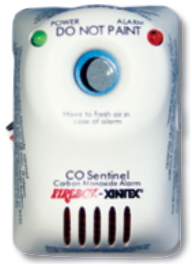
Depending upon the manufacturer, carbon-monoxide detectors utilize one of three sensor technologies.
- Metal-oxide semiconductor (MOS) carbon-monoxide detectors use a heated tin-oxide sensor. When CO is present, the tin oxide reacts with CO and an alarm sounds.
- Biomimetic carbon-monoxide detectors use a gel-coated disc. When CO is present, the gel coating darkens, causing an alarm to sound.
- Electrochemical carbon-monoxide detectors chemically react with CO, creating an electric current that triggers an alarm.
Although all of the above technologies are approved for CO detection, select a CO detector that is rated for marine use. Also select one that has the ability to compute the time-weighted average of the CO concentration. This will eliminate false alarms. Most CO detectors will sound an alarm when they encounter 70 ppm. If you want a detector that monitors low levels of CO, look for one with a memory. CO detectors should be installed at or near eye level. Keep them dry; water can destroy their sensing capability. Prices for CO detectors range from $75 to $175. They should be easy to install.
Test your CO detector weekly by pushing the device’s self-test button. Consider replacing your detector every five to seven years, unless the manufacturer recommends otherwise.
Smoke detectors
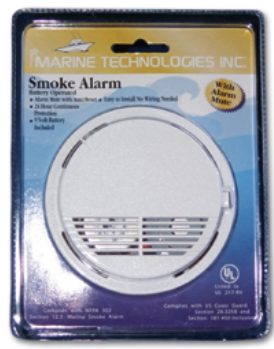
Although not technically fume detectors, smoke detectors save thousands of lives each year and are among those amazing inventions that, because of mass production, cost practically nothing. If you spend time sleeping aboard your boat, install one in each cabin.
The two most common types of smoke detector used today are photoelectric units and ionization detectors.
Inside a photoelectric smoke detector, a light and a sensor are positioned at a 90-degree angle to one another in a chamber. During “normal” mode, the light source misses the sensor. When smoke enters the chamber, however, the smoke particles scatter the light, some of which then strikes the sensor. When this occurs, the sensor sets off an alarm. Photoelectric detectors are best at sensing smoky fires, such as a smoldering mattress.
An ionization smoke detector uses an ionization chamber and a source of ionizing radiation. This is the most common type of smoke detector because it’s inexpensive and better at detecting the smaller amounts of smoke produced by flaming fires.
Inside the ionizing smoke detector is a very simple ionization chamber that consists of two plates with a voltage across them, along with a small amount (perhaps 1⁄5000 of a gram) of americium-241. In operation, the americium ionizes the air in the chamber and creates very tiny electrical charges. The circuitry of the detector senses the small amount of electrical current being generated and considers the situation normal. When smoke enters the ionization chamber, it disrupts this current. The circuitry detects the resulting drop in current and sets off the alarm.
Because smoke rises, install smoke detectors overhead. Test them periodically by depressing the self-test button. They range in price from $5 to $15 and installation is simple. Unless physically damaged or exposed to salt water, a smoke detector will last for years.
While your nose is a very effective fume detector, there is much to be said in favor of using electronic fume detectors on your boat.
Gregg Nestor is a contributing editor with Good Old Boat. When he’s not writing about sailing, Gregg and his wife, Joyce, cruise Lake Erie aboard Raconteur, their Pearson 28-2. They also trailersail an O’Day 222.
Thank you to Sailrite Enterprises, Inc., for providing free access to back issues of Good Old Boat through intellectual property rights. Sailrite.com