Restless nights on the hook? Larry Pardey worked out a solution that works for them
Issue 6 : May/Jun 1999
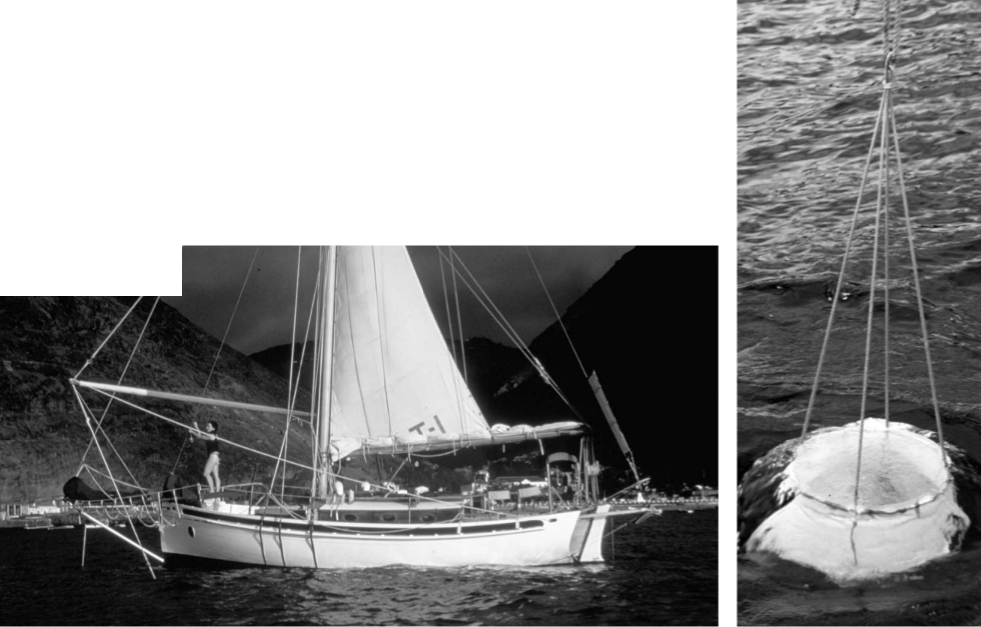
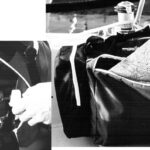
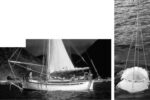
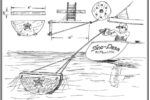
An excellent defense against restless nights at anchor in less-than-perfect anchorages is the homemade, low-cost flopper-stopper we have used successfully over the years. The main part of the flopper-stopper is simply a strong, heavy-duty plastic carry box (just like the stacking storage boxes sold in many children’s furniture stores). I chose one with solid sides and a sturdy mesh bottom. I then sewed two 8-ounce folded and doubled Dacron flaps to the bottom to produce a simple, one-way valve.
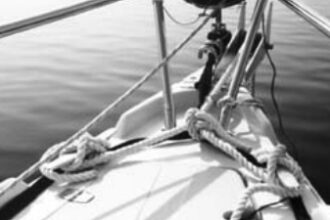
A bridle line of 7/16-inch-diameter line is led through the handles on the box, then up to a bowline. By trial and error, I learned that a swivel needs to be fitted to this line. Without the swivel, the line tends to twist and could eventually become hockled. The upper end of this line is tied into a bowline, and the loop of the bowline is snapped onto the spinnaker-pole end. I found I needed weights on the bottom of the box to make it sink quickly; the ones I used consisted of a spare length of chain and a dinghy anchor, which I lashed in place with a short piece of line to hang below the bottom of the box. I then set the spinnaker pole about square to the centerline of the boat, using the staysail halyard as a topping lift, and held it in place with fore-and-aft guy lines.
I adjusted the length of the bridle line so the flopper-stopper box always remained below the surface of the water, the Dacron flaps close and the weight of the water in the box counters the motion. On the rollback, the anchor and chain pull the box back down, and the flaps open upward and fill the box with water again. If the swell is approaching from port, we set the pole on that side, and vice versa — this helps keep the boat more synchronized with the motion of the sea. We now have made this flopper stopper more stowable by replacing the plastic sides with Dacron.
Our spinnaker pole is 19 feet 8 inches (6 meters) long. With this long lever, we find that an 18-inch x 18-inch box, plus 30 pounds of weight, is all we need to cut the snappiness out of the rolling motion and steady the boat. If you have a proportionately shorter pole, or a larger boat, then a larger-volume box or heavier weights would be needed to produce a similar roll-dampening effect. For larger boats, another option would be to set up flopper-stopper boxes in series, choosing boxes that could be stored inside one another when not in use.
If a flopper-stopper such as this is used in a busy harbor at night, it would be prudent to attach a light to the end of the pole to prevent collisions. In out-of-the-way anchorages and roadsteads, we relied on the anchor light, which we secured 8 feet (2.4 meters) up the staysail stay to show our position and illuminate the pole. We felt this was sufficient, as few yachts should be maneuvering within 15 feet of our anchored boat.
Thank you to Sailrite Enterprises, Inc., for providing free access to back issues of Good Old Boat through intellectual property rights. Sailrite.com