An oldie but goodie CCA’er from Pearson Yachts
Issue 67: July/Aug 2009
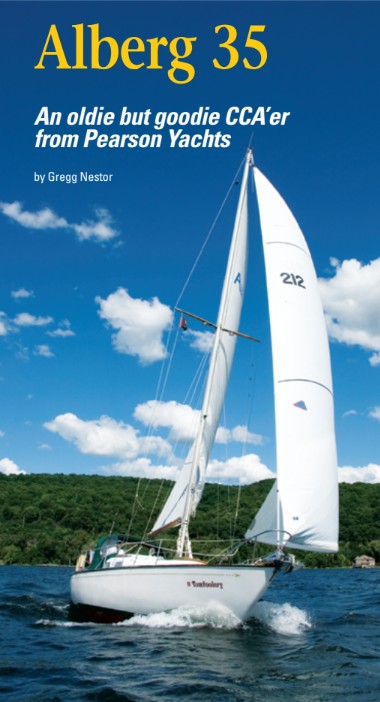
The Alberg 35 is but one of several classic cruising yachts designed by Swedish-born Carl Alberg and built in Rhode Island by Pearson Yachts. Introduced in 1961, it was a fixture in the Pearson line until 1967, and during this six-year period, approximately 280 Alberg 35s were built. From the standpoints of both sales and performance, the Alberg 35 was a very successful production yacht.
Although a bit long in the tooth today, the Alberg 35 continues to deliver sailing pleasure and adventure while showcasing Carl Alberg’s legacy of well-designed, good-looking cruising boats that are both exciting and safe to sail.
Design
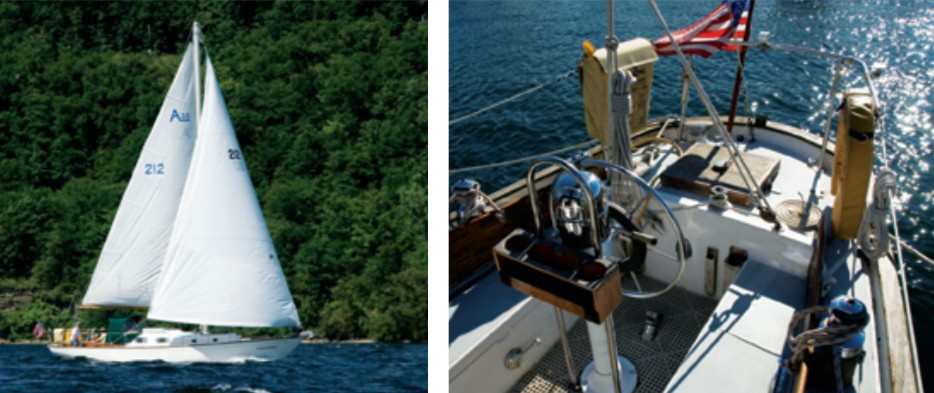
All Alberg-designed boats have distinctive lines and shared characteristics. The Alberg 35 is no exception to this seaworthy Scandinavian influence and has all the hallmarks of Alberg’s style: a somewhat flat yet slightly springy sheer, spoon bow, long balanced overhangs, rounded cabin trunk, slightly raised doghouse, winch pedestals, and wooden cockpit coamings.
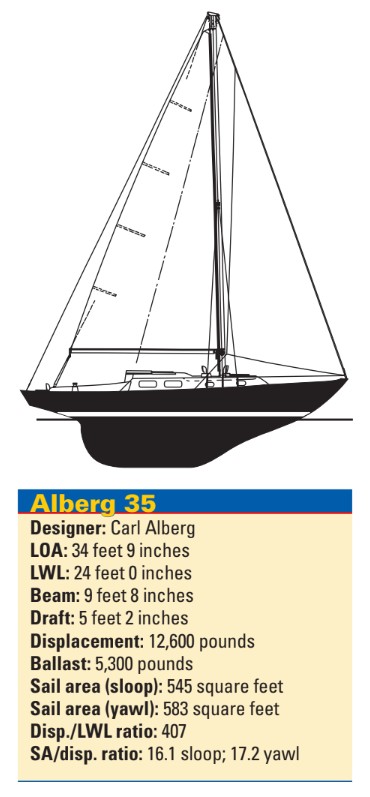
Alberg designed the 35 to suit measurement under the Cruising Club of America (CCA) Rule and it represented the state-of-the-art racer/cruiser for 1961. By today’s standards, the beam is a bit narrow at 9 feet 8 inches, and the waterline, at 24 feet, is a tad short. These proportions are good for gliding along in light air, in spite of the boat’s somewhat squat rig. Add a breeze, and the long overhangs help extend the waterline length when the boat heels.
The boat’s underbody is a cutaway full keel, drawing 5 feet 2 inches, with an attached rudder. Its displacement of 13,000 pounds, 5,300 pounds of that in the form of encapsulated lead ballast, gives the Alberg 35 the seakindly motion expected in a boat with a solid comfort ratio of 34.6. (Note: Designer Ted Brewer devised the comfort ratio. It’s based on displacement, waterline area, and beam. –Eds.). The higher the comfort ratio (CR), the more comfortable the ride. Most ocean cruisers generally exhibit a CR in the 30s. For comparison, a Niagara 35 has a CR of 28.7. For a C&C Landfall 35, it’s 30.8; and for a Bristol 35.5, it’s 32.2.
Construction
Both the hull and deck of the Alberg 35 are fiberglass. While the hull is a heavy uncored hand-laid laminate that is greater than 1-inch thick below the waterline, the deck is a sandwich of two layers of fiberglass with a core of balsa.
Balsa is extremely light and has physical properties that make it well suited for sandwich construction techniques that create rigid, but light, structures. It also insulates against heat, cold, and sound. Unfortunately, the balsa used in many early fiberglass production boats was not end-grain cut, but edge-grain cut. Edge-grain balsa has less compression strength than end-grain balsa and permits water to migrate through the laminate. Beginning around 1963, Everett Pearson, who founded Pearson Yachts, pioneered the use of end-grain balsa as a coring material.
However, constant flexing of cored decks can, over time, cause a break in the bond between the fiberglass skins and the balsa core. Water penetrating the voids that result can turn the core into pulp.
If the deck feels mushy beneath your feet or gives off a dull thud when struck with a mallet, it’s a good bet the deck is at least partially delaminated. While small areas of deck sponginess can be corrected, extensive delamination is reason enough to reject the boat.
The underbody of the Alberg 35 has a cutaway full keel. Its 5,300 pounds of ballast, cast in one piece, was lowered into the hollow fiberglass keel cavity of the one-piece hull molding, then glassed over. This encapsulated ballast eliminates concern over corroded keel bolts — there aren’t any. However, some boats have a void between the bottom and sides of the lead casting and the fiberglass shell. This makes the fiberglass shell vulnerable to damage from groundings. Should a surveyor find that this condition exists, it can be corrected by filling the void with resin.
The rudder is tiller-operated (wheel steering was an option) and attached to the keel on a raked rudder post. The rudder itself is wood and the post a heavy bronze rod. While the design is dated, this form of construction is sound and can be easily inspected, maintained and, best of all, upgraded.
Deck features
Apart from port and starboard mooring cleats and a deck pipe leading to the chain locker, the foredeck is free of clutter, making it a good working platform from which to deploy or retrieve an anchor or make headsail changes.
Located on top of the rounded cabin trunk, the teak-covered forward hatch provides ventilation for the forward cabin, aided by a pair of bronze-framed opening ports. Two cowl vents mounted on Dorade boxes just aft of the mast, together with another pair of opening ports, afford ventilation and light to the head. The slightly raised doghouse outwardly denotes the main cabin, which is naturally illuminated by four fixed portlights.
Wide sidedecks, outboard shrouds, and four sections of teak handrail along the coachroof make fore-and-aft movement on deck easy and relatively secure.
The cockpit is long and large, and while it provides plenty of room for daysailing and entertaining, its size is a concern for any serious offshore work.
The cockpit is self-draining and its bona fide bridge deck will help prevent water from spilling into the cabin should a wave fill the cockpit. The teak cockpit coamings are relatively high and provide reasonable, but less-than-comfortable, back support.
The standard tiller is long and takes up a lot of cockpit space. Pedestal wheel steering was available from the builder and many boats have been fitted with this option.
For storage, the cockpit has large seat lockers port and starboard, as well as a true lazarette beneath a hatch located just aft of the mainsheet traveler. These stowage areas share three undesirable characteristics: inadequate watertightness, poor closures, and drains that lead directly into the bilge. All of these conditions should be addressed before heading out for serious bluewater sailing.
Belowdecks
Just aft of the chain locker is a large forward cabin with a V-berth, hanging locker, and bureau. Beneath the berth are four drawers; outboard and above it are fiddled shelves. Because of the lack of an insert and the arrangement of the V-berth, the cabin has adequate floor space under standing headroom to permit normal activities like changing clothes and rummaging through lockers.
Aft of the forward cabin is the head compartment. It spans the full width of the boat, which provides a fair amount of usable space and maneuvering room. The head and a linen locker are to starboard, while the sink, a hanging locker, and additional stowage are to port. The shower is on the centerline and has its own sump — the Alberg 35 was one of the first boats of this size built with a shower and pressurized hot and cold water as standard equipment. Privacy in the head is gained by closing the doors to the forward cabin and saloon.
The saloon was offered in two configurations, a “traditional” arrangement with opposing settees and a more “modern” dinette arrangement.
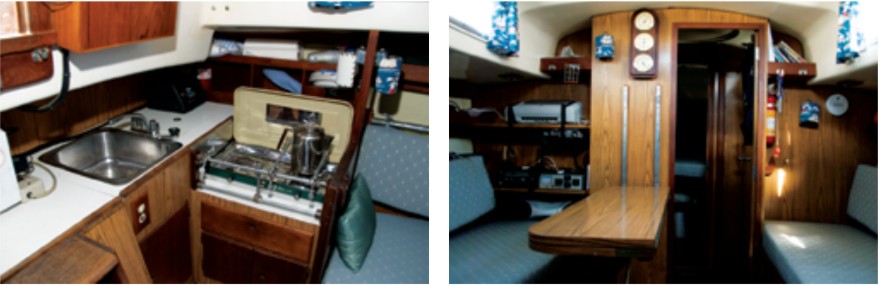
In the traditional configuration, the settees face each other, with a bulkhead-mounted, drop-leaf table between them. In this arrangement, the galley is aft and spans the width of the boat. There are no quarter berths, so the settees are used as sea berths. The aft galley incorporates a small sink and a two-burner alcohol stove to port, and a top-loading icebox to starboard. When closed, the icebox provides galley counter space and serves as a navigation and chart table.
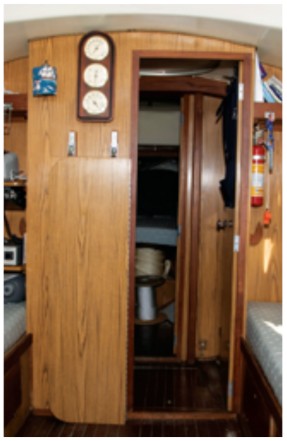
The alternative arrangement has a U-shaped dinette on the port side and the galley to starboard. This offers some interesting possibilities. First, lowering the dining table converts the dinette to a double berth. Also, the galley is a bit more workable and has room for a three-burner stove/oven along with the icebox, sink, and food lockers. Since the galley no longer spans the aft portion of the saloon, there’s room for two quarter berths, but the dining table will have to double as the chart table.
Although the forward cabin gets adequate air flow from its overhead hatch, and the head compartment from the cowl vents, the only direct ventilation in the saloon is that provided by the open companionway hatch.
The interior décor is dated. Pearson finished the bulkheads, cabinetry, and other surfaces in what it termed “low maintenance” wood-grain-pattern plastic laminate. With a little sanding and painting of the laminate, and some varnish on the standard teak trim, the boat’s interior appearance will improve dramatically. Headroom is a generous 6 feet 4 inches.
The engine is situated beneath and behind the companionway stairs; by removing several panels, near total access can be obtained. Lifting the cabin sole provides access to the potable water tank and the relatively deep bilge.
Depending upon the production year, the Alberg 35 was fitted with any of a variety of tanks. They were made with different volumes, of different materials, and placed in different locations. The design specifications for a late-production-run boat called for an integral fiberglass 48-gallon water tank beneath the cabin sole and a 23-gallon Monel fuel tank beneath the cockpit sole, behind the engine.
The rig
The Alberg 35 was available as a sloop or yawl. The CCA Rule lightly taxed the mizzen sail and permitted a mizzen staysail to be carried without any penalty. This feature of the rule made the yawl quite popular. The mizzen can be used to help balance the boat and is especially helpful in maneuvering in a crowded anchorage under sail.
Nevertheless, when the actual performance of the yawl and the sloop are compared, the sloop comes out ahead.
In both the sloop and the yawl, the mainmast is in the same location. It is somewhat forward, resulting in a small foretriangle and large low-aspect-ratio mainsail. One of the benefits of this rig is that the Alberg 35 can be sailed quite effectively under main alone. The sail area/displacement ratio is 16.1 for the sloop and 17.2 for the yawl.
The Alberg 35’s mast height is 44 feet 6 inches from waterline to masthead. The mast is stepped on deck and supported below by a bridge and two compression posts. The mast’s standing rigging is comprised of a forestay, a single pair of cap shrouds, dual lower shrouds, a single pair of spreaders, and a backstay. The mast is anodized aluminum; the boom is varnished spruce.
Originally, roller reefing was standard on the mainsail. All halyards are cleated at the mast(s) and mechanical advantage is achieved by means of Merriman #2 winches. Merriman #5 winches for the genoa sheets are mounted on pedestals outboard of each cockpit coaming. As is the case with the original roller reefing, upgrades are well warranted. New self-tailing winches are expensive but would make a big difference. The end-boom mainsheet is attached to a traveler located just forward of the lazarette.
Under way
While Pearson Yachts promoted the Alberg 35 as a racer/cruiser, it was and still is primarily a cruising sailboat.
Its relatively narrow hull and heavy displacement give it an easy motion in a seaway and the ability to carry a modern cruiser’s payload. Its displacement/length ratio is 407, making it a very heavy-displacement cruiser. Unlike more modern boats with more beam, the Alberg 35 is a bit tender. However, once it reaches 25 degrees or so of heel, its 42 percent ballast/displacement ratio begins to make itself felt. The boat stiffens up dramatically and, like most narrow boats, sails quite efficiently at fairly steep angles of heel. Unlike some modern beamy boats, the Alberg 35 shows no tendency to round up uncontrollably in gusty winds.
For auxiliary power, the Alberg 35 relies on the Universal Atomic 4. This venerable gasoline power plant is cooled directly with raw water and can provide a cruising speed of about 6 knots in calm conditions. The boat handles well when motoring forward; in reverse, however, it steers poorly. This is due to a combination of several factors. The rudder is tucked well forward under the boat, it’s attached to a full keel, and the prop is in an aperture between them. It takes practice and time to get used to it.
Things to check out
Before you fall for an Alberg 35, remember that the youngest one rolled off the line in 1967. For starters, check the decks for delamination caused by a balsa core saturated with water. Pay keen attention around fittings, such as cleats and stanchions. Delaminated areas sound dull and hollow when tapped with a plastic hammer or the handle of a screwdriver.
Compression of the structure under the mast step is a potential problem. Look for signs of cracking, bending, or movement of the mast support beam and associated compression posts.
As with most sailboats of this vintage, the gelcoat may be crazed and faded. While this may be mainly a cosmetic problem, if crazing becomes so extensive it allows water to migrate into the laminate, the problem then becomes structural.
Have the surveyor check for a possible void between the ballast casting and the fiberglass shell. Inspect the wooden rudder for damage due to groundings and for corroded mounting bolts.
Because water and fuel tanks can vary from boat to boat, take a close look at them. It has been reported that early boats had galvanized tanks. These will eventually rust through. Monel and fiberglass are much better materials for this purpose.
As with any boat of this vintage, be prepared to address the wiring, the rigging, the sails and sail-handling gear, the alcohol stove, the electronics, and the Atomic 4.
Conclusion
While it may initially appear that the Alberg 35 is a tired old craft, that’s by no means true for all of them. This boat was designed and built with reasonably heavy scantlings and is suitable for serious offshore sailing. Its classic lines are still appealing and cause heads to turn when the boat enters a marina.
Prices for an Alberg 35 range from $23,500 for a 1964 to $29,500 for a 1967 model. If you’re looking to do some serious cruising, for the money, an Alberg 35 is hard to beat. Repairs, modifications, and upgrades will add to the price, but you won’t break the bank or destroy your investment.
Gregg Nestor is a contributing editor with Good Old Boat. When he’s not writing about sailing, Gregg and his wife, Joyce, cruise Lake Erie aboard Raconteur, their Pearson 28-2. They also trailersail an O’Day 222.
Thank you to Sailrite Enterprises, Inc., for providing free access to back issues of Good Old Boat through intellectual property rights. Sailrite.com