Cruisers pull together for the dear departed
Issue 73 : Jul/Aug 2010
The brassy summer sun beat down on the tiny Turkish port of Marmaris. Tom, the crusty old Brit, sat sweating under his cockpit awning as he surveyed the village across the glassy bay. He had been cruising the eastern Mediterranean in his raised-deck Hillyard cutter since WWII. Tom had retired from the Royal Navy with a small pension, enlarged liver, and generous heart. He was generous with his experience, correcting our charts and sharing weather lore and local knowledge.
To our yachtie potlucks on the beach, he always brought potatoes boiled in seawater. That was all he could afford. Invariably someone would declare, “Those were the best spuds I ever tasted,” and ask him for the recipe. Tom always blushed with pleasure.
By the time the campfire was out, all the old stories retold, and all the old songs sung, a cool night-breeze — scented with orange blossoms and rosemary — drifted down the valley and signaled time to return to our anchored boats. By unspoken agreement, all the leftover food and wine would be left for Tom in his rotten old lapstrake dinghy.
One particularly hot afternoon, Tom was not at his usual place observing the sunset from under the big white canvas cockpit awning with his usual drop of brandy. We thought nothing of it. The next morning he did not appear at the weekly farmers’ market. A friend rowed over to check on Tom and found him in his bunk, thoroughly and unpleasantly dead.
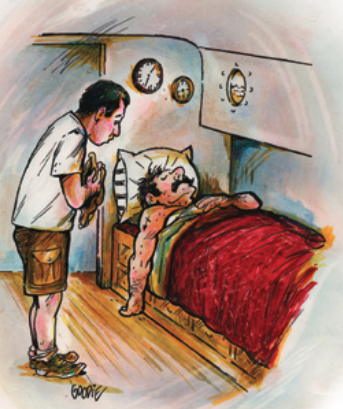
Now what?
In minutes Tom’s little cutter was surrounded by dinghies, his cockpit full of anxious cruisers.
“This is terrible. Now what do we do?”
We did what cruisers always do in a crisis. Together, we collected options and opinions until we had enough to make a plan and swing into action. All the sailors there assumed the tasks for which they felt best qualified. I rowed ashore to phone the British consulate in Istanbul.
“No, we cannot help you, as you are neither next-of-kin nor a British subject,” was their answer. I suspect they simply did not want to make the three-day bus trip.
Tom’s best friend found correspondence from Tom’s son, complete with envelopes showing the son’s address in London. A telegram was duly dispatched.
There being no police, no doctor, and no coroner, one of the cruisers notified the port captain, who wanted no part of the business.
Another deputation went to the mosque to see about burial in the local cemetery. The imam was patient and sympathetic as he explained that Tom could not be buried in the Muslim cemetery. He did, however, point out an attractive, pine-covered hilltop that would be suitable for our purposes. “It has a fine view over the sea,” he offered. “Just fine,” we thought.
In the cooler
Turkey, being a Muslim country where bodies must be in the ground by sunset on the same day, has no embalming or cremation facilities. The only ice in the village was in the cooler at the waterfront hotel. We had a problem.
The two most attractive — and, we hoped, most persuasive — women in the fleet were deputized to call on the owner of the hotel and the only ice in town. He listened to the sad story and begrudgingly consented to hold Tom’s remains in the cooler overnight. The four youngest and strongest men in the fleet wrapped Tom’s body in an old cotton storm jib, wrestled the bundle into a dinghy, then ashore, across the beach, and into the hotel cooler.
Three days later, we received an answer from Tom’s son, in London: “DO NOTHING UNTIL I ARRIVE!” Tom was becoming an increasingly unwelcome and unpleasant tenant at the hotel. The poor hotel owner was beside himself. Now we had a real problem.
Again we did as cruisers so often do. We met in the cockpit of the biggest boat to toss about options until we had a new plan. There was no avoiding the odious task ahead. The two best speakers of Turkish were sent up the valley to borrow picks and shovels from the orange grower. The rest reported to the hotel. Being a pallbearer is unpleasant even under the best of circumstances. We carried and dragged what was now a stinking and dripping bundle up the steep hillside to the place indicated by the imam.

Hard stony soil
Once there, we found the hard, sun-baked red earth was no more ready to receive Tom’s remains than anyone else in the village. The stony soil, rocks, and roots resisted mightily our best efforts to dig a proper grave. Our sailors’ salt-hardened hands blistered on the hafts of the pick and shovel, implements unfamiliar to mariners. We could not come close to the requisite 6-foot depth. “Good enough. It will have to do,” we said when we could do no more, and we lowered Tom in and covered him up.
Tom was a good man. We all loved him, but on that day our sweat flowed faster than tears. Poor Tom’s requiem was a chorus of sailors’ curses. We cursed the steepness of the hill. We cursed the hardness of the soil. We cursed the rocks, the roots, the heat, the flies, the stink, and, most of all, Tom himself for his lack of consideration in pegging out in such an inconvenient time and place.
We were done . . . relieved and satisfied that we had done the right thing and that we had done it together. It was time for refreshment back down at the hotel. As we slipped, skidded, and tumbled down that accursed steep hill, one of the youngsters asked, “Why didn’t you simply bury him at sea?”
Our obvious collective stupidity exposed, we began to snicker, then giggle, then laugh. We laughed until we cried.
That evening, at the wake in the hotel, one of the assembled gave the shortest and best eulogy I’ve ever heard: “Our dear friend, Tom, is dead. We are alive. Let us be glad.” With that, the party began.
I like to tell this story because it can happen to any of us. As pelagic cruisers, we must be prepared for the eventuality of grave illness or death while at sea or overseas.
Repatriating a grieving surviving spouse or partner can be difficult. I recall participating in a “capstan auction” to sell off personal effects and boat parts in an effort to raise enough money to repatriate the widow. Later, her boat had to be moved to a place where it could be legally sold.
Birth and death always come at inconvenient times and places. Fortunately, a little thought and preparation can make things much easier.
Sig Baardsen raced dinghies and crewed on Stars and Dragons as a teenager and crewed in the 1957 and 1959 Transpac races. In 1987, he bought Mary T, a Cheoy Lee Offshore 40 yawl, in which he and his wife, Carol, sailed south from San Pedro on a cruise that became a circumnavigation.
Thank you to Sailrite Enterprises, Inc., for providing free access to back issues of Good Old Boat through intellectual property rights. Sailrite.com