A low-priced club racer and shoal-water cruiser
Issue 74 : Sept/Oct 2010
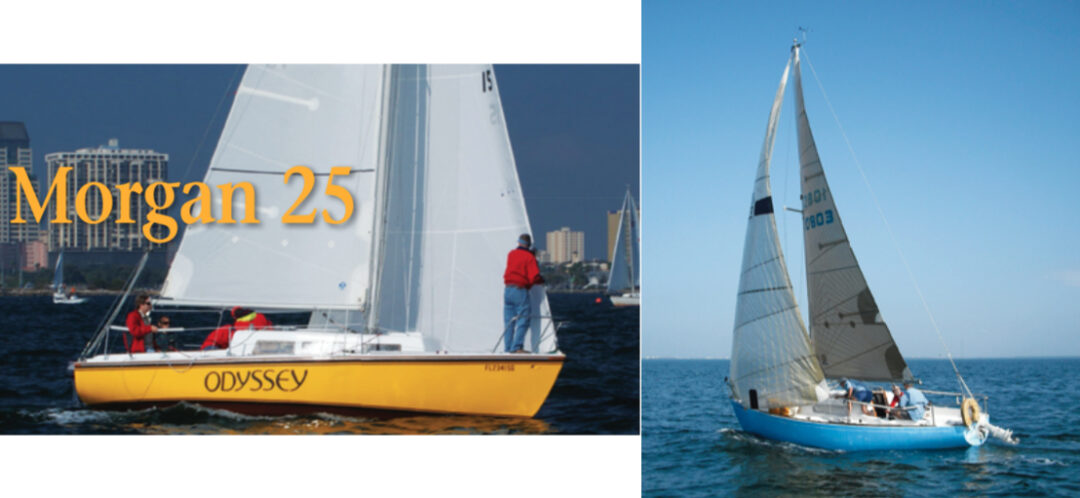
Needing a break from winter, my wife and I flew to St. Petersburg, Florida, to participate in the inaugural Good Old Boat Regatta, held last January. With the help of the St. Petersburg Sailing Association’s regatta coordinator, Steve Lang, I was able to crew on a Morgan 25. This let me have some fun on the water with owner Grover Griffin and also gave me an opportunity to review a classic boat.
Grover bought his 1975 Morgan Classic 250 (a version of the Morgan 25) from a cruising couple in 1979 and set it up for racing — about 60 races a year in the Tampa Bay area. Odyssey’s bright yellow hull is well known and respected in bay area racing circles.
Design
Charley Morgan was a well-known designer and boatbuilder in the St. Petersburg area where, in the 1960s, he was something of a pioneer in the new medium of fiberglass. Morgan has numerous designs to his credit, from a 22-foot trailer sailer to 60-foot offshore racers and world cruisers. After winning the Southern Ocean Racing Circuit (SORC) in 1961 and ’62 aboard his 40-foot Paper Tiger, Morgan formed Morgan Yachts. He always had an interest in racing and most of his designs sail well. An exception might be the aft-cabin Out Island 41, a break-through design that helped establish the Caribbean charter trade but sometimes needed the jib backed to come about.
In 1984, after several changes of hands, Morgan Yachts was sold to Catalina Yachts, which built the OI 41 for a few more years before retiring the molds and the Morgan name. (For more on the man and his company, see “Charley Morgan and the Fiberglass Factory,” March/April 2005.)
The impetus behind the Morgan 25 was the popularity of competition-worthy Midget Ocean Racing Club (MORC) yachts and growing demand in the late 1960s for inexpensive and easy-to-maintain fiberglass sailboats. The market was flooding with new designs for a new breed of sailors.
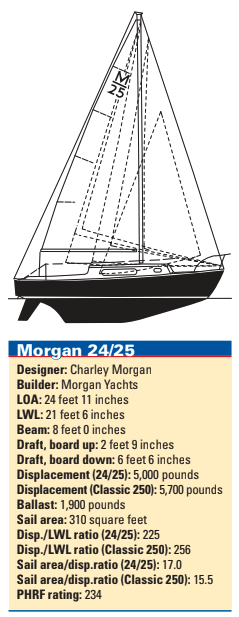
The Morgan 25 has an LOA of 24 feet 11 inches and was first called the Morgan 24. The 24, 25, and Classic 250 have the same hull. Grover’s Classic 250 has a thicker deck, which, along with some other changes, makes it 700 pounds heavier than the other models. Production of the three began in 1965 and ran to 1976, with 460 hulls completed. The Classic 250 was only built in 1974 and 1975.
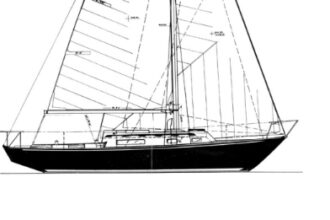
The Morgan 25 has simple yet attractive lines, with a spoon bow, gentle sheer, a bit of tumblehome in the low topsides, and a counter transom. The cabin trunk transitions into gently sloping cockpit coamings. Below the water, firm bilges provide good initial form stability. The long stub-keel/centerboard combination has 1,900 pounds of lead ballast and draws 2 feet 9 inches with the centerboard up and 6 feet 6 inches with the board down.
Grover converted Odyssey back to a centerboard boat after a previous owner had modified the boat with a
fixed keel. Some early boats may have had cast iron or bronze centerboards. The rudder is a balanced spade well aft of a large cutaway in the keel and steering is with a tiller. A Universal Atomic 4 or diesel inboard engine was available as an option to the standard outboard motor.
Construction
The hull is hand-laid sandwich fiber- glass, 5⁄8-inch thick, cored with “Q Cell.” The hull-to-deck joint is a standard shoebox type in which the overlapping deck flange is caulked and through-bolted to the hull. The inside of the joint is glassed over. On later boats, pop rivets were used in place of the bolts — a less desirable method. At the edge of the deck is a molded toerail capped by a teak strip.
A cut-out in the transom allows for direct attachment of an outboard motor on centerline, although some boats were built without this feature.
The underside of the deck is gelcoated — no fiberglass liner, no vinyl panels. A fiberglass hull-liner pan forms the foundation for the interior furniture.
The centerboard and trunk are entirely below the cabin sole. This creates room in the cabin but places all the hardware below the waterline, leading to leaks and corrosion problems. The centerboard is controlled with a removable crankhandle to port near the helm.
On deck
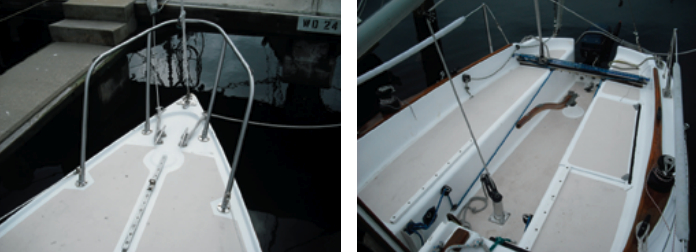
Odyssey’s cabin trunk is fitted with six non-opening portlights (the number varies with vintage). Two teak handholds (or stainless steel in Odyssey’s case) per side on the cabin top are well placed, while the teak companionway slides add some class.
A large, solid-fiberglass hatch just forward of the tabernacle-stepped mast provides good ventilation. There is no anchor locker forward, so some arrangement would need to be made to carry the anchor below or stow it on deck. There is no dedicated location for the outboard’s fuel tank.
Unlike most smaller boats with a cabin trunk, the Morgan 25 has wide sidedecks that are quite usable for going forward. However, the chainplates are located in the middle of them, necessitating a hop onto the cabin top to get around them. The abundant non-skid surface provides good traction even when the boat heels.
The cockpit coamings deflect water and, capped with teak, are wide enough for sitting on when working the winches. They also provide nice back support for sitting on the 8-foot-long cockpit seats. Earlier boats had two large hatches in the cockpit seats, while on later versions only the port seat opens to the hull interior. In both versions there is plenty of storage space for lines, fenders, and gear.
A stainless-steel bow pulpit and single lifelines keep crew aboard. On Odyssey and Amanda, a Morgan 24 I also inspected in St. Petersburg, the lifelines start low to the deck to allow the foot of a genoa to pass outside the lifelines.
Belowdecks
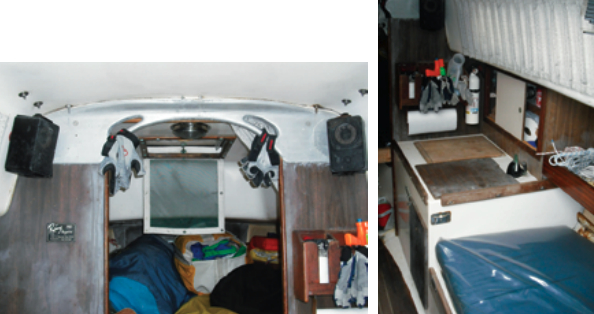
Stepping aboard Odyssey I quickly saw that she has no accommodations. Grover had removed the interior and installed plywood bins for handy sail stowage during races. This stripped a lot of weight out of the boat. He also reinforced the bulkhead to withstand mast compression and upgraded the rigging and chainplates. I could see plain as day the complex cable rigging for raising and lowering the centerboard. Headroom is 5 feet 6 inches.
Later, I went aboard Amanda for a brief look at a stock interior from the 1960s. There I found the standard V-berth forward and a portable toilet beneath it. Aft of the forward cabin bulkhead, to port and starboard, are fiberglass cabinets forming a small galley and storage area. Depending on the year the boat was built, these cabinets were trimmed with mahogany or oiled American walnut. The starboard side features a sink, an icebox that drains to the bilge, and storage spaces. A stove can be located on the work area to port. Aft of the galley, the saloon seats extend under the cockpit to form quarter berths. The inside of the hull is lined with fabric.
In an optional roomier cabin arrangement, a dinette that converts to a berth is to port and the galley to starboard.
Water capacity can be 15 to 20 gallons in tanks of varying construction.
Rig
The standard masthead-sloop rig has single spreaders and single lower shrouds. Grover shortened Odyssey’s shrouds and rigged double lower shrouds. He also added an adjustable split backstay, which is a common modification. All the 24/25s had roller-reefing booms and boltrope mainsails, but many, if not most, have been modified for slides on the sail and eschew use of the roller reefing.
The standard mainsheet system has an end-of-boom bridle. Some owners have fitted mid-boom sheeting and a traveler forward, as on Amanda. To keep the cockpit clear, others have fitted a traveler aft of the helm, as on Odyssey. The standard headsail track is mounted on the toerail, whereas Grover mounted Odyssey’s inboard. He also led his halyards aft to the cockpit and installed self-tailing winches. Odyssey has a foil on the headstay, while other Morgan 25s may have hanked-on sails or roller furling.
Under way
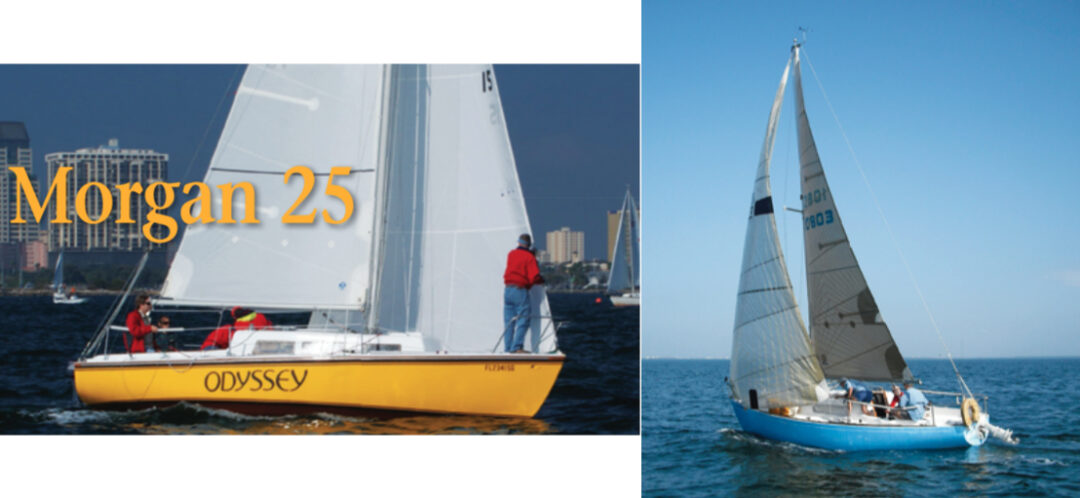
I joined Grover and his three crew for the Good Old Boat Regatta, which started near The Pier on the St. Petersburg waterfront within easy watching distance from shore. We were in the spinnaker class. The two other divisions, “cruising” and “fun,” sailed a shorter course. All sailed the course twice. We did well on the start, but ended up chasing the stealthy Amanda up the windward leg of the triangular course to the first mark. Amanda may not look like much at her slip, with her faded blue hull and deck, but when the Kevlar sails come out you know she’s not going to be a pushover.
The air was light, and on the second leg it was was a tossup between staying with the genoa and launching the big yellow asymmetrical spinnaker. We switched to the spinnaker before Amanda did and slowly overtook her. With Amanda safely behind us, I took the helm for the second lap.
The boat felt stiff enough and stable, particularly with the centerboard down. The helm had a firm feel without being heavy. When the sails were trimmed in hard, there was a very light weather helm. When tacking or jibing, the boat was very responsive. It turned fairly quickly, although not dinghy-like due to the long stub keel. I felt some vibration in the tiller from turbulence generated by the centerboard slot. Whether sailing to windward or off the wind, tracking was very straight; this boat could probably be trimmed to sail hands-free.
It was fun watching all the other classes of boats milling about and, because of the two courses and overlap of time, the last leg got crowded toward the finish. The race committee had moved the finish line to very near The Pier and, once we arrived, the combination of no wind and some current made crossing the line agonizingly slow. As soon as we drifted over the line, Grover fired up the outboard, and Odyssey moved nicely under power.
There was a big do at the St. Petersburg Yacht Club later on where awards were presented. Odyssey turned in a creditable third-place finish and was only two minutes out of first place on corrected time. Her PHRF rating had been 222, but Grover is protesting this rating since he learned that sail area on the Classic 250 is less than the standard Morgan 25. These few seconds per mile have cost him a number of races — including this regatta. For comparison, the two biggest fleets of Cal 25s rate 222 and 231, and the much newer J/24 rates between 165 and 174.
Based on the design, I would suspect the Morgan 25 would be a bit tender in breezier conditions due to its shoal-draft keel, but it should perform very well on any point of sail and take most seas in stride. Grover reports reaching a maximum speed of 6.3 knots.
Conclusion
Grover shows that one can take a relatively inexpensive boat and, with some elbow grease and investment in upgraded systems, make it competitive for racing. The Morgan 24/25 still seems to be a popular low-cost racer/cruiser. Mix in a good crew and you have a formula for exciting and fun-filled weekends. Leave the interior stock, as in Amanda, and you can enjoy racing while still being ready for the occasional cruise or overnight. The shallow draft makes it an ideal gunkhole explorer. With a road-legal 8-foot beam, the boat is trailerable, which opens up many sailing opportunities while reducing ownership expenses.
Problem areas are typical of any 30- to 40-year-old boat, but the Morgan’s construction is not known for any severe weaknesses. Trouble can arise with the centerboard pendant, pivot pin, and a weakly supported turning sheave under the cabin sole, which requires vigilant and frequent inspection, particularly in salt water. Also look for gate valves on through-hulls. These should be replaced with proper seacocks.
While the early 24s were of somewhat better quality construction, the Morgan 25 is still a solid buy, and there are plenty of these boats to supply the market. Some were sold as kits and these amateur-built boats can vary substantially in quality. Prices range vastly, from derelict boats at giveaway prices to well-found examples in the $6,000 range.
Allen Penticoff is a freelance writer, sailor, and longtime aviator. He has trailer-sailed on every Great Lake and on many inland waters and has had keelboat adventures on fresh and salt water. He presently owns three sailboats: an American 14.5, a MacGregor 26D, and a 1955 Beister 42-foot steel cutter that he’s restoring.
Thank you to Sailrite Enterprises, Inc., for providing free access to back issues of Good Old Boat through intellectual property rights. Sailrite.com