Pressing pure water out of the sea
Issue 77 : Mar/Apr 2011
Osmosis is a natural process in which molecules of a liquid spontaneously pass through a semi-permeable membrane. The direction of fl ow across the membrane is from a liquid with a low concentration of dissolved substances (solutes) to one with a high concentration. The process can generate very high pressure, called osmotic pressure, on the side of the membrane occupied by the liquid with the high concentration of solutes.
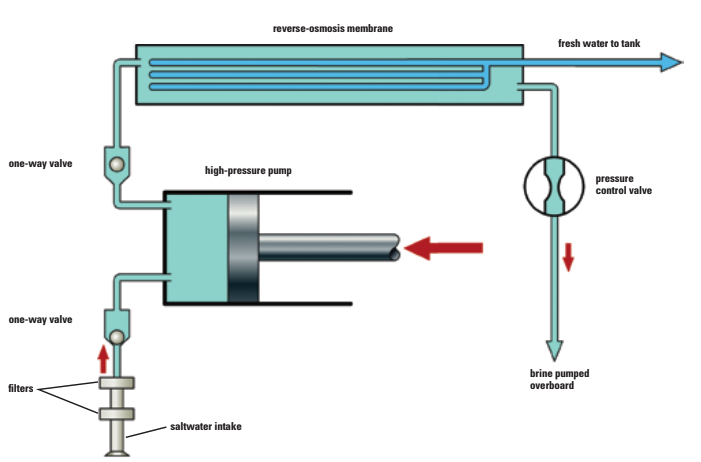
Osmosis can be reversed when pressure higher than the osmotic pressure is applied to the liquid high in solutes. When high enough pressure is applied to salt water, for example, water molecules, but not the salt molecules, pass through the membrane to the low-pressure side. This principle is used in reverse-osmosis (RO) watermakers to desalinate seawater.
Reverse osmosis is similar to a membrane filtration system but with several differences.
Reverse-osmosis watermakers
The primary function of an RO watermaker aboard a boat is to make potable water by removing salt from seawater. This is done by pressurizing salt water to 800 or more pounds per square inch (psi) and forcing water molecules through the semi-permeable membrane. The desalinated water is collected for storage and the salt water (now more concentrated) is discharged overboard.
In recent years, the cost, complexity, size, and power requirements of RO watermakers have been reduced to the point where even a small boat can take advantage of the technology. RO watermakers vary in size and capacity from small manually operated ones for use aboard a life raft to huge units weighing hundreds of pounds.
Watermakers are wonderful devices for offshore passagemakers. With the capability of making water, long-distance cruisers don’t need large water tanks aboard. Reverse osmosis can have an added advantage for those who cruise abroad, where the quality of the water at some marinas may be in question and the price high. Coastal cruisers equipped with watermakers can eliminate trips to marinas for water.
Ocean water contains approximately 30 to 32 parts per thousand (ppt) of dissolved salt. An RO watermaker can reduce salt content by 150:1. The resulting drinking water will have 0.2 ppt of dissolved salt, a salt content that can’t be tasted and is medically safe.
RO watermakers should not be used in harbors where pollution, oil, or chemicals might be in the water. Oil and chemicals will clog the primary filters and some chemicals, such as chlorine, may also destroy the membrane, requiring an expensive replacement. In addition, some viruses in polluted water are small enough to pass through the membrane into the drinking-water supply. If the watermaker might be used where the possibility exists of germs passing through the membrane, an ultra-violet sterilizer is a logical addition to the system (and is a good option to choose in any case).
The stated production rates for RO watermakers are usually given for 70°F water. When the water is colder, the watermaker’s output will be reduced.
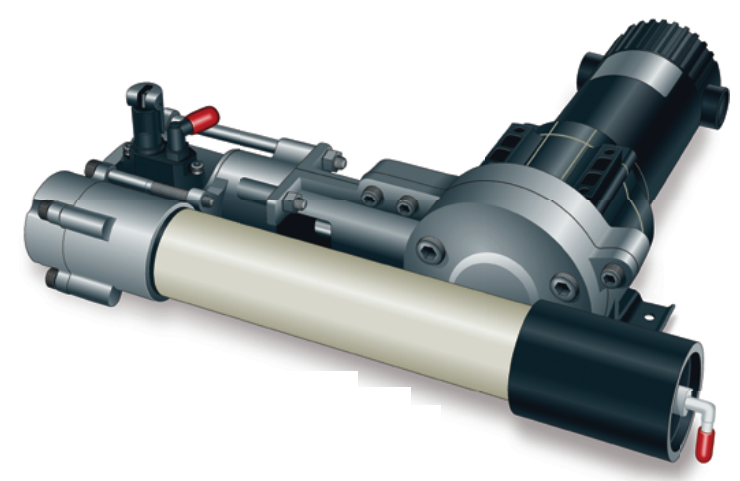
Reverse osmosis watermakers come in many shapes, sizes, and capacities. This small RO watermaker produces 1.5 gallons of fresh water per hour, weighs 25 pounds, and operates on 12 VDC at 4 amps. This small power requirement can often be supplied by solar panels or a wind generator.
Installation and maintenance
Installation of an RO watermaker requires two extra throughhulls to be fitted. One through-hull will be below the waterline, for the saltwater intake, and the second will be above the waterline, for the saltwater discharge. The intake through-hull should have an external strainer and the water going to the watermaker should then pass through two progressively finer filters. These filters require regular cleaning.
Some RO watermakers are available in modular form, which makes it easier to install the various components in available unused spaces aboard.
A key component of a watermaker is a high-pressure pump. This can be belt-driven by the engine or, if it’s a smaller unit, powered by the boat’s batteries. If the boat has a generator, the pump can run off 120 volts AC.
All RO watermakers require a strict maintenance schedule and operate at their best when used daily. If a watermaker is not used for several days, special maintenance procedures are necessary to protect the membrane, which means a watermaker is probably not practical for the weekend sailor.
During an extended passage, the watermaker’s pre-filters must be cleaned about once a week and replaced periodically. Also, the watermaker’s O-rings and check valves should be replaced after 1,000 hours of use and the equipment should be cleaned annually. In addition, it’s a good idea to periodically check the fresh-water output with a Total Dissolved Solids (TDS) meter to assure the unit is operating properly.
Don Launer, a Good Old Boat contributing editor, built his two-masted schooner, Delphinus, from a bare hull and has held a USCG captain’s license for more than 34 years. He has written several books, including Navigation Through the Ages and The Galley: How Things Work, and frequently gives talks on the history of navigation.
Thank you to Sailrite Enterprises, Inc., for providing free access to back issues of Good Old Boat through intellectual property rights. Sailrite.com