A quick and accommodating Gary Mull design
Issue 78 : May/Jun 2011
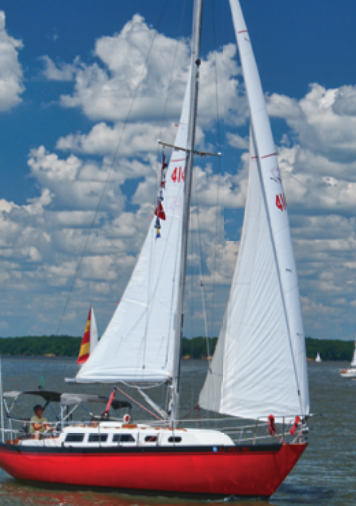
When David “Swede” and Marcia Samuelson sold their San Juan 28 in 1987, they left 14 years of sailing behind and began traveling on motorcycles. They eventually proved true the old adage, “Once a sailor, always a sailor.” In the summer of 2003, the allure of sailing won out over the call of the road. That’s when they found their 1973 Ranger 33, hull #100, Drifter, in Superior, Wisconsin, and moved her to Rathbun Lake in southern Iowa. The lake is a popular sailing venue and an easy drive from their home in West Des Moines. In July 2010, Swede and Marcia hosted a test sail and photo shoot for this review.
History
Jensen Marine of Costa Mesa, California, the builder of the popular line of Cal sailboats, had an exclusive agreement with Bill Lapworth to build boats to his designs only. At the same time, designer Gary Mull was drawing successful racing boats, including the Santana 22 and Santana 27 produced by W.D. Schock. (Note: for more on Gary Mull, please refer to our article in November 2002. –Eds.) Jack Jensen admired Gary’s work and saw an opportunity to produce another line that might have broader appeal. He formed Ranger Marine in 1967 and entered into an arrangement with Gary to build only his designs. The first of these was the Ranger 26; the Ranger 33 was his second. The first 33 hit the water in 1969. Gary designed several more boats for Ranger, including the 22, 23, 28, 29, and 37.
In 1973, Jensen Marine and Ranger Yachts were acquired by corporate giant Bangor Punta. Gary had some philosophical disagreements with the management and his exclusive design agreement was terminated. Ranger and Cal production was moved from California to Massachusetts. Ranger 33 production halted after 464 hulls in 1978, and Bangor Punta’s Ranger division was shut down in 1981. Gary Mull died in 1994 at the age of 55.
Design
Like Gary’s other Ranger designs, the 33 has pleasing proportions, with a raked bow, reverse transom, and saucy sheer. Neither the freeboard nor the cabin trunk is too high.
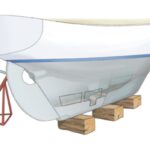
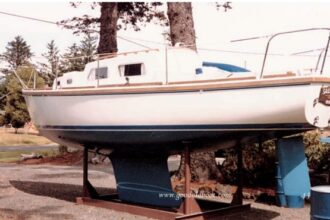
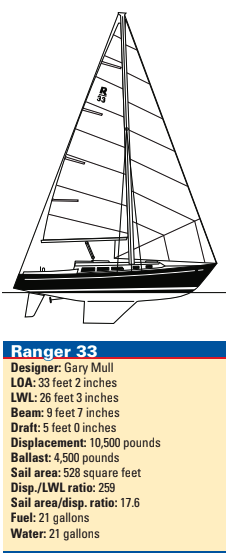
Underwater, the keel is of the type commonly referred to as a “cruising fin.” It has a sufficiently long and fl at run on the bottom that the boat can be careened against a seawall. The spade rudder gives optimal control. While skeg-mounted rudders are considered to be more protected, many skegs lack the structural strength to do much good if they take the brunt of an impact. The displacement/LWL ratio of 259 and sail area/displacement ratio of 17.6 mark the Ranger 33 as a moderate-displacement cruiser/racer.
Construction
The Ranger 33’s hull, with its integral keel, is a solid fiberglass layup. Lead ballast is encapsulated within the keel, which eliminates the need for keel bolts and a joint. The draft is 5 feet and the spade rudder is almost as deep. Rudder bushing problems are common but easily addressed.
The deck is fiberglass, cored with plywood in early boats and balsa in later ones. The hull and deck were joined with a through-bolted flange that incorporates the toerail. Early toerail caps were teak; later boats have aluminum toerails.
Ranger used an interior fiberglass liner, coupled with interior bulkheads and furniture, to provide structural stiffness. The liner was bonded to the hull at contact points with reinforced polyester cement putty, and stiffness was augmented by connections to bulkheads that were likewise connected to the deck. Fiberglass-encapsulated wood members in the bilge beneath the liner add further interior support. This method of construction provides for ease of production and somewhat lower initial cost, but it does present problems for owners if access to the hull behind the liner is needed or if maintenance work on wiring or plumbing is required.
Rig
The aluminum mast is stepped on deck and supported by a compression post built into the bulkhead at the forward end of the saloon. The bulkhead sits atop the fiberglass liner at this point. A space between the liner and a 2-inch-thick mahogany strip tabbed to the hull near the bilge was filled with polyester putty with the intent of providing a solid base to bear the load from the compression post. In some boats, insufficient putty was used and the area depressed under the mast load. Repairs require cutting into and removing some of the liner to gain access. This area bears watching.
Two halyard winches are mounted on the mast and they are adequate for most purposes.
The mainsail sheet is led from a cabintop traveler to the midpoint of the boom. The aluminum boom has a cutaway on its underside near the gooseneck to house turning blocks for internal lines. Drifter has a single-line reefing system and two reef points in the mainsail, which are adequate for most coastal sailing.
On deck
The Ranger 33’s sidedecks are cambered from the cabin trunk to the rail. This feature promotes drainage and provides a more level walking surface for crew going forward when beating to weather.
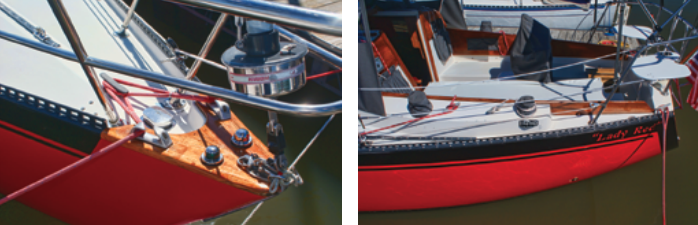
There is no provision for anchor storage or handling anywhere on the foredeck. As the standard stem fitting was small, many boats have been modified to add anchor rollers. Drifter has a teak overlay at the stem that incorporates the bases for the navigation lights. Boats that have had anchor rollers fitted usually have a combination navigation light fixture on the top rail of the pulpit.
The stainless-steel bow and stern pulpits provide good security and support. Single lifelines were standard; double lifelines were offered as an option. Mooring cleats are small but well placed.
The cabin trunk is narrow and slightly cambered. Teak grabrails run the full length of the cabin, offering good security for crew going forward or working at the mast. The cabintop has a single fiberglass hatch forward. The hatch laminate is fairly thin. A good improvement project would be to replace it with a beefi er Lexan or similar hatch, which would be stronger and would provide better natural lighting below. Two Dorade vents over the saloon and a single pie-pan vent over the head provide ventilation. The companionway hatch slides forward into a sea hood.
As is the beam, the cockpit is narrow for a 33-foot boat but has room for four adults and a fifth at the helm. The cockpit seats are exactly 6 feet long, to which the stern seat adds 12 inches. Swede and Marcia have built a custom contoured helm seat for Drifter.
The primary winches are mounted on molded fiberglass coamings that extend from the cabin trunk aft to the helm position. Teak coaming boards cover the inside faces of the moldings.
The rather small wheel and the Edson pedestal are located near enough to the primary winches that singlehanding is possible, although the cabintop traveler complicates things. Engine shift and throttle controls are mounted on the pedestal. Many earlier boats have tiller steering, which might make the cockpit seem more cramped when under way but would open things up a bit at the dock.
There is a sizable stowage locker to port and coaming cubbies forward on each side. Some owners have added small hatches (which were not offered by the builder) to access space under the stern seat for stowage.
The companionway sides taper sharply to a fairly narrow entry. There is a low sill at the base of the opening but not enough to keep a boarding sea out of the cabin. When the boat is under way and any kind of sea is running, at least the lower dropboard should be in place and secured.
Belowdecks
The Ranger 33’s cabin offers over 6 feet of standing headroom from the companionway all the way forward. The dark teak joinerwork provides a rich atmosphere below, although without the generous portlights it could be too dark for some tastes. The fit and finish are of average to good quality.
The galley lies to port of the companionway. A two-burner pressurized-alcohol stove was standard, although many have been replaced with propane stoves. The sink is inboard nearer the companionway. The icebox, which is aft of the stove, is generous. Counter space is limited but adequate when the icebox is closed and a sink cover is in place. Dual shelves along the hull provide space for dinnerware and utensils and more stowage is available beneath the stove and sink. The bulkhead between the galley and the saloon is half-height and incorporates a post that provides support for the deck.
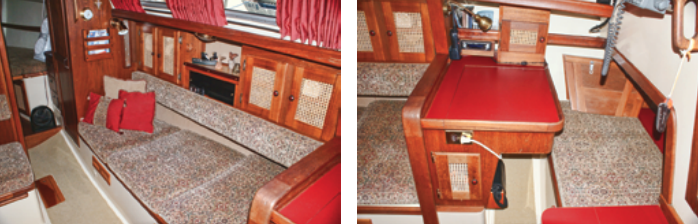
To starboard, a quarter berth extends beneath the cockpit seat. A forward-facing chart table uses the forward end of this berth as its seat. The electrical panel and radio are mounted above the chart table. Two shelves along the hull over the table provide more stowage.
The interior liner forms the cabin sole and has molded non-skid in walked-on areas; sole hatch boards that give access to the bilge are teak-veneered plywood. Swede and Marcia have carpeted Drifter’s sole.
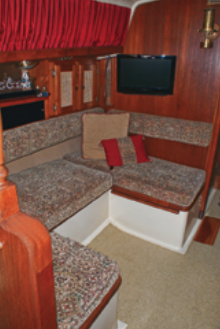
A U-shaped settee occupies the port side of the saloon, and the dining table lowers into the U to form a double berth when needed. A straight settee lies to starboard and can serve as a single berth. The original interior was fitted with shelves behind both settees, with the lower shelf space enclosed by sliding doors. Swede and Marcia added to Drifter’s saloon stowage by building attractive, full-height, double-door cabinets on the forward and aft ends of both shelf sections.
Large portlights provide good light for the saloon but, as they are not opening ports, ventilation is available only through the companionway opening, the Dorade vents, and the forward hatch.
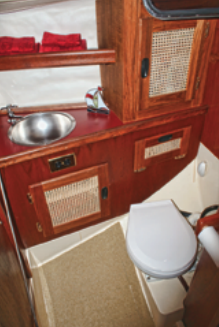
The head is to port, forward of the saloon. The marine toilet stands on a molded fiberglass platform in the forward part of the compartment. There’s stowage and seacock access under the stainless-steel vanity sink, an enclosed cabinet forward behind the toilet, and a small opening port. A teak door provides privacy and a similar door to starboard opens to reveal a generous hanging locker.
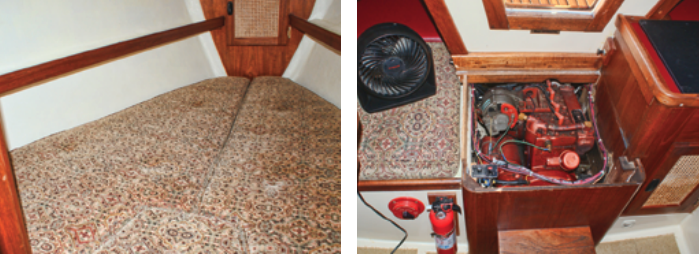
The V-berth is just long enough to accommodate a 6-foot person. It’s comparatively narrow, but two people can sleep fairly comfortably in it with the center insert in place. For stowage, the cabin has narrow shelves with teak fiddles along both sides and three drawers to starboard forward of the hanging locker.
Under power
The standard engine for the Ranger 33 was the gasoline-powered Atomic 4, although a 16-hp Universal diesel was offered as an option during the last three years of production. A 21-gallon fuel tank was standard. Swede and Marcia replaced Drifter’s deteriorated original fuel tank with an 11-gallon polypropylene tank. This has reduced the boat’s cruising range but they have made use of the stowage space the smaller tank freed up.
The engine box protrudes into the cabin beneath the companionway, where its top forms one of the steps. Removable top and front panels provide good access to the engine.
An effective and fully operational engine-compartment blower system is a must on any boat with gasoline power and should be checked carefully by anyone considering a Ranger 33. The Atomic 4 is adequate for the boat under most conditions. The 16-hp diesel option would also be acceptable since the hull is easily driven.
The boat has some fairly typical prop-walk issues when backing. Many owners who raced their boats fitted early-model folding props that performed poorly in reverse and could make backing in close quarters an adventure.
Sailing performance
Rathbun Yacht Club Commodore, Karl Fenton, skippered his Catalina 28, Second Wind, as the chase boat for picture taking. Winds began at only 6 to 8 knots but strengthened toward the afternoon. By the end of the photo and test-sail activities, Drifter was showing her stuff in a steady 12-knot breeze.
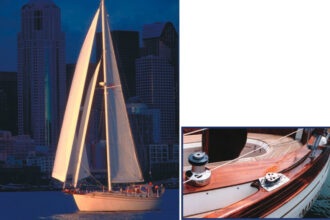
With Marcia at the helm and Swede trimming the sails, Drifter cut a fine figure, showing her capability on all points of sail and highlighting her bright new roll-and-tip topsides paint job.
To say that this boat was responsive in the 12-knot breeze would be an understatement. Minor adjustments in sail trim produced palpable speed gains and the feel of the helm was sensitive but not overly so. Drifter did very well on all points of sail, saving her best for a reach or close reach where the comparatively flat underbody comes into play.
Because of the fairly flat bottom sections, there might be some pounding when beating into heavy seas. That is not to imply that the Ranger 33 doesn’t go to weather well. It has a relatively narrow beam, and needs its generous ballast to help keep it on its feet. When sailed “on her ear,” Drifter developed a fair amount of weather helm. Easing the main helped balance the helm and improved windward performance. This boat can be sailed to 35 degrees apparent wind and perhaps slightly higher, but any crew racing a Ranger 33 will need to watch velocity made good (VMG) on windward legs. That’s because footing off a bit will result in a noticeable speed increase that might just get them to the mark more quickly.
When the sails are eased and the Ranger 33 bears off onto a reach, it surges ahead with authority. It will sail deep downwind courses, but if powered up a bit and taken on a broad reach, it will likely reach that leeward mark at least as quickly as a sister ship sailed wing-and-wing. A spinnaker would add power and make a deeper course more efficient.
The Ranger 33 has the seaworthiness and accommodations to serve as a good coastal cruiser and some have performed well and safely on offshore passages. Many Ranger 33 owners race their boats, and that is understandable. With a PHRF rating of 150, the boat is very competitive. On San Francisco Bay, a C&C 33 of similar vintage carries the same 150 rating and the Tartan 33 standard rig rates 156.
Price and availability
In early 2011, at least nine Ranger 33s were available for purchase in North America. The asking prices ranged from a high of $26,000 to a low of $15,000, with the average price near $20,800. The information available on the lowest-priced boats showed them to be in need of significant and very basic maintenance; the boats in the higher range appeared to be well tended.
Tom Wells and his wife, Sandy, own and sail a 1979 Tartan 37, Higher Porpoise. They have been sailing together since the 1970s and look forward to cruising upon retirement. Tom’s musical contributions at the Annapolis boat show have earned him the title of Troubadour with Good Old Boat.
Thank you to Sailrite Enterprises, Inc., for providing free access to back issues of Good Old Boat through intellectual property rights. Sailrite.com