An example of innovative French style
Issue 79: July/Aug 2011
French naval architect Michel Dufour began designing yachts in the 1960s. Perhaps his best-known design is the elegant Arpège (1966), a 30-footer that performed well offshore and offered chic accommodations below. The 27-foot Safari (1969) followed, along with the Dufour 41 (1970) and the Dufour 35 (1971). In 1973, the Dufour yard built more than 600 boats, making it one of the largest production boatbuilders in the world. There followed a lull in exports to the U.S., but by the late 1990s Dufour Yachts had acquired the Dynamique and the well-known Gib’Sea brands and had resumed exports to this country. In addition to innovations in design, the Dufour approach included the extensive use of structural inner liners or pans that cover the sides of the hull and also form the cabin sole and furniture.
I remember the Dufour 27 from my sailing days in the United Kingdom during the 1970s and ’80s. Compared with tried and proven British designs — such as the venerable Westerlys, Macwesters, and Kingfishers — the Dufour 27 seemed to offer a departure from the commonplace and suggested the future of yacht design. There was something about the boat that earned a second glance.
Design
The Dufour 27 has a raised flush deck — well, almost. Some have termed it “semi-flush.” A benefit of this configuration is relatively wide sidedecks. The almost-flat sheerline is enhanced by a heavy aluminum extrusion that covers the hull-to-deck joint. Freeboard is unusually high, which results in a healthy reserve buoyancy but makes windage a concern.
The companionway hatch slides into a raised deckhouse that continues just beyond the mast. From some angles the hull looks as if the builders forgot the portlights. A closer inspection reveals that there are indeed portlights port and starboard . . . in the topsides. All this angling and tiering eases the appearance of the vertical bulk of the topsides.
The Dufour 27 has a raked and slightly concave stem and a reverse transom. The rudder is fitted to a deep and narrow skeg. The 1-ton iron keel is a swept-back parallelogram that’s narrow in thickness at the top and widens toward the base. It was offered in both a 5-foot 2-inch depth and a deeper version that drew 6 feet — unusual for a boat with a 20-foot 4-inch LWL. Like many boats built for sailing along European coastlines, where extreme tides mean deep water becomes thin very quickly, provision is made for the use of adjustable “sheer legs” that can extend from either side of the hull amidships to allow the boat to lie more or less upright when taking the ground.
Construction
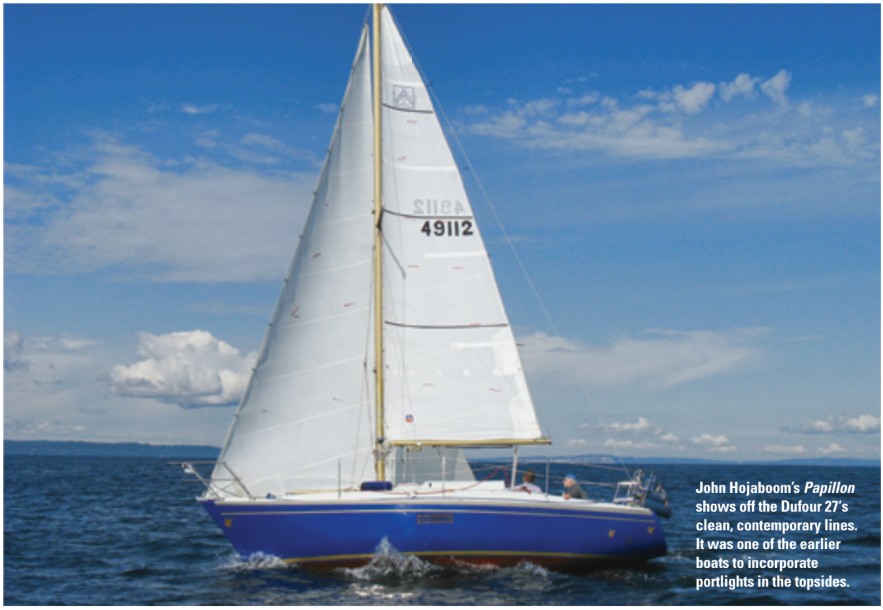
Production of the Dufour 27 began in 1974. Our review boat, Papillon, owned by John Hojaboom, is #314, launched in 1975. The hull is hand laminated with alternating layers of woven roving and mat. The deck is fiberglass cored with either balsa or polyurethane foam. Solid wood blocks are substituted where necessary to back up the generally robust deck hardware. Stainless-steel backing plates are used in mounting the genoa tracks and mainsheet traveler.
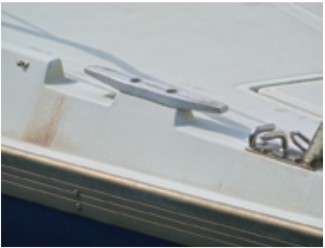
The large rubrail that covers the joint between hull and deck moldings was offered in teak or extruded and anodized aluminum. Papillon’s is aluminum and John had it removed recently for inspection. Aside from the bonding sealant, little could be seen of how the hull and deck were fastened together. A visual inspection inside the boat revealed the whole assembly to be covered by fiberglass and all seemed tight and secure. There has been no distortion or leakage at the joint.
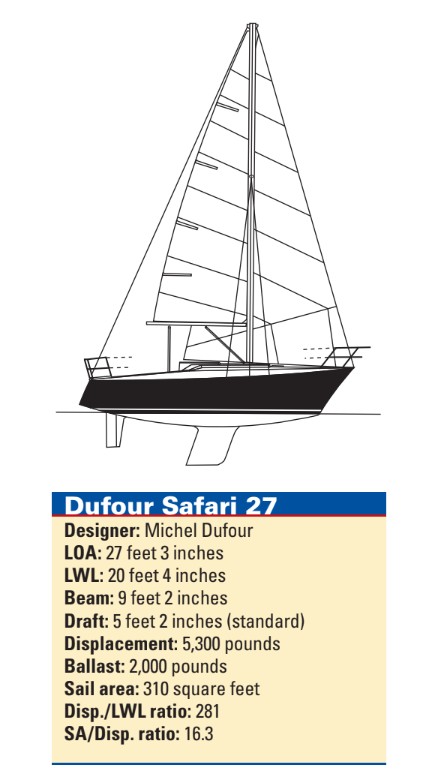
The 2,000-pound bulb keel is secured to the hull by 12 1/2-inch stainless-steel bolts and covered with fiberglass. Some owners report slight periodic leakage at the joint; a survey should reveal any serious damage.
The berth foundations and other furniture are incorporated in the fiberglass interior pan molding. Another molding forms the overhead, cabin sides, and supports for handrails and light fixtures, making it impossible to tab the bulkheads to the underside of the deck.
Generally, the Dufour 27 appears to be well built, although 35 years of hard use can take its toll. For instance, John intends to stiffen (i.e., rebuild) the weakened hatch covers in the cockpit that show the strain of years of people jumping onto them from the raised deck. Papillon’s plastic deck hatches and portlights are crazed and should be replaced. Apart from these two examples of wear, her hull seems to be in fine shape.
On deck
Papillon’s deck is clean and workmanlike. There is no dodger. John prefers working with halyards at the mast to eliminate the hazards of stepping on lines led back to the cockpit. He also eschews roller-furling gear, preferring to bend on and change headsails and maintain a familiarity with the foredeck. The molded-in non-skid is about average for grip. As a member of the Edmonds, Washington, Corinthian Yacht Club, John does a combination of racing and cruising and singlehands frequently.
For trimming sails, Papillon has two Lewmar 25 sheet winches and a small Enkes winch for the spinnaker. Another Enkes works the outhaul. All are single speed.
An anchor locker at the bow provides stowage for a 25-pound CQR, 20 feet of chain, and 150 feet of 1/2-inch nylon rode. A handy notch in the forward end of the hatch makes it possible to pay out the anchor tackle with the hatch closed. This provides good footing for the crew during the process. The 24-inch-high lifeline stanchions are seated in molded sockets and, together with their lifelines, are easily removable.
Four or five people can sit in close company in the cockpit, and the benches are long enough for two 6-footers to stretch out for a nap. Seats are a comfortable height above the sole and backs are high enough and angled just about right. The distance between benches provides good foot support for the helmsman when hard on the wind and heeling. A narrow bridge deck raises the companionway sill, stiffens the deck structure, and serves as a mounting base for the mainsheet traveler.
Cockpit storage is outstanding, about as big as I’ve seen in a boat of this length. The starboard under-seat storage is huge, with room for a well-packed inflatable boat. The port-side locker gives away some space to a hanging locker belowdecks but still provides good stowage as well as access to the 13-gallon fuel tank. The deep lazarette abaft the tiller allows inspection of the rudder stock, deck fill, fuel line, manual and electric bilge pumps, and cockpit-drain through-hulls. It also provides stowage for a Danforth anchor.
The rig
The Dufour 27 is a masthead sloop. Standing rigging consists of a forestay and backstay, upper shrouds, plus forward and aft lower shrouds. There is a tension-adjustment wheel on the backstay.
When it came time for new sails, John had a new mainsail cut with a slightly more pronounced roach in order to get a little more area. He also added full-length battens. The slight shift in the center of effort hasn’t affected the boat’s balance. Sailing with a 150 percent genoa and spinnaker, John reports all-around improved performance. It’s true: new sails make a huge difference in performance.
Belowdecks
Although it’s neatly contained and saves space, I found the companionway ladder on the Dufour 27 too vertical and the treads a bit too narrow for an easy drop onto the cabin sole. John says it just takes some getting used to.
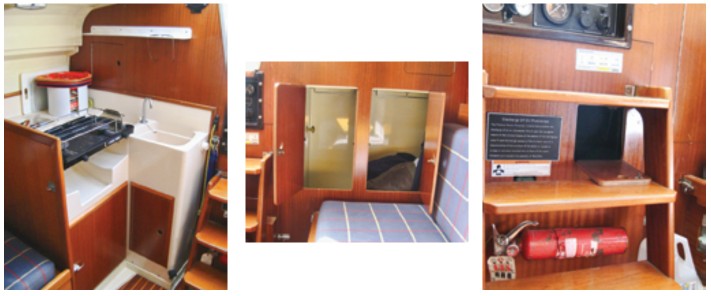
The small galley is located to starboard of the ladder where there is about 6 feet 2 inches of headroom under the companionway slide. John replaced the original alcohol stove with a two-burner propane unit. This is located within the inner pan molding that also forms the icebox and an integral sink served by a foot pump. A door below the sink provides access to galley storage. The icebox is large, about 7 cubic feet, and unusual in design. Ice is dropped into a special hatch at the back, separate from the icebox itself. A nice French touch is the two deep built-in wells at the back for keeping white wine chilled.
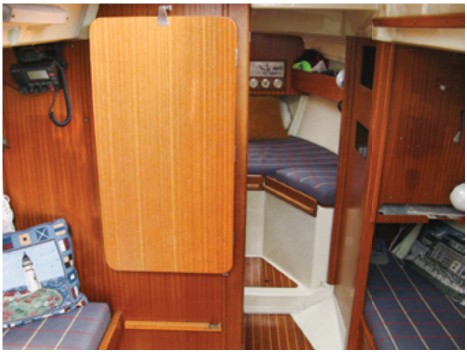
Moving forward, headroom drops to just under 6 feet in the saloon. The starboard settee berth lies forward of the galley. Its foot is located under a hanging closet in the forward cabin. There’s a slot above this opening for chart storage. Lifting the mattress reveals storage that includes two more wells, a good place for a couple of bottles of Bordeaux.
Opposite, on the port side of the saloon, a settee berth extends between the companionway and head bulkheads. This berth converts to a double when the table is stowed against the bulkhead. When lowered, the table has a leaf that opens to serve four or five comfortably. A large translucent hatch lights the saloon and provides ventilation. Starting and house batteries are located under the port berth.
The settee backs are high and comfortable with the topside portlights affording good views out from the sitting position. Overhead handrails run along the length of the saloon. The sole is teak-and-holly-veneered plywood with hatches to access the bilge.
The head compartment is very tight. The Dufour 27 was originally delivered with a manual marine head but Papillon has been refitted with a portable toilet. There’s a small swing-out sink. Opposite to starboard, a hanging locker provides the kind of minimal storage to be expected in a 27-footer.
In the forward cabin, headroom is about 5 feet 9 inches and the berths are about 6 feet long. A 24-gallon freshwater tank is located below the berths alongside considerable bulk storage. A small deck hatch lets in light and air through a translucent insert.
The general ambience of the Dufour 27 belowdecks is somewhere between a traditional interior and something a little different. The absence of conventionally located portlights in cabin sides might bother some people, but the design made sense to me and I appreciated having eye-level views from a sitting position. This feature, a novelty in the ’70s, has become a common and accepted arrangement. The translucent overhead hatches provide plenty of light in the interior, which has a good balance between teak paneling, the teak-and-holly sole, and areas of white gelcoat.
In addition to the under-berth stowage, there are fiddled shelves for books and miscellaneous gear in the saloon and forward cabin.
The engine
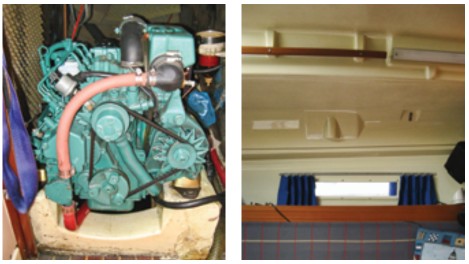
Papillon was originally powered by a 10-hp Volvo Penta single-cylinder diesel. This was replaced by an 18-hp 3-cylinder Volvo Penta. At the same time, John replaced the 2-bladed folding prop with a 2-bladed fixed prop. To access the engine compartment it’s necessary to remove the companionway steps and then the panel in line with the main bulkhead. The crankcase-oil dipstick and filler are right in front along with the water pump and other engine accessories, like the primary fuel filter, that require regular attention. Access to the oil filter is via the starboard cockpit locker.
In the event of an engine-room fire, a small and cleverly located door under the first companionway step allows a fire extinguisher to be directed at the engine while letting in a minimal amount of oxygen. A fire extinguisher is conveniently placed below the second step.
John is pleased with the performance of the new 3-cylinder engine and fixed 2-bladed prop in handling adverse currents found in the many passages winding through his summer cruising grounds.
Under way
John backed out of the slip smartly, then I took us out of the marina while he attended to the fenders, mooring lines, and sails. The engine was quiet and the tiller steering precise. Just outside the breakwater, John hoisted the sails and we were off in about 10 to 12 knots of wind and smooth seas. We managed the wakes of ferries and large powerboats with little fuss.
Dufour 27 owners differ in how they assess the boat’s speed under sail. John confessed that, compared with that of other boats of her size, Papillon’s performance is often disappointing. Be that as it may, I found her sprightly, with good acceleration. She came about smartly with little loss of speed. She was extremely well balanced and light on the helm even in the gusts, with no sign of weather helm. Once we were farther into Puget Sound, we encountered a light chop, but the boat was steady on the helm, holding her course well and taking large wakes in her stride. John reports he’s taken water over the rail only on the more dire occasions when high winds were combined with freighter wakes.
Close-hauled, Papillon pointed very close to the wind without slowing down — a product, perhaps, of that deep fin keel and those fine new sails. She steered herself; too much movement of the tiller merely slowed her. With sheets eased, she stood up and purred right along.
Without a dodger, visibility was excellent, although in the congestion of that Saturday morning’s Salmon Derby, ferry traffic, and power cruisers making upwards of 20 knots, I would have appreciated a window of sorts near the foot of the deck-sweeping genoa.
Conclusion
After 35 years, this good old boat is almost as good as ever. Her dockside appearance is still as remarkable as when she was new; the Dufour 27 is clearly not a 21st-century boat but still unusual enough to get a second glance. Owners can be proud of this boat and the resolute appearance that continues to confound those with preconceived ideas about where sheerlines, cabin sides, and portlights should be.
Cruising for more than a week may be difficult for less hardy crews but she will respond well to carefully organized provisioning. Her cockpit stowage is well above average and stowage below is adequate for a well-disciplined crew. The promise of speed suggested by her lines may not be entirely realized, but her well-balanced good behavior under way, deep keel, and snug sail plan will be appreciated at times when others are looking to tuck in another reef.
A search of the Internet shows Dufour 27s listed from $7,900 to $9,500 depending on condition.
Donna Paden has posted extensive information about her Dufour 27, Petite Cherie, on her website http://web.mac.com/donnapaden/Dufour_27 and I am indebted to her for the assistance she gave me as I was preparing this review.
Richard Smith, a contributing editor with Good Old Boat, is an architect. He specializes in designing and building very small houses and has built, restored, and maintained a wide variety of boats. These days, he and his wife, Beth, sail their Ericson Cruising 31, Kuma, on the reaches of Puget Sound.
Thank you to Sailrite Enterprises, Inc., for providing free access to back issues of Good Old Boat through intellectual property rights. Sailrite.com