A cruising family installs the Air Head
Issue 80 : Sept/Oct 2011
While debating a return to the continent after nearly six years in the Caribbean, we tried to imagine the changes that would force us to make in our lives. Since our first stop was to be a few months in Marathon, Florida, we narrowed our Internet search to the Florida Keys, and that’s where we first learned of their no-discharge laws.
No-discharge laws have been in place in the Great Lakes for years and many states are implementing similar laws. We recently read that North Carolina boaters are required to maintain a pump-out log, documenting timely pump-outs depending on the amount of time spent on board.
To ease (and verify) compliance in Marathon’s Boot Key Harbor, a pump-out boat makes its rounds and each boat is expected to give an appropriate donation from its holding tank. Boaters who fail to do so on a weekly basis are fined and can be expelled from the harbor. With the increase in regulations and enforcement, it was time for us to find a legal replacement for our bucket.
Aboard our 34-foot Creekmore, Eurisko, we had been using a bucket for five years, ever since we removed the marine head, holding tank, Y-valve, various hoses, fittings, and through-hulls, and fiberglassed over the two holes in the hull that had been left behind. Unwilling to lose all we had gained by such a change, we searched for an alternative. (A bucket has its advantages: less space required, no hoses to leak or smell, no through-hulls, no sharp hose clamps to scrape against as you clean, and, best of all, it needs no periodic rebuild.)
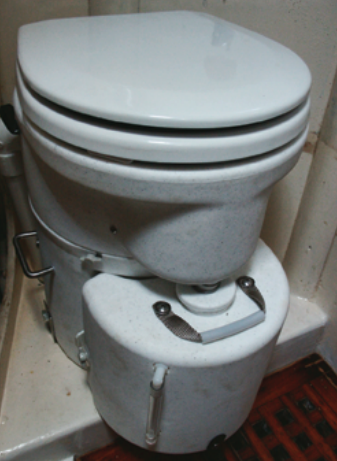
Our best alternative was an Air Head dry toilet. It meets all no-discharge laws without the space demands and fuss of holding tanks and pumpouts. We had investigated the Air Head when we switched to a bucket, but there were five of us on board at the time and we were told it would not compost as quickly as we could fill it. Now, with two boys in college, the Air Head was a more viable option.
Physical fit
Before ordering the toilet, we had to be sure it would fit in the designated space. On the company’s website, the Air Head toilet is shown to be 17 1⁄2 inches fore and aft, a bit less than 18 1⁄2 inches from side to side including the crank handle, and 19 1⁄4 inches tall. These dimensions do not tell the whole story, however. The crank handle (used to stir the compost) must have room for a complete revolution, the household-sized toilet seat sticks out the back an additional 2 inches, and there must be room for a fitting to attach the ventilation hose to the unit. Since space was an issue for us, we ordered (free) a handle that accommodates a 3⁄8-inch-drive ratcheting wrench handle, so very little room is required to “stir” a complete revolution.
We also requested a marine-sized toilet seat (free) to save the 2 inches in the back. When ordering, you must specify a right- or left-hand crank — that’s your right or left hand as you stand facing the Air Head. The exhaust hose will be on the side of the unit near the back, making it another variable to consider. The most difficult part of the entire process was paying for it: $1,100 with tax and shipping, including 5 extra feet of exhaust hose. But with so few moving parts and a 2-year warranty, we hope this is the last time we have to invest in a marine sanitation device.
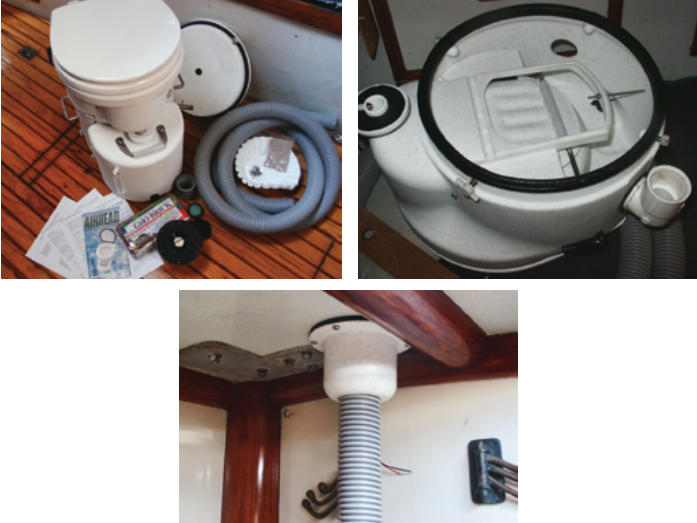
The Air Head arrived complete with the wrench-handle adapter and the marine-sized seat we had requested (including rubber gaskets on the seat and lid to decrease odor in the boat), 10 feet of exhaust hose, a rubber hose fitting, a 12-volt fan in a shroud, a removable liquids tank with cover, a lid for use when transporting the solids tank, mounting hardware, one block of coconut-fiber starter peat, a few tablespoons of enzymes, 50 bowl liners (we call these “deposit slips”), and instructions. I was disappointed by the fact that the exterior of the unit is textured, making it harder to clean. The folks at Air Head redeemed themselves, though, by making the inside of the bowl exceptionally smooth and very easy to keep clean.
Installation and priming
The Air Head can be installed easily in a few hours. The base is attached to two brackets that are screwed onto the platform where the head will sit. The rubber hose fitting attaches to the base of the head at one end and the exhaust fan at the other. We chose to attach the fan under the Dorade vent to avoid drilling another hole in the deck. My husband, Dave, connected the hose to the shroud around the fan and then attached the shroud to the headliner under the Dorade vent already in place.
If no Dorade is available, some sort of exterior vent or cover must be installed. The folks at Air Head recommend a passive vent, though you could also use a Nicro solar vent. So far, our installation in the Dorade has been sufficient. We keep the vent facing away from the wind so it does not counteract the fan. Total installation time was 8 hours, including two trips to the hardware store for parts that added $40 to the cost of the head.
We were then ready to prepare our Air Head for use. Following the instructions, we placed in the solids tank the coconut-fiber brick (as an alternative to peat moss) that had been provided, added 2 quarts of water, and let it sit overnight.
After it had absorbed the water, the coconut fiber was easy to stir with the crank handle. We learned to be sure to close the trapdoor to the solids tank (we call it the “deposit box”) because the stirring can fling the contents around a bit. Next, we stirred in the package of enzymes, also included. Additional enzymes must be added after each emptying of the tank. They are the same enzymes used for maintaining septic-system health and can be bought at hardware stores. One brand is Drain Care. The liquids tank is prepared for use after each emptying by pouring in 1⁄2 to 3⁄4 cup of sugar. This reduces the odor released during emptying.

Operating protocol
As with any marine head, when we have guests aboard we run a brief “toilet etiquette” class. Because the system works best when as little liquid as possible is put in the solids tank, we recommend that everyone sit. This has always been our rule offshore anyway; it is safest, cleanest, and ensures that liquids are kept separate.
When making a deposit, place a “deposit slip” (coffee filter) over the trapdoor, provide donation, depress the lever for the trapdoor, and the deposit falls in. Close the trapdoor and turn the handle to stir and bury the deposit in the compost. Alternatively, you can make a direct deposit with the trapdoor open, in which case no deposit slip is necessary. This is not recommended for liveaboards or for rough weather usage because it leaves the deposit box open too long. For weekend-only use, Air Head says toilet paper may be placed in the solids tank as the unit will have more time to compost. This is not recommended for liveaboards.
After a few days of use, or before leaving your boat for any length of time, empty the liquids bottle. A clear hose allows you to see the liquid level and gives you an idea of when it needs to be emptied. Unscrew the two attachments, slide the bottle out the front, attach the lid, and take it to any toilet to empty. The bottle is discreet and weighs only 12 pounds when full. Before reattaching it to the tank, rinse it with a little vinegar and hot water, then add the sugar.
Since the solids shrink as they decompose, the longer the contents stay in the deposit box the more times the head can be used before it needs to be emptied. Weekenders can make about 80 deposits, liveaboards about 60.
When the time comes to empty the tank, you have a few options. If the contents have been sitting for a minimum of three months, they will have completely composted and can be trenched into soil in most areas (but check local regulations). Otherwise, it’s perfectly legal to empty the contents into a trash bag and throw it away. It is also legal to empty the solids tank into a composting toilet, such as those often found at national parks. Offshore, the tank can be dumped over the side.
For liveaboards, whose tank contents will not be completely composted by the time the tank is full, a second solids tank is a good idea. Simply cap the full one and store it until everything has composted. It is 12 inches in diameter and 11 inches high.
Maintenance and recharging
After emptying the solids tank, don’t clean it. In the presence of the peat and with the airflow through the deposit box, non-odorous aerobic bacteria have grown and some of them will still be present in what remains in the tank. These are the good bacteria, as opposed to the stinky anaerobic bacteria. Urine inhibits all bacterial growth — another reason to be careful to keep it separate.
The bowl itself can be cleaned with any non-abrasive, non-chlorine, hard-surface cleaner. To ensure we do not introduce any cleaner into the deposit box and disrupt the growth of the good bacteria, we use cleaning wipes.
It is recommended that you clean the screen on the fan every few months. We have simply eliminated the screen since its purpose is to keep out bugs and we don’t have screens in our Dorades anyway. Removing it may also increase the airflow through the tank.
Other users of composting toilets have warned us that getting them “primed” is tricky, so we were not surprised by the smell wafting from the Dorade by day three. We thought maybe our “good” bacteria needed more time to grow, so we waited. Finally, after a week, I reread the instructions to see what we had done wrong.
“The more you use the unit the more moisture is in the solids tank,” they read. “Adding peat has a surprising drying effect. When in doubt, add more peat moss.”
As it turned out, although we had been provided with only one brick of peat, Air Head recommends liveaboards start with two. We purchased another brick, and within hours of adding it to the tank the smell was mostly eliminated. Peat can be purchased at most garden centers, but we prefer the coconut fibers from Air Head.
For weekenders, I would recommend the Air Head composting toilet without reservation. Liveaboards, however, must consider several factors before deciding if it is right for them.
How many people are on board? The folks at Air Head do not recommend full-time use for more than three people.
How strict are the laws where you sail? With the increase in regulations and their enforcement, a composting toilet may soon be the only option in some areas.
For the price, ease of installation, and peace of mind (being certain we are legal even in no-discharge zones), the Air Head composting toilet is, for us, the next best thing to a bucket.
Connie McBride , her husband, Dave, and their three sons set off on Eurisko, their 34-foot Creekmore cutter, in 2002 and have since spent most of their time cruising the Caribbean. Connie’s book, Simply Sailing: A Different Approach to a Life of Adventure, is available through Amazon.
Thank you to Sailrite Enterprises, Inc., for providing free access to back issues of Good Old Boat through intellectual property rights. Sailrite.com