. . . with two contemporary classic cruisers
Issue 80 : Sept/Oct 2011
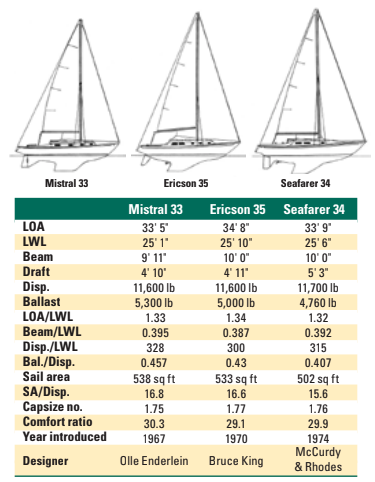
The Mistral 33, Ericson 35, and Seafarer 34 are classics by three top designers representing some of the best of a good era: the late 1960s and early 1970s. The boats are as alike as peas in a pod. A study of the numbers bears this out. It’s almost as if the designers were told to develop a yacht with a 25- to 26-foot waterline, 10-foot beam, moderate draft, and husky displacement. The differences are very slight indeed.
The Seafarer 34 appears to be a newer, fin-keel development of the original 3-foot 9-inch draft, keel-centerboard Seafarer 34 we featured in May 2008. However, major changes in the deckhouse, displacement, waterline length, underbody, and sail area make this a different yacht.
Performance of the three will be very close, as they are within a few inches of the same waterline length and beam and within a few pounds of the same displacement. The Seafarer has the lowest sail area but her slightly deeper draft and lower wetted area might give her an edge over the Mistral in all but the lightest air. The Ericson’s spade rudder helps reduce wetted area. She also sports a significant bustle that, combined with her good ballast ratio, could give her a slightly higher potential speed in a stiff breeze. It would be a close race. The final result would be decided, as it often is, by the the skipper, sails, weather conditions, and luck of the draw! Still, any of the three could provide a lot of fun in club competitions and also perform well as a comfortable and fast cruising yacht.
The droopy boom on the Ericson was not a slip of the drawing pen. It is a strange quirk of the old IOR rule that was, fortunately, amended a year or two later, so there’s no reason not to have the sail re-cut to normal proportions. The Seafarer and Mistral were both designed with single-spreader, deck-stepped spars with double lowers, and the Ericson with a deck-stepped, double-spreader rig with inboard shrouds and a single lower. Being old-fashioned, I prefer double lowers for cruising and a keel-stepped mast for bluewater voyaging. The latter has nothing to do with strength, as a properly designed deck-stepped spar is just as strong as a keel-stepped spar. My reasoning is that, if the mast is lost due to a rigging failure, the keel-stepped spar usually will have a stub left from which an emergency rig can be set. In the same situation, there is little hope of saving the deck-stepped mast before it beats a hole through the fiberglass. It must be cut away, leaving you with a low-speed motorboat.
That said, Marvin Creamer’s Globe Star, one of my Huromic 35s with a deck-stepped mast, was rolled 360 degrees in fierce seas between Tasmania and New Zealand and came upright with her mast and rig intact. She went on to round the Horn and complete her historic circumnavigation without the use of instruments. A sister ship rounded the Horn in both directions, solo, with no problems. So a yacht with a deck-stepped spar can be a true bluewater vessel, provided the designer did his job. I have no qualms in saying that the designers of these three boats produced strong masts and rigs. Given good workmanship and proper maintenance, these yachts will take you anywhere you want to cruise.
Their moderate draft and strong ballast ratios denote stiff hulls. Their capsize numbers of 1.75 to 1.77 indicate they will recover in good order from a knockdown and bring you home safely. They are a far cry from the capsize numbers of 2.0 to 2.10 and above of many modern, super-beamy, light-displacement yachts. Their comfort ratios are also reassuring. Modest beam and good displacement combine to produce a yacht that will have an easy motion in heavy weather. They’ll sail at a greater angle of heel than today’s chubby cruisers but they’ll scend more slowly in big seas and will not be as bouncy in beam seas or a steep chop.
These are three good old boats that combine performance, comfort, and safety in one package and their classic designs will bring approving nods from knowing sailors wherever they drop their hooks.
Ted Brewer is a contributing editor with Good Old Boat and a well-practiced and respected authority on the art of yacht design.
Thank you to Sailrite Enterprises, Inc., for providing free access to back issues of Good Old Boat through intellectual property rights. Sailrite.com