A Swedish classic is the retirement plan he can live on
Issue 80 : Sept/Oct 2011
When Stephen Thompson reached 50, he didn’t have a midlife crisis in the same way that most do. He didn’t buy a red Corvette or a motorcycle. Let’s just call it, instead, a midlife moment. A very active guy, he looked up one day and wondered what he could find to keep himself occupied in retirement.
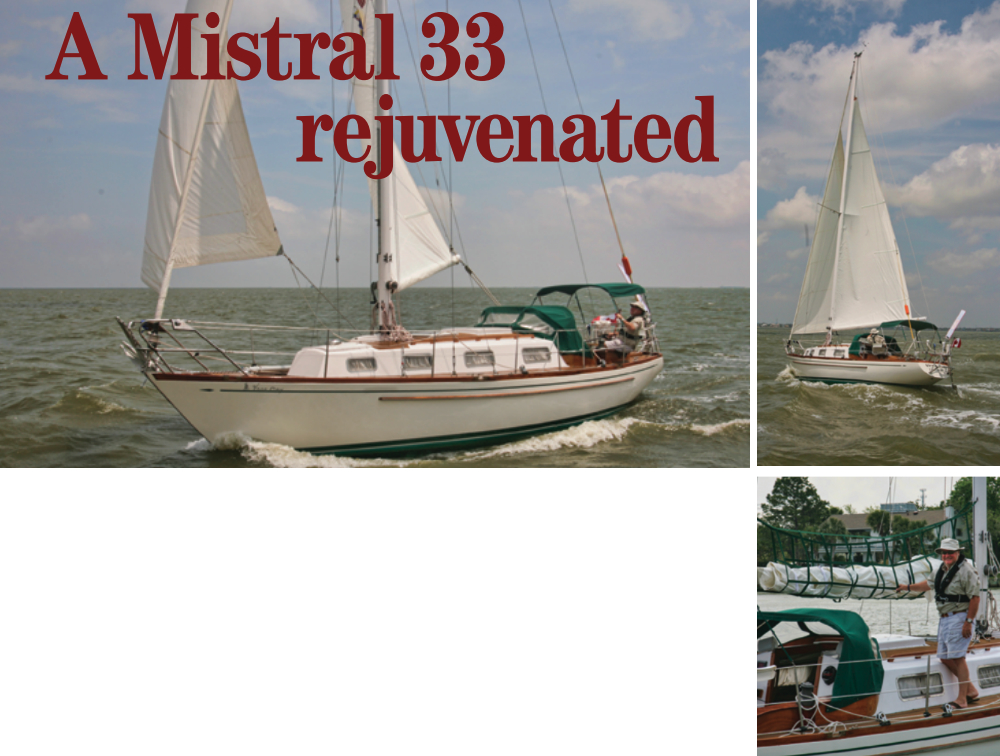
“I wanted a retirement project that would be challenging mentally and physically and be somewhat active,” Stephen says. The Cliff Notes version of the plan went something like this: “After I retire, I’m going to sail around the world.” The Vera May, a Mistral 33, is a key part of that “retirement plan.”
Stephen has not yet reached retirement age, but he has been following the plan for at least five years. He realized quickly that the longer version of this plan takes years of work and it starts with finding or building the boat.
Stephen says, “I figured I’d build a 44-footer. How do you build a 44-footer? You start developing your skills by building a 22-footer. How do you build a 22-footer? You build an 11-footer.” So he built an 11-foot Winsom Wherry and sailed it on Lake Wabamun near Edmonton, Alberta, where he was working at the time. That boat taught him quite a bit, not just as a builder but also as a sailor.
“It was lightning quick to respond. You had to know what you were doing,” Stephen says, then grins as he relates how he once spent most of an exhausting blustery afternoon righting the boat and bailing it out . . . only to be capsized again. When he noticed a fellow on a 23-footer having a much easier time of it, he knew he was ready for the next boat.
He did not build his 22-footer. Instead, he started casting about for plans for his ultimate cruising vessel. He was contemplating building a Sam Devlin design using a stitch-and-glue method, but it occurred to him that it would be difficult to turn the boat over once the hull was completed. So before committing to a building project, he took a look at what was available on the used-boat market.
A simple search for a boat no less than 30 feet in length and priced at no more than $15,000 brought a Mistral 33 to his attention. Perhaps he wouldn’t have to build his cruising sailboat after all . . .
These days, Stephen, a very capable and creative Canadian, lives in Houston, Texas. The Vera May followed and, over time he has disassembled, rebuilt, upgraded, tested, and modified everything aboard. But that’s the abridged version of their story.
A fiberglass wooden boat
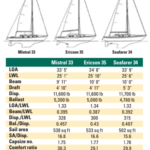
The Mistral 33 was built by Harry Hallberg of Hallberg-Rassy fame before the two companies merged in 1972. Stephen had located hull #15, built in 1970. Harry Hallberg began his career building the Swedish Folkboat and the King’s Cruiser, both of wood. (Note: For more on the Hallberg-Rassy company, see Good Old Boat’s January 2003 issue. –Eds.)
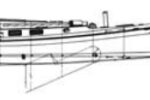
The Mistral was the first Hallberg yacht to be introduced in the U.S. An early Olle Enderlein design, the Mistral bears a striking resemblance to Olle’s personal boat at the time he designed the Mistral, but his boat was built of mahogany. Stephen points out that, due to the timing in the evolution of boat design from wood to fiberglass, the lines of the Mistral’s fiberglass hull are very similar to those seen in the wooden boats of the late 1960s.
Stephen offered $12,000 for his Mistral, which was located in Nova Scotia, a continent away from his home in Alberta. Relying only on photos and a survey, he made his offer and had his new baby shipped west. The survey said there was “some wood rot.” As was the case with many early experiments in fiberglass boatbuilding, the hull was built of fiberglass but the trunk cabin was built entirely of wood, and some of that wood was beyond repair. Stephen figured, “Fine, I can do woodwork.”
So the boat — that was to be named the Vera May after Stephen’s mother — came west to Alberta leaking snow and water through the hatches until she arrived with a 2-inch-deep ice-skating rink in the cabin. The decks were cored with Divinycell, now super-saturated by water that had been soaking through the holes in the teak decking for years. And the wood rot? That was “as advertised.” He could put his hand through parts of the cockpit coaming.
“What a disaster!” Stephen recalls. “But I didn’t see the disaster. I saw the potential: a beautiful and sound hull and a full rig.” A friend’s son wondered about his sanity, Stephen says. It was going to take a long time before he could impress the youngster with the value of deferred gratification.
Dismantle, then rebuild
Before he could move into the constructive phase, he first had to spend two years in Alberta in the destructive mode. “I gutted the boat,” he says. “This was a wooden boat with a fiberglass hull. I took the whole thing down to bare fiberglass and then sanded the interior of the hull.” Stephen removed the upper layer and core of the soaked deck, the entire trunk cabin (leaving just the overhead beams), and all the interior furniture.
“The whole interior was a jigsaw puzzle with furniture built of stick-and-glue construction,” he says, but adds that the furniture was very well made, so he cleaned, refinished, and rebuilt each piece. “The more I took it apart, the more I realized what a good pedigree I have here,” he says. “She has good bones. These guys knew what they were doing. So I put the interior right back together again the way they had it.”
Eventually, he reduced his new boat to a pile of small pieces. “I started to rebuild it,” Stephen recalls,” from the inside . . . one step at a time.”
At this point he learned one of the first big lessons of good old boats. “I realized you have to be careful when you read about what you “should do” in most sailing magazines that are writing about good new boats, rather than good old boats. Based on something I read in a magazine, I lined the inside of the hull with Kevlar from the bow to the companionway entrance for puncture resistance.” Later he realized the Mistral hull was plenty strong without the additional Kevlar layer.
An unexpected move
It was about this time that Stephen and his company’s investors decided his company really should have a presence in Houston, Texas, and that he was the one who should relocate.
Texas?! The Vera May was not much more than a fiberglass swimming pool. Big lesson number two, he soon learned, is that “building a boat is like a dream . . . as long as you don’t have a deadline.” But he was suddenly faced with a date for transporting his boat to Houston. Moving from one country to another is complicated enough. Moving your unfinished boat from one country to another takes it all to another level. The deck had a number of spongy spots, and the trunk cabin was open to the elements. These structural items had to be addressed before the boat could be moved.
“The hull is solid fiberglass,” he says. “But the deck was cored with Divinycell. A previous owner had removed the teak deck surfacing but had not completely sealed all the screw holes. I didn’t want a spongy deck. So the upper fiberglass surface of the deck had to be cut away and the saturated core material had to be removed. I then epoxied new Divinycell material into the core and rebuilt the upper layer with multiple layers of fiberglass cloth and woven roving.” He rebuilt the trunk cabin using the original pieces as templates and mating everything to the existing fiberglass flanges of the deck and interior bulkheads. Then he covered the framed structure with two layers of plywood to seal it for transport. Fiberglass and other finishing work would have to wait until she was settled in Houston.
In spite of the complications in need of creative solutions, Stephen got the boat sealed in time for her second cross-continent ride in less than a decade. The Vera May is one very well traveled boat. Once she was settled in a warehouse in Texas, the rebuilding of the Vera May resumed.
Decisions made, and made again
As typically happens when rebuilding a sailboat, there was an unforeseen battle. Stephen’s was with the flat portlights that didn’t conform to the curve of the Vera May’s trunk cabin. He had a choice: build up the surface at the ends to shim the portlights, or recess the middle portions of the portlight frames into the sides of the cabin trunk. After a great deal of head scratching, Stephen chose the second alternative, and installed the ports so you’ll never notice they don’t fit exactly flush from middle to end.
Consider this: in a warehouse you are rebuilding a boat that you have yet to sail. You would like to launch this boat someday and soon afterward sail around the world. As a single fellow, you’re likely to do your circumnavigation singlehanded, so all systems should be arranged for simplicity and convenient access. Before you even cruise short distances with this boat, your job is to figure out what to install and what is unnecessary for offshore cruising.
Sometimes Stephen installed something and then had second thoughts and removed or modified it. The most telling of these stories is the beautiful binnacle mount he built for the wheel. He wrote about this work of art in our July 2009 issue. Imagine our surprise when we learned that he’d removed the wheel altogether and replaced it with a tiller . . . for perfectly logical reasons.
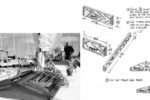
If the name Stephen Thompson rings a bell in your subconscious mind, it’s because quite a few of his articles about the restoration of the Vera May have appeared in Good Old Boat. In addition to the article about the binnacle mount, he wrote: “Matching New Wood to Old,” in March 2008, about a cool process to match stain; “Some Like it Hot,” September 2008, telling how a heated chisel can ease the removal of sealant; Adapting Flanged Seacocks,” in November 2009, about replacing bronze gate valves; “A New Classic Toerail,” in March 2011, about replacing the rotten toerail; and “Classy Cable Clamps,” in May 2011, about easily manufactured wooden clamps to keep wires in place.
A lifetime of skills
“I spent 40 years of my life learning skills that I never realized would apply in my boatbuilding,” Stephen says. “This is the culmination of all those skills: design, project planning, woodworking, working with epoxy and fiberglass, sewing, painting, installing mechanical and electrical systems, not to mention marching ahead in blind faith!”
“It was a very enjoyable time. I spent weeknights researching,” Stephen says, “and weekends building.” And he would do it all over again in a heartbeat. “It’s much more fun doing it yourself,” he reports, “than buying a new boat.”
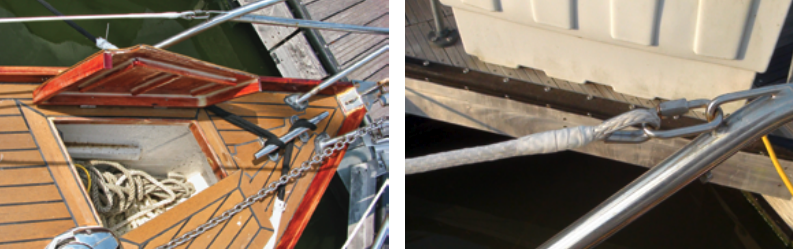
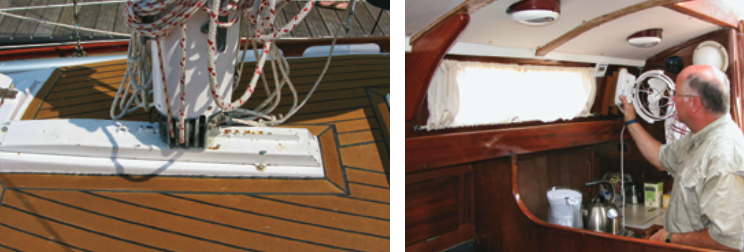
The following is just a short list of the things Stephen has done for the Vera May in five years. He has sewn a new mainsail, 135 genoa, and storm trysail, modified two existing sails for roller furling, and built new Sunbrella bags and covers to go with them. He’s about to re-cover the interior cushions with a fabric selected by “the ladies of pier 18 at Waterford Harbor,” as he refers to boat neighbors Nancy and Kelly. He rebuilt the deck, toerails, and trunk cabin. He put an anchor locker in the bow, complete with electric winch, and reconfigured the plumbing and holding tanks. He rewired the boat. He replaced the Bimini covering with new Sunbrella using the original tattered pieces as templates, and will soon be modifying the design of the dodger to provide more shade from the Texas sun. He replaced the old 23-hp Volvo MD11C with a new 30-hp Volvo Penta D1-30. He resurfaced the entire deck and working areas of the cabintop with TekDek synthetic teak.
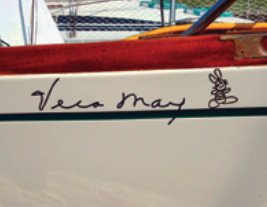
In addition, he is building a new 9-foot nesting dinghy using a stitch-and-glue method. He upgraded the navigation station with a Garmin chart plotter, GPS, and XM weather equipment. He installed new standing rigging with heavier turnbuckles and added a new roller-furling unit for the jib. He added a Monitor windvane, customized just for the Vera May to preserve his mother’s signature rabbit logo that he had already added on the transom. He’s also considering a conversion from the original roller reefing to slab reefing and notes that modifying the mainsail is no big thing when you made it yourself in the first place. “That Sailrite Ultrafeed sewing machine has paid for itself a number of times!” Stephen says.
“Once you’ve done it, you’re absolutely fearless about cutting holes in the boat. However, I don’t want many of those below the waterline,” he concludes, then adds with a wicked grin, “I’m going to butcher the V-berth next. I think I can tailor a twin-sized memory-foam mattress from IKEA with an electric bread knife and make what was basically a sail storage area into a proper cabin, complete with a clothes dresser!”
A plan on track
In spite of the many tasks and occasional setbacks, the Vera May was not destined to be a 20-year-project. She was launched in August 2010.
Now that she’s floating, Stephen is somewhat distracted by the fun he’s having sailing, but the work continues apace. As a tinkerer who thinks outside the box, Stephen has replaced the vinyl-covered wire-cable lifelines with Endura 12 single-braid core protected by a Dyneema anti-chafing sleeve. Everywhere you look aboard are little creative touches that come with time spent aboard: a multi-directional fan that has mounting spots all over the cabin, a clever magnetized light that can cling to the Bimini, a miniature tiller below the aft deck with lines to act as rudder stops, even a removable mainsail catch net (in lieu of lazy-jacks) to work with the boat’s original roller-reefing system.
Retirement will come in another four years or so. Stephen is likely to do exactly what he planned at age 50. When that happens, we expect to receive articles about his creative innovations from far-flung destinations.
Karen Larson is the editor and co-founder, with her husband, Jerry Powlas, of Good Old Boat. She is often amazed at the stories related by others similary afflicted with oldboatitis and hopes the magazine helps them recognize the condition as normal.
Thank you to Sailrite Enterprises, Inc., for providing free access to back issues of Good Old Boat through intellectual property rights. Sailrite.com