It’s invisible, insidious, and destructive
Issue 83: March/April 2012
Everyone today knows we shouldn’t go out in the sun without wearing adequate protection, but it wasn’t always so. Noel Coward wrote a song, “Mad Dogs and Englishmen go out in the Midday Sun,” about the English habit of ignoring the customs of native inhabitants of Southeast Asia and other tropical places who took cover from the sun at the time of day when its rays are harshest.
Opinions abound concerning the bad effects of the ultraviolet (UV) component of sunlight and how we should protect ourselves from exposure to it. We should expand this concept to include our good old boats. UV is a hungry destroyer of all things under the sun.
Aboard our sailboats, many items critical to their operation and to our comfort are subject to UV degradation. It’s our job to find them and replace them with parts made from less vulnerable materials, or simply replace them within a reasonable time frame with parts made of similar materials. First, it’s useful to know what UV is and how it affects us.
A, B, and C, of UV
UV light is electromagnetic radiation with a wavelength shorter than that of visible light but longer than that of X-rays. It gets its name because it has a frequency higher than that of violet light, the highest frequency that is visible to humans.
Three types of commonly classified ultraviolet light — UVA, UVB, and UVC — all originate from the sun and are harmful, but each has some useful characteristics.
UVA, commonly referred to as black light, has a wavelength range of 400 to 315 nanometers (nm). Your dentist uses UVA to harden the epoxy when he fills your teeth, and police find it helpful when they are looking for fingerprints.
UVB, which is in the wavelength range of 315 to 280 nm, is the one that causes sunburn.
UVC, in the wavelength range of 280 to 100 nm, is germicidal. It is used to disinfect milk and has other specific and useful applications.
Even though 97.5 percent of the UV that originates from the sun is absorbed by the earth’s atmosphere, enough UV reaches the earth’s surface to be harmful.
Susceptible parts
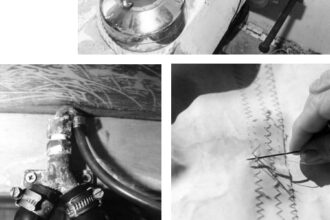
We’ve all been warned by dermatologists to protect ourselves with UV-resistant clothing and lotions, but what about our good old boats? They too are affected by UV and have no sunscreen. Everything aboard — hoses, tanks, through-hull fittings, lines, fabric, thread, and plastic moldings — is subject to long-term degradation by UV. Even reflected UV is damaging over time. Just as a person sitting under an awning at the seashore will get suntanned, our equipment will be made brittle by reflected ultraviolet light.
Some of the materials most susceptible to UV damage are sail stitching, lines, trailer hold-downs, and fabrics. My grandson put his weight on a trailer hold-down recently. What should have been a 2,000-pound-test hold-down parted under his 40-pound weight. Sailcovers and UV strips on roller-furling jibs are put in place specifically to protect the sailcloth from UV degradation. Conventional polyester thread lasts between three and five years in the southern U.S. Sailmakers ask for a premium to provide UV-resistant stitching, but this additional expense will extend the life of the stitching to between five and 10 years. The manufacturer of Sunbrella says the material will last approximately 10 years in constant use but — with care and UV protection — I’ve had a sailcover last up to 12 years. In today’s competitive racing world, running rigging is evaluated based on UV-resistance — as well as stretch, strength, and so on — as a prime factor for success.
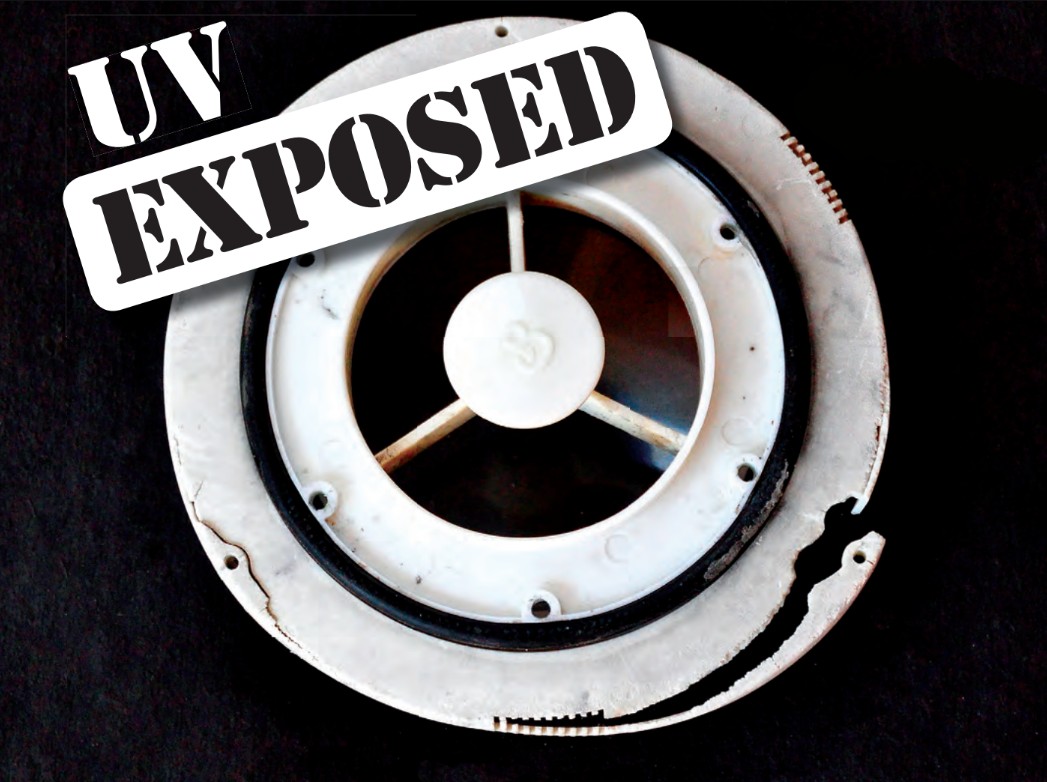
Other items to protect and check for degradation are plastic portlights, which become brittle with age and crack, and plastic through-hulls above the waterline that are exposed to sunlight. Just a note: plastic through-hulls should never be used below the waterline unless they are made of Marelon, a fiberglass-reinforced polymer designed specifically for the purpose.
Even parts that are not exposed directly to UV can be impaired. My sailboat had a plastic holding tank under the V-berth. While it was not directly exposed to sunlight, the plastic had become so brittle that, when I tried to remove it, the fill fitting broke in my hand. The deck pumpout valve had been fully exposed to UV and also had deteriorated.
While you can’t put sunscreen lotion on a plastic fitting, you can remove a plastic through-hull and substitute a bronze through-hull or replace a plastic fill pipe with a stainless-steel one. Develop a list of the types and locations of all of the questionable fittings on your boat then, in an orderly manner, visually check and replace them as needed. Waiting until they fail could prove disastrous.
While you are compiling the list and inspecting the fittings, running rigging, sails, and so on, be sure to wear a hat and appropriate sunscreen to protect yourself from UV. This is vital for your enjoyment of your sailboat and your enjoyment of life.
Bill Sandifer started sailing at age 8 or 9, and through high school and college taught sailing at Sagamore Yacht Club in Oyster Bay, New York. He has cruised the Far East, the Mediterranean, and the East Coast of the U.S. and has had a boatbuilding business. Bill and his wife, Genie, currently sail an Eastward Ho 31 cruising sloop they’ve owned for 12 years.
Thank you to Sailrite Enterprises, Inc., for providing free access to back issues of Good Old Boat through intellectual property rights. Sailrite.com