. . . meets veterans designed for similar goals
Issue 83: March/April 2012
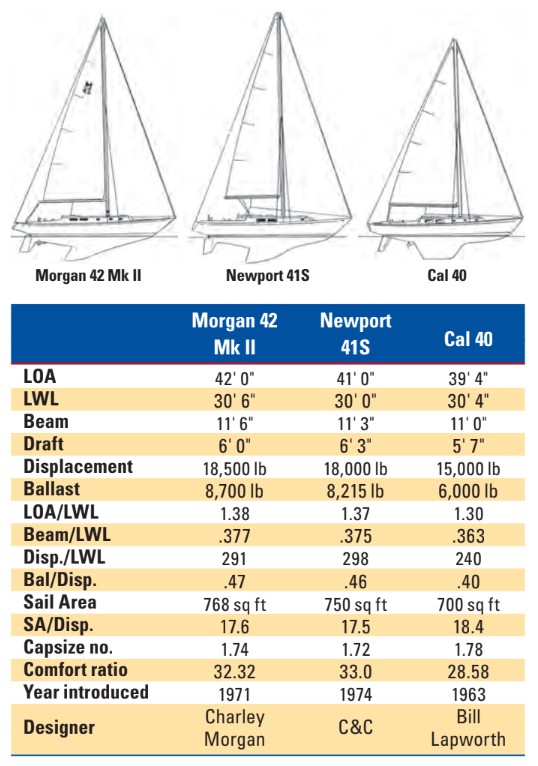
In this issue we have three 30-foot-waterline cruiser/racers, all designed originally for serious ocean racing with cruising as a sideline. It started in the mid-1960s with the Cal 40 as the first fin-keel/spade-rudder yacht on the ocean-racing scene since WW II.
Designed and built in California, the Lapworth Cal 40s naturally gained their first successes there. But the Pacific Ocean was not, of course, the stormy Atlantic and all that implied. East Coast designers and skippers knew you needed a real boat for the Atlantic . . . not a lightweight screamer but rather a boat that rated well under the Cruising Club of America (CCA) rule that emphasized husky displacement, a short waterline with long ends, and moderate sail area, often in a yawl rig.
But, eventually, a few Cal 40s were shipped east where they proved their mettle and won their share of silver over the best the East Coast had to offer. That opened up some eyes to the virtues of moderate displacement in a fin-keeled hull. As a result, East Coast sailors reluctantly gave up on the string of heavy keel/centerboard yawls that had begun with the famous Sparkman & Stephens 38-foot Finisterre in the late 1950s. Designers did an about face and started to create their own versions of fin-keel cruiser/racers, but that pesky CCA rating rule was still foremost in their minds. So, in order to obtain a favorable race-winning rating, most of the new fin-keel creations stuck to generous displacement on short waterlines, combined with moderate sail area.
The Morgan 42 and Newport 41 are typical of the East Coast designs of that era and are two of the better examples of the type. Their shark-style fins are a far cry from the trapezoidal fin of the Cal 40 but they proved to be strong competitors and did well under the CCA rule. Unfortunately, the first of the International Offshore Rule (IOR) races were run in 1970 and that rule started to become de rigueur for international competition. It was based on a combination of the old CCA and the British Royal Ocean Racing Club (RORC) rules and produced a new type of boat, but not a seaworthy type in my opinion. For a long coastal or offshore voyage, I would greatly prefer one of the three yachts in this review to any of the early IOR designs. The disastrous Fastnet Race in 1979, which resulted in the deaths of 15 competitors and the loss of a number of IOR sailboats, proved their weakness in heavy-weather conditions.
On the other hand, all three of our review yachts show a reassuring capsize figure and a good comfort ratio for their size. Indeed, when it comes to motion comfort, the Morgan and Newport are right up there with boats like the Valiant 40 and Whitby 42, and the Cal 40 is not too far behind. Their performance is a bit more difficult to estimate. The heavier Morgan and Newport, with their high ballast ratios, will show well when it breezes up, beating to weather rail down and plunging through the seas. The lighter Cal 40, with less ballast and stability, will have to reef down earlier on a windward beat but could still show her heels on a breezy reach and, with low wetted surface, should also do very well in lighter air.
Of course, these three yachts are no longer competitive against today’s crop of long-waterline, light-displacement, fin-keel, tall-rig racing machines. But they will still be fun to take out on a club race for an afternoon, a weekend, or a week. And, for coastal cruising or even bluewater voyages, their owners will not be disappointed with their stability, comfort, or performance. All three have proven themselves over the years, both racing and cruising, on both coasts, across the oceans, and in every condition of weather and seas. Better yet, when the voyage is over, all three are the type of yacht that, as you row ashore, you can look back at her and say to yourself, “She sure is handsome!”
Ted Brewer, is a Good Old Boat contributing editor. He began designing boats before the Cal 40 was launched and brings the lessons of his long and varied experience to these comparisons of good old sailboats.
Thank you to Sailrite Enterprises, Inc., for providing free access to back issues of Good Old Boat through intellectual property rights. Sailrite.com