. . . with two variations on the theme
Issue 82 : Jan/Feb 2012
Note: In an editorial snafu, we didn’t make it clear to Ted that the feature boat is a centerboard version of the Bristol 35.5 so his comparison boats are for the fixed-keel version. We expect we’ll see the centerboarder in a comparison article in the future. Ted notes that the deep-keel version would probably have the edge over the centerboard boat upwind, but the keel/ centerboard boat could prove slightly better reaching and running, particularly in softer breezes. –Eds.
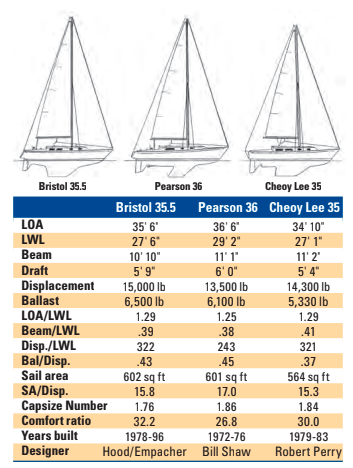
At times, selecting comparison boats can be a problem. For this issue, I chose three boats designed in the 1970s by three top designers to show that great minds do not always think alike. The Bristol 35.5 is a husky cruising auxiliary clearly designed with racing in mind. She has the earmarks of a true Down East boat with generous displacement, moderate sail area, and no condescension to the shoal draft considered so essential by the majority of sailors south of Maryland. She also has her propeller located in an aperture in the skeg, where it is less susceptible to the loving attention of the pot warps on the millions of lobster traps dotting northeastern waters.
Apparently Bill Shaw had similar thoughts when he gave the Pearson 36 a full 6-foot draft. Of course, many sailors like to feel their way into the quiet coves and anchorages that are forbidden to deep draft vessels. I, for one, would prefer the slightly shoaler draft on Bob Perry’s Cheoy Lee 35. It all depends on why you sail and where you cruise.
I have to admit that, as the designer, I always argued for the deepest draft my client would accept, as deeper draft contributes so much to weatherliness and reduced leeway. My arguments did not work in the case of one very experienced owner, however. He was a retired U.S. Navy Commander with years of experience cruising and racing on the East Coast and he insisted on a relatively shoal, 6-foot draft for his new 52-foot yawl. As he explained, “With 6-foot draft you stay outside the one-fathom mark on the charts and you know you’re safe. With 4-foot draft you can explore inside it and rip your bottom out on an unmarked rock.” A word to the wise!
Bill Shaw was thinking of racing when he designed the Pearson 36. She has the narrower stern that was coming into vogue with the IOR and of these three, having the deepest draft, the longest waterline, the lightest displacement, a high ballast ratio, and the highest sail area/displacement ratio of the group, she would be a tough contender indeed. Of course, the final result would depend, as usual, on how well she was handicapped under the rule and the skills of her crew. The Bristol and the Cheoy Lee appear to be on a more equal footing when it comes to performance in medium air, but the Bristol has some advantages in variable conditions: more sail area in light air and a higher ballast ratio for when it blows. A race around the buoys between the Bristol 35.5 and the Pearson 36 would be very interesting indeed and, I believe, a close one.
For general cruising, the heavier Bristol and Cheoy Lee seem to have the edge in motion comfort while their husky displacement should help them maintain speed on a long beat to windward in a steep chop. All three designs show good capsize screening numbers and can be considered highly capable of making long bluewater voyages. Even a Cape Horn rounding is not out of the question given good condition, equipment, sails, and an experienced crew with a taste for adventure.
I rarely comment on the interior layout but I much prefer the U-shaped galley of the Cheoy Lee to the L-shaped galleys in the others. That is a personal thing of course and, usually, the average male buyer will be guided by his better half when it comes to interior preferences. I also like the two pilot berths of the Bristol — the very best place to sleep at sea and great for a racing crew.
In any case, these are three fine yachts, capable of good performance for club racing and comfortable, safe, voyages for coastal and trans-ocean sailors. They will take you there and bring you back.
Ted Brewer is a Good Old Boat contributing editor. He is one of North America’s best-known yacht designers and his passion for his vocation shows in his writing as well as in his designs. Many of the boats he has designed over his career are now good and old . . . and still sailing.
Thank you to Sailrite Enterprises, Inc., for providing free access to back issues of Good Old Boat through intellectual property rights. Sailrite.com