In Bristol condition and a fine place to be
Issue 82 : Jan/Feb 2012
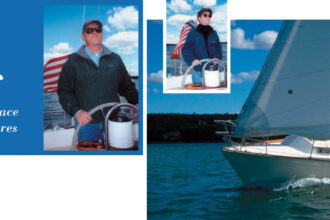
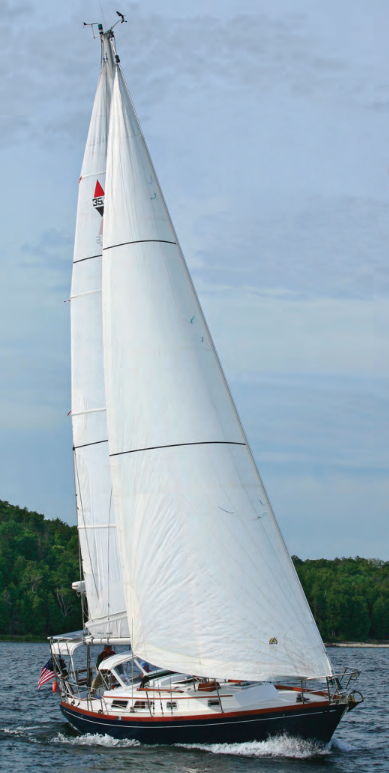
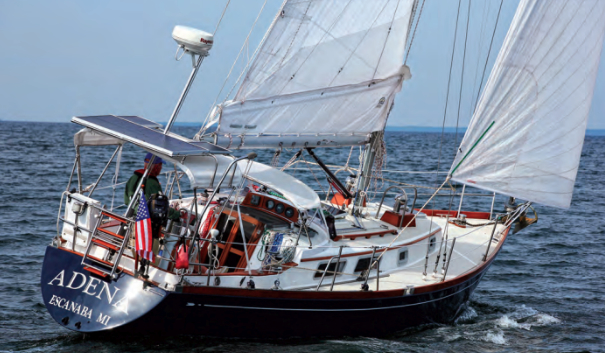
Her dark blue hull laid down to a building breeze funneling through the Mississagi Strait, one of three entrances to Ontario’s North Channel. Adena was on a roll, beam reaching in a 35-knot wind as if she were on rails. If Glen and Marilyn Kinsey Brown didn’t already know they had found the ideal boat, it was perfectly clear to them at that moment.
It’s a 150-nautical-mile trip across the tops of lakes Michigan and Huron from the Browns’ home port of Escanaba, Michigan, to the North Channel. But, like many other sailing couples, the Browns have become mesmerized by the incomparable beauty of this pristine cruising destination. It’s a trip they’ve made 10 times in the past 25 years . . . and in three different boats.
What made this sleigh ride all the more memorable was that they had never before been so comfortable while moving at such speed in a sailboat. To make the trip safely and comfortably, a strong and solid sea boat is best. The most northern reaches of these two Great Lakes can dish out all imaginable conditions. Glen and Marilyn had looked for two years before deciding on the 1989 Bristol 35.5, designed by Ted Hood.
Solid credentials
It would be difficult to appreciate the importance of this particular sailboat without reflecting on the long pedigree it inherited from its builder and its designer (see “Marblehead’s finest kind,” page 51). Clint Pearson, a pioneer in the building and marketing of fiberglass sailboats, founded Bristol Yachts in 1966. When the company filed for bankruptcy in 1997, it had built more than 4,000 boats. The 35.5 was built beginning in 1977 and more than 180 boats were completed before production ceased in 1997. Although a full-keel version of the 35.5 was offered, most were built with the centerboard configuration as buyers chose the limited draft for gunkholing.
The hand-laid-up hull is constructed of alternate layers of mat and woven roving. The deck is laid up of mat either side of a balsa core and is attached with stainless-steel fasteners to a 3-inch flange molded to the inside of the hull just below the sheer. The fiberglass centerboard is weighted with lead ballast and controlled by a stainless-steel cable led over bronze sheaves and through a stainless-steel tube to a reel winch located on the cabintop to port of the companionway. The balanced fiberglass rudder is molded around bronze plates welded to a bronze rudder stock supported by a bronze rudder shoe at the base of a partial skeg. During the 35.5’s production run, Bristol used several diesel engines for auxiliary power including Universal, Westerbeke, and Yanmar.
Ted Hood took delivery of one of the early Bristol 35.5 hulls for his own use. “We won quite a number of races right out of the box,” he told me, “and although she was a good sea boat, I remember my son Bobby, who was around six at the time, losing his lunch below while we were taking some huge head seas.”
Adena, hull #181, one of the last Bristol 35.5s, was built in 1989. Marilyn and Glen purchased her in 2004. Several years before, they had sold their Wauquiez Pretorien 35 and switched for seven years to a classic Jarvis Newman 46-foot lobster boat. “But we decided we really preferred sailing,” Marilyn says, “and we missed the chuckle when you turn off the engine and the wind fills the sails.” Both Glen and Marilyn had grown up in sailing families. The tradition continues with their children, Ian and Laura.

A careful search
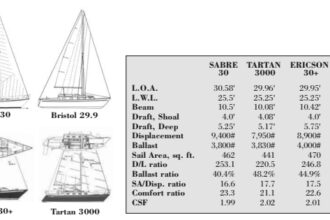
Before they began their search for a sailboat to buy, they prepared an extensive spreadsheet with more than 50 features they wanted in their next boat. The list covered everything from size to seaworthiness, draft, comfort, storage, interior layout, and cruising speed. They looked at centerboard models from Tartan and Sabre before remembering their good friends Jack and Pat Martin, who had a Bristol 35.5 across Green Bay in Wisconsin. It had just been sold.
The Browns contacted the Martins and discussed their 28 years of experience with the 35.5. As a result, they added the Bristol to their list of potential sailboats. Eventually, they settled on the Bristol 35.5 as the clear choice.
At the time, three of the boats were listed for sale across the country and they visited all three. They chose a boat in Charleston, South Carolina. Although the boat had been well cared for and had under 1,500 hours on the engine (a Yanmar 3GM30F), none of the key systems (hoses, plumbing, sails, or rigging) had been replaced or upgraded. They realized there was work to be done. It was July. They didn’t want to work in the heat and humidity of South Carolina, so the Browns had their new boat trucked to their home yard in Escanaba.
So they could launch their boat in Big Bay de Noc and enjoy what remained of the short sailing season, they wanted to complete a few jobs quickly. They replaced the engine exhaust hose and lubricated the seacocks (and attached softwood plugs to them all). They christened her Adena, a name derived from the Indian vernacular referring to Eden, or a wonderful place.
A slew of improvements
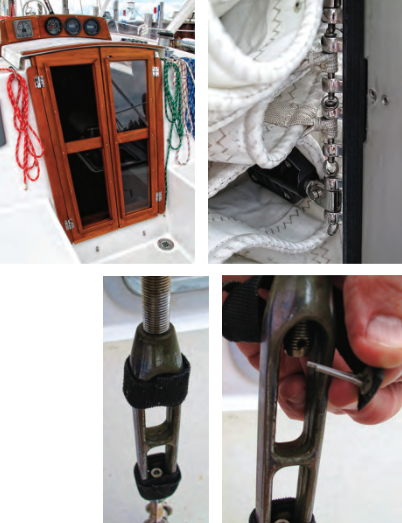
As they sailed their new boat into the fall, the maintenance/replacement list grew longer by the week. From the fall of 2004 through the spring of 2011, Marilyn and Glen completed more than 70 projects. Among them are new Doyle sails, running rigging, standing rigging, lifelines, traveler, anchors, and portlights. They also repaired the centerboard and fitted a feathering prop, custom companionway dropboards, new electronics, LED
lighting, solar panels with controllers, water heater, electronic cold-plate refrigeration . . . the list goes on and on. Capable do-it-yourselfers, the Browns took on the vast majority of repairs and installations themselves and have accomplished each task in accordance with the highest standards for yacht maintenance and installations.
Speaking of the original workmanship, Glen says, “There is no 35-foot production boat being built today that compares to this quality of construction and attention to design detail.” And it’s evident from an inspection of this high-quality Bristol that the Browns have applied a similar approach in all their upgrade and repair projects.
After five years of ownership, and the intimate knowledge an owner acquires only through hands-on involvement in so many upgrades, the Browns remain very enthusiastic about their Bristol. They believe this boat will take them through any conditions they are likely to encounter, thanks to her well-designed hull and her easily handled sail plan, which is made all the more manageable by a roller-furling genoa and a full-battened mainsail with single-line reefing and lazy-jacks. In addition, her draft of only 3 feet 9 inches with the board up allows them access to almost any anchorage. And with her low wetted surface, she performs well in light air.
Classic for her era
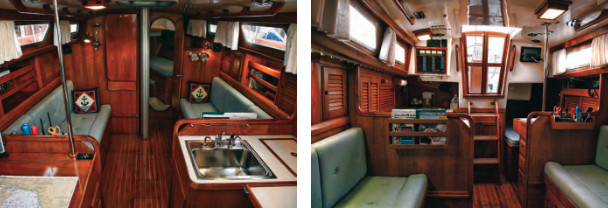
The ample interior of the Bristol 35.5 is laid out in the classic fashion with opposing settees in the saloon, a U-shaped galley to starboard, a navigation station and quarter berth to port, what must be one of the most comfortable V-berths in any boat, and a profusion of drawers and hinged-door cabinets that provide enough storage capacity for weeks of cruising. Glen also points out, “She’s so pretty that you can’t walk away without turning around for a final glance.”
The Browns are also quite honest about a few things a potential owner should understand before buying a 35.5. The cockpit is best described as a very efficient workspace for a crew of two or three, four in a pinch. Marilyn says about the boat, “It sleeps two, cruises three, and feeds four.” It does not have the space that a comparable modern design offers, but it is very secure and well laid out. Docking would be easier with a full-length rubrail. The boat is not easy to handle in reverse, although lowering the board a few inches makes a big difference. The engine installation is tight, so access to either side of the engine is difficult. In boats, as in life, there are always tradeoffs.
The Bristol 35.5 was a design success, an example of a high-quality production yacht and, with the able assistance of Glen and Marilyn, this 1989-vintage good old boat has clearly found a home in the new century.
Bill Jacobs has spent the last 48 years in sailboats and powerboats. He is a recognized marine photographer and has written for boating publications since 2004. Bill winters in Sarasota, Florida, and cruises on a Mainship 34. In the summer he can be found sailing his Cape Dory Typhoon on Lake Michigan off the shores of Door County, Wisconsin.
Thank you to Sailrite Enterprises, Inc., for providing free access to back issues of Good Old Boat through intellectual property rights. Sailrite.com