Coming to an anchorage near you
Issue 82 : Jan/Feb 2012
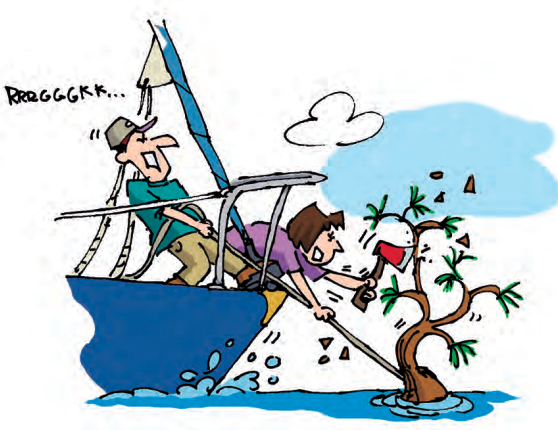
During a 2010 cruise to Barkley Sound on the west coast of Vancouver, we found ourselves anchored for two days in a tree. Not tied to a tree, but anchored in one. It held us tight in a tiny cove in the Stopper Islands. We only discovered the fat cedar when we hauled it up from the bottom. It was the first time we’d ever heard of anyone having to chop a tree off their anchor. That was when we learned what bow recoil looks like. Although it was a change from the usual ho-hum, “The anchor’s up!” we don’t recommend it.
The best thing about anchoring badly is the re-telling, which of course is generally done by spectators, not the spectatee. Since very few sailors, myself included, have not entertained a whole anchorage at some time or another with a “learning-curve moment,” I always feel a little tweak of empathy for the folks on another boat trying unsuccessfully to get a good bite, unless they are to windward of me . . . at which point they become nincompoops.
Anchored late one evening in a (thankfully) deserted bight behind Dungeness Spit near the Strait of Juan de Fuca, my partner, Jim, and I argued about whether we were dragging. We couldn’t be! Not with 200 feet of rode out in 20 feet of water! Besides, we’re experts! But we were dragging. A nice ball of gooey kelp and mud let our anchor slide over the bottom like a greased pig at a county fair. It was humbling.
Ready for prime time?
Once in a great while, someone puts on such a spectacular show that it makes me wish there was an ESPN channel for anchoring. I, who in my early days could have been a star, am going to pitch this idea to ESPN because they are literally missing the boat.
We’d sailed our Dana 24, Sockdolager, into Barkley Sound’s Effingham Bay, where we anchored after trying unsuccessfully to catch a fish for dinner. We were planning to cook fish and chips, but it’s pretty hard without fish, so we went for a hike before trying to figure out what to do with some leftover “effing ham.” While we were hiking, a large motor yacht anchored quite close to us in an otherwise empty bay. Returning to Sockdolager in the dinghy, I saw how close it was, heard the generator, smelled the exhaust, and uttered a string of salty epithets about big powerboats outnumbering the small sailboats and then anchoring on top of them. Why, those so-and-sos, now we have to listen to their generator all night, etcetera.
Jim was the epitome of wily patience. He noticed the motor yacht’s crew cleaning fish — lots of fish — on the stern deck, so he rowed us over there to ask them where they’d fished and what bait they’d used. The first thing they did was yell, “YOU WANT SOME HALIBUT?” Whoa! Things were looking up! We yelled of course we do, and they passed us a nice chunk, enough for fish and chips.
As we reached Sockdolager, I turned to Jim and said, “I guess they’re not so bad,” at which he guffawed, causing me to add, “Am I that cheaply bought off?” But stay with me, there’s more.
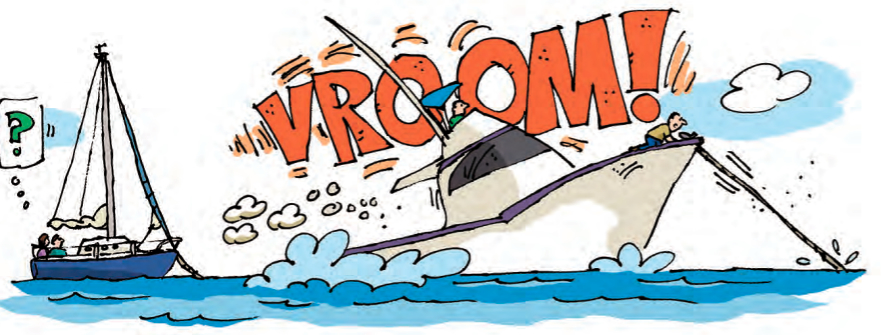
They were too close and they knew it. While dinner was cooking, we witnessed a feat of anchoring that can only be described as impossible to exaggerate. First we heard the twin VROOM! VROOM! of their big engines rumbling to life. Hooray, they’re moving!
But wait, nobody’s on deck and the anchor chain’s still down. The boat angled itself in an odd direction, stern away from us. Suddenly, DOUBLE LOUD VROOOOOM! Engines gunning in reverse, they dragged their entire anchor and chain 200 feet, going 7 or 8 knots across the bay stern first. The anchor jerked and tugged as if through rocky Jell-O. They finally idled the engines, but the boat’s momentum kept it racing astern until we thought they’d crash into shore. Just in time they stopped, close alongside a rocky reef. Grateful we were not in their way, we ate dinner with a weather eye out for their next move. Nobody could top that.
But someone did.
Put out more decibels
The next afternoon, we were on deck getting ready to sail out of Effingham Bay, in which about a dozen sailboats and three motor yachts had arrived. A very large sport-fishing yacht came into the bay towing a smaller sport-fishing yacht that was larger than Sockdolager. It lumbered around the anchorage looking for a good spot. A loud “DROP IT!” boomed from its loudhailer. The command echoed rather godlike across the water . . . our dog, Jack, dropped the snack he was chewing.
The anchor plunged into 50 feet of water and the crew let out about 30 feet of chain.
“IS IT ON THE BOTTOM?” thundered the Captain from his tower.
The crew shrugged. The boat went into reverse. Further announcements followed, including, “IS IT DRAGGING?” Nods.
“LET OUT ANOTHER 50 FEET!”
Suddenly, still reversing through the attentive anchorage at 4 knots, the Captain said, “CHICKEN?” which puzzled us. “Hey!” we bristled, “who you callin’ a chicken?” Then we realized he’d said “stickin’?” as in, “Is the anchor stickin’?”
It wasn’t, and he declared, “THE BOTTOM IS CRAPPY AND MUDDY. LET OUT ANOTHER 300 FEET OF CHAIN!” This created quite a stir among the boats anchored behind him.
Nobody could top that, we thought, as we headed for a small cove where we anchored in a tree.
Karen Sullivan and her partner, Jim Heumann, are not likely to snag a cedar tree in Mexico, where they are preparing to set off across the Pacific in Sockdolager in early 2012.
Thank you to Sailrite Enterprises, Inc., for providing free access to back issues of Good Old Boat through intellectual property rights. Sailrite.com