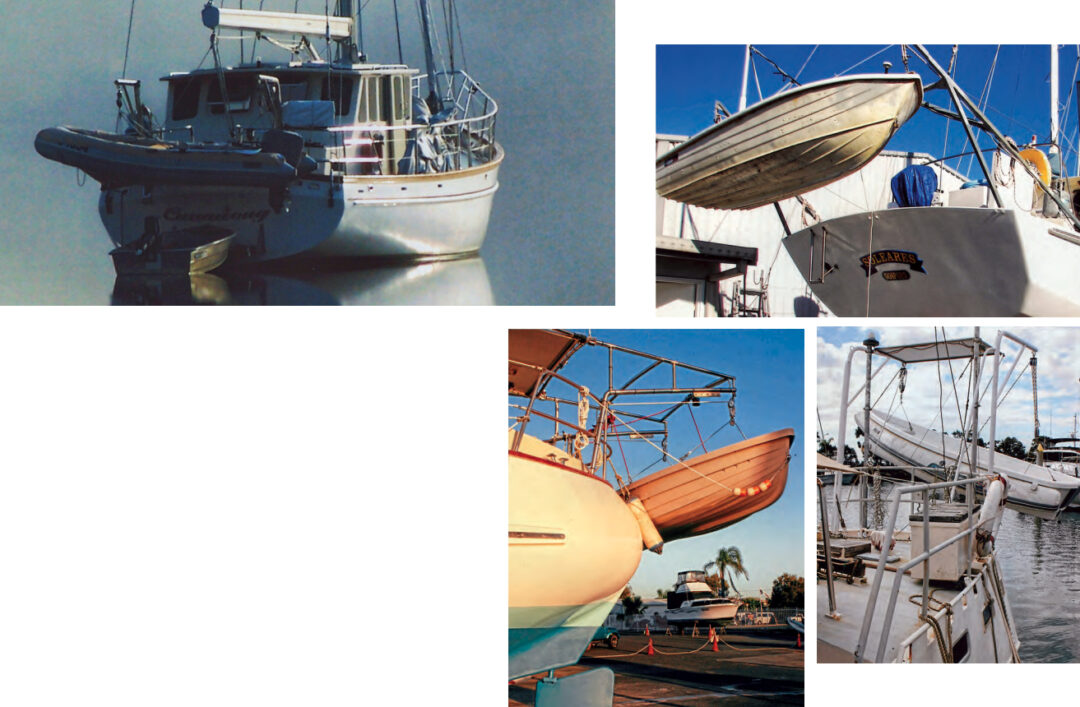
A safe and reliable installation takes thought
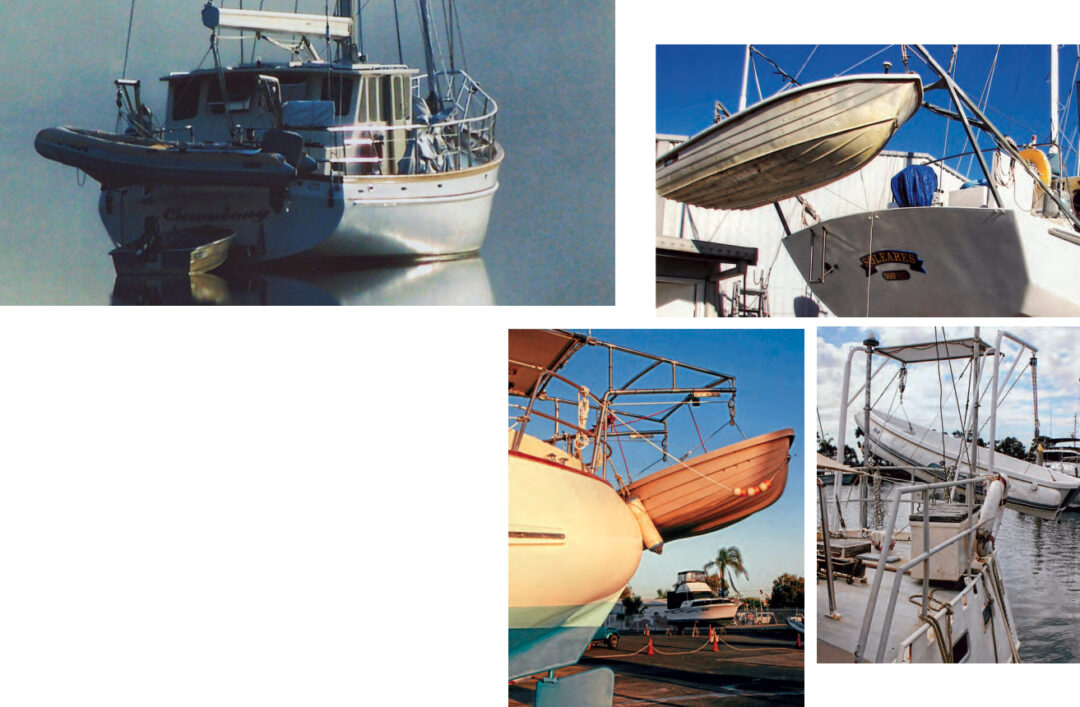
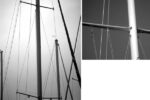
Davits of excessive height keep their tender clear of breaking seas but need to be very well braced on the vertical and horizontal planes. With a heavy tender, these davits would almost certainly suffer from reverse-pendulum motion.
Issue 82 : Jan/Feb 2012
Davits provide the ultimate system for launching, retrieving, and stowing a tender while offering a few bonuses beyond their designed intent. When hauled up into davits, for example, a tender becomes a great place to stow errant fenders that rarely find a real home under way and, in the event the tender becomes a lifeboat, their flotation will never be regretted. An advantage for those who enjoy fishing is the “self-draining kill-pit” potential of a tender in davits. It is ideally situated for landing struggling fish that can thrash around in containment without sliming the mother ship. Once the fish are scaled, cleaned, and stowed in the freezer, the tender can be hosed or bucketed clean with the assistance of the washing-machine action of the sea.
In spite of their attributes, davits do not suit all vessels; the size and type of the tender and the mother ship are dictating factors. There are no hard and fast rules regarding what’s appropriate. Some large trailersailers have enough reserve buoyancy aft to hang a small tender while some larger craft — such as those with a counter or canoe stern — lack sufficient buoyancy aft or have a transom too narrow to accommodate the structure. One more factor is that, regardless of size, most yachts with auxiliary-rudder or servo-pendulum self-steering systems cannot be fitted with davits at all.
Assuming your vessel has the buoyancy and space to t a set of davits, take potential destructive forces into consideration when reviewing their design and fabrication. Many existing davit arrrangements are inadequately braced against the sometimes-violent reverse-pendulum action of a beam sea as well as the fore-and-aft jerking of a vessel hobbyhorsing into sloppy head seas. Such forces can only be offset by adequate bracing and sound footings.
How and where
A modern trend is to incorporate davits into the Targa bar. We use this term in Australia. It’s borrowed from the rear wing of the Porsche Targa of some decades ago and refers to the over-cockpit tube frame, seen on many cruising sailboats, that supports antennas and other equipment. This is a sensible arrangement on a catamaran because it can be easily attained by angling the whole structure out over the rear of the bridge deck between the hulls. It’s adaptable to monohulls as long as the paraphernalia of radar, aerials, solar panels, and wind generators do not push the limits of outboard foot-pounds.
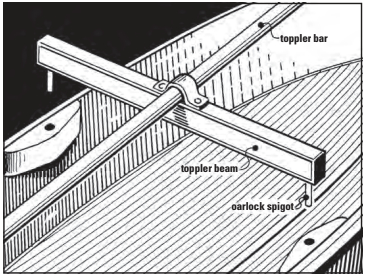
An alternative is to extend the davit arms back from a fully inboard Targa bar, using extra bracing where needed. Otherwise, davits can marry into the stern rail from which they angle out over the stern or they might be attached directly to the transom. Because transoms are so much stronger than decks, this can prove an ultimate method, depending on the transom in question.
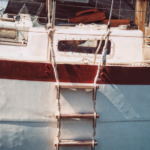
Because the tender is always hooked onto or unhooked from the davit-tackle across the mother ship’s stern, access through her stern rail is vital. If this access can incorporate a stern swim ladder that hinges up to become a secure gateway, a number of good outcomes can be achieved with a single modification.
Gaining height
On small boats, a compromise must be struck between davits high enough to hang the tender clear of the waves yet low enough to maintain structural integrity without unnecessarily heavy bracing.
On Renee Tighe, the ketch we sailed in the 1990s, I replaced the traditional davits with strong, tapering H-section aluminium beams angled out over the stern, and hoisted my rigid tender up against them (see illustration at right). Renee Tighe was a fat 30-footer from the boards of Angelman and Davis and built by the Willard Boat Company in California. (Note: See Alan’s article on her restoration in the January 2003 issue. –Eds.)
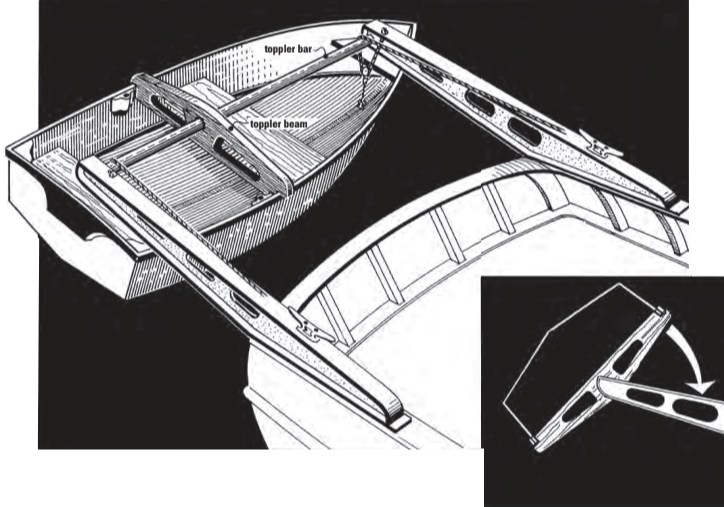
The system was entirely self-braced and worked well for the first few thousand miles of coasting until one miserable night, while lying ahull in a gale, Renee rode back on a few rogue waves and drove her tender hard down onto the sea. The tender’s buoyancy responded by trying to lift the davits off the boat and take a few timbers with it. To survive the night, I cut the dinghy free and trailed it astern. Soon after, I developed what I called the Toppler Effect.
To achieve the Toppler Effect, I fabricated a laminated plywood fore-and-aft beam that would rotate around the lateral tube that connected the outer ends of the davits. Thereafter, the tender was hauled up to this beam then lashed and toppled upside down on the top of the davits. This not only increased the dinghy’s height above sea level but also denied its buoyancy to oversized waves. Furthermore, in port, the upside-down flat-bottomed tender proved to be a marvelous outdoor table, although this was at the loss of an ideal site for a solar panel.
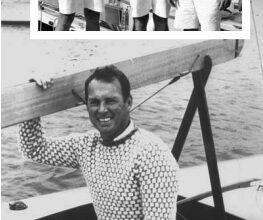
It was my intention to improve the system by matching the oarlock holes with two pegs fitted into the beam (see illustration at left). This would have simplified the lashings and produced greater stability during its toppling and upside-down stowing, but I never got to that as we sold Renee soon after and began work on building another yacht.
Davit details
Returning to the subject of normal davits, the best types are of medium height at a distance apart, preferably no less than three-quarters the length of the tender. Their outreach must be at least half the beam of the tender and clear of all fittings beneath. When fully hoisted, rigid tenders — and a few RIBs — are eminently suited to being locked into dedicated fittings on the davits to prevent movement at sea (see illustration at top right). If such fittings are impractical, good old-fashioned lashings work fine as long as they include cross-bracing lines that are periodically sweated up during long passages.
The tender’s lifting bridles and eyes must be above her center of gravity (including the outboard motor) to prevent her from tipping when suspended (see illustration at right). If lifting points are not already incorporated into your tender, you can attach a bridle below the center of gravity near the stern and the bow tackle to the forward cleat or other suitable fitting.
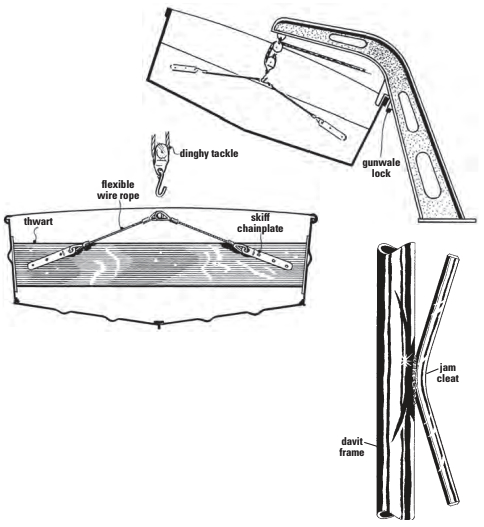
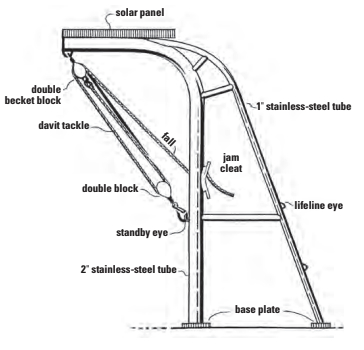
Tackles employing two double blocks (the fixed one having a becket) are adequate for most tenders. Electric winches are an option. Runabout trailer winches are ideal, as they simplify things with their single-cable action and require no hardening-up once the tender is fully hoisted. Bear in mind, however, that should the tender be needed in an emergency, nothing beats cutting rope lashings with a sharp knife. It is a good habit to keep one or two knives permanently sheathed near the davits.
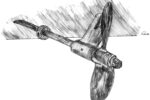
On a smaller yacht with a lightweight tender, there may be no need for a top block in the davit’s tackles. The tails can instead be led over a rounded smooth surface (such as in the center illustration) after passing through a single block at the dinghy. Eliminating the block allows the tackles to be sweated up harder and closer to the davits, thus reducing the dinghy’s tendency to swing while under way.
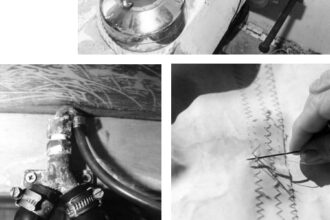
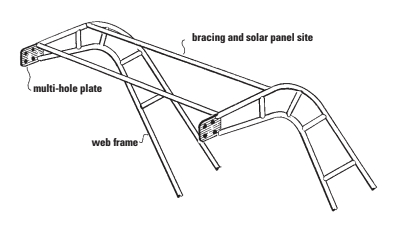
A jam cleat on each arm (see illustration at right) allows one person to incrementally hoist the tender’s bow and stern by jamming the tail temporarily at each increment. It is also worth using multi-hole plates at the davits’ outer ends instead of eyes. These allow for future add-ons such as shade awning tie-downs, a wind generator post, and solar panel supports. A solar panel here has the opportunity to articulate to the sun’s varying angles through one plane (see illustration below).
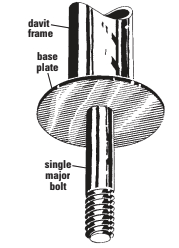
When designing davits, take into account the deck structure under the feet. If the feet land on a major under-deck member, consider single through-bolts and large circular plates (see illustration below).
Safe use
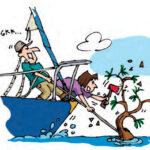
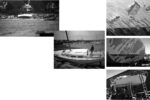
Stern davits — as opposed to traditional side davits — are obligatory for small vessels. This is inconvenient when the mother ship is anchored in a strong tidal stream that sweeps the tender away the minute it hits the water (when launching) or loses way beneath the davits (prior to hoisting). These are dangerous moments if not handled carefully (see illustration at center right).
When a tide or current is running, you should board the mother ship over her side. Then, from the safety of the deck, warp the tender around the stern by its painter and stern line and secure it temporarily athwartships under the davit’s falls (see illustration at bottom right). With the tender now firmly restrained from being carried away on the tide, it’s safe to board it to connect the tackles. When it’s thus captured, the dinghy can be hoisted into the davits and its painter and stern line untied and used as part of the lashing system.
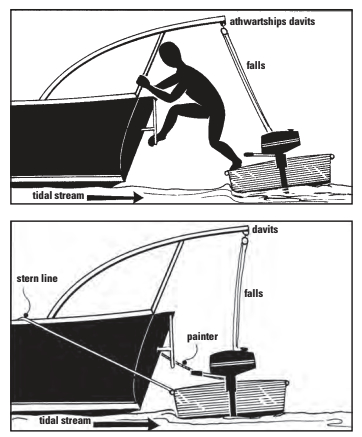
When lowering the tender into a strong tidal stream, reverse the operation, pre-tying the stern line and painter and adjusting them as the tender descends. Once the tender is afloat, secure the two lines so you can safely board the tender to release the falls, then warp it alongside the mother ship.
When a tender is stowed in davits, always keep its drain hole open; the bigger the aperture the faster it sheds deluge-strength rain or breaking waves. Only when catching rain (after a preliminary rainwater rinse) should the bung or a hose be inserted into the drain hole.
Davits are a life-changing addition that makes handling and stowing a tender absolute child’s play. However, before committing to their design and fabrication, try this simple test: lift your tender onto the stern of your vessel, add a normal complement of crew to the cockpit, then assess her aft immersion. If it’s extreme, you may only need a lighter tender. If that change doesn’t return your boat to her lines, you should abandon any thoughts of fitting davits to your little ship.
Alan Lucas, an Australian from New South Wales, has been cruising for 50 years, primarily south of the equator. He is the author of several Australian cruising guides.
Thank you to Sailrite Enterprises, Inc., for providing free access to back issues of Good Old Boat through intellectual property rights. Sailrite.com