The bottom line in mainsail trim
Issue 85 : Jul/Aug 2012
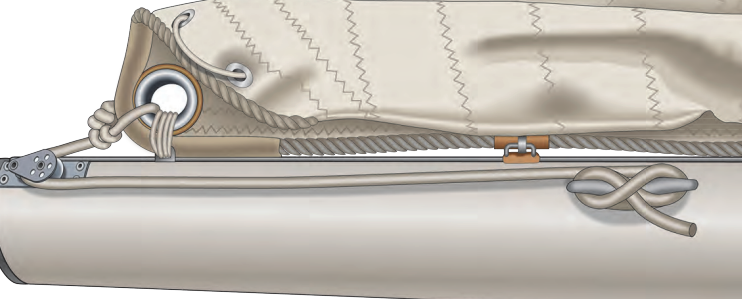
Outhauls have been in use since the days of the square rigger. An outhaul is part of the running rigging, specifically a line fastened to the clew of the sail. As the name implies, it hauls the clew out on a spar, which might be a yard in the case of a square sail and is the boom in the case of a fore-and-aft sail.
On a modern sailboat, the outhaul is used to adjust how flat or how full the mainsail is and aids in shifting the draft, or curvature, of the sail forward or aft.
Adjusting sail shape
Many who are new to sailing use only the mainsheet to trim the mainsail. But it’s important to understand that the main- sheet traveler, boom vang, Cunningham, and outhaul can also be used to help create proper sail shape, which results in higher efficiency, better boat speed, and more control. Racing sailors and experienced cruisers know good sail shape is the result of a combination of adjustments — the tension on the sheet, the position of the traveler, the tension on the boom vang, the tension on the Cunningham, and the tension on the outhaul.
In light winds, the larger the draft, or curvature, of the sail, the more powerful it will be, within limits. Lessening the tension on the outhaul will increase the draft and create more drive in lighter winds, but you must also be careful not to have too little tension on the outhaul.
In strong winds, it is better to de-power the sail by making it flatter. Flattening the sail allows you to continue sailing longer before you have to reef down. This can be accomplished, in part, by putting more tension on the outhaul, which straightens the foot and flattens the bottom third of the sail.
Outhaul tensioning methods
An outhaul system should allow changes in tension to be made easily while under sail. In the simplest outhaul system, a control line leads from the clew to a turning block on the aft end of the boom and then forward, either on the outside of the boom or inside it, to a cleat or cam cleat. This system provides no mechanical advantage so, overlooking added friction, the pull on the clew is the same as the pull exerted by the sailor.
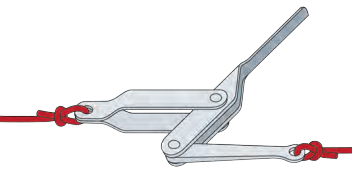
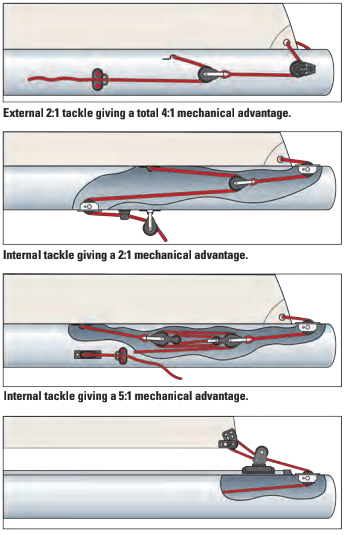
On larger sailboats, mechanical advantage is needed on the outhaul to put enough tension on the clew. A 2:1 block-and-tackle system can be added, mounted on the outside of the boom or inside it. When a higher mechanical advantage is needed, a multiple-part block-and-tackle system, which can be bulky, is generally fitted inside the boom.
Mechanical advantage can be obtained in other ways than through a block-and-tackle. The outhaul line can be led through a turning block at the end of the boom, then forward to a winch, similar to a small sheet winch, mounted on the side of the boom.
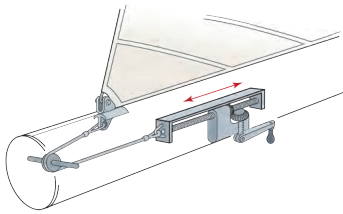
Another alternative, although rarely seen today, is a worm-drive outhaul winch that is operated with a handle similar to that of a sheet winch. If this worm-drive winch were at the end of the boom, it would be very difficult to reach the handle when running or on a reach, so it’s more common for it to be fitted at the forward end of the boom. From there the outhaul line is led through the boom to a turning block at the end of the boom. Better yet is the outhaul worm-gear winch that can be operated from either side of the boom so the operator can always be on the high side of the boat where it is safer and visibility is better.
Occasionally, the change in tension on the outhaul is accomplished with a small Highfield lever mounted forward on the boom. The disadvantage of the Highfield lever is that it allows only two tension settings: tight and loose. The advantage is that the change in tension can be made easily and almost instantaneously.
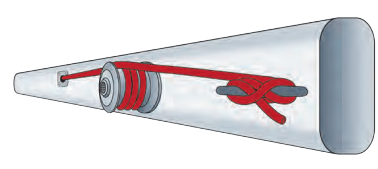
A roller-reefing (rotating) boom presents a special difficulty when it comes to adjusting foot tension. When the sail is rolled up several turns on the boom, the reefed sail has no clew cringle on which to apply tension, which is unfortunate because the sail needs to be flat when reefed.
Don Launer, a Good Old Boat contributing editor, built his two-masted schooner, Delphinus, from a bare hull. He has held a USCG captain’s license for more than 37 years and has written five books. All of his 101 articles are now available for downloading as a collection from the Good Old Boat download website, www.audioseastories.com. Look under Archive eXtractions.
Thank you to Sailrite Enterprises, Inc., for providing free access to back issues of Good Old Boat through intellectual property rights. Sailrite.com