Why American sailors stuck with a movable appendage
Issue 85 : Jul/Aug 2012
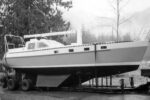
First, let me say it’s a humbling experience to take over the design comparisons in Good Old Boat from someone with the breadth of knowledge of the yachting industry and things maritime as Ted Brewer. Interestingly, Ted and I share a common ancestry in the industry, as we both began our careers with George Cuthbertson, albeit in different decades. I also feel fortunate that my first article happens to be about the Mercer 44, because it is an example of the keel/centerboarder, which has an important place in the history of yachting.
An exclusively North American phenomenon, the keel/ centerboarder traces its origin to 1885 and the Boston design office of Ed Burgess. At a time when the difference between the deep-draft, heavy-displacement, narrow-beam (“plank on edge”) British cutters, and the beamy, shoal-draft, light-displacement American centerboarder was at its greatest, the British mounted back-to-back challenges for the America’s Cup with the Beavor-Webb-designed Genesta and Galatea, typical products of the British Tonnage Rules. The New York Yacht Club (NYYC), feeling the need to defend the “American Type,” responded with defenders in that traditional American style, causing A. Cary Smith to lament, “They’re forcing me to design a damned scow!” However, Burgess and the Boston syndicate headed by Paine, less restricted by the need to uphold American yachting “tradition,” responded with what was to become known as the “compromise” cutter, Puritan, followed by Mayflower and Volunteer of the same type. Note the obvious New England names, emphasizing their non-NYYC origins. These successful defenders had narrower beam, deeper draft, and greater displacement and ballast than the typical “American Type” of the time but still utilized a centerboard protruding down through a slot in the external ballast. The introduction of the Burgess compromise marked the end of the extremes in yachts on opposite sides of the Atlantic, and the Mercer 44 and its contemporaries can certainly stretch their ancestry back to these “compromise” cutters of the 1880s.
From a personal perspective, owning as I do a 1965 Cuthbertson and Cassian-designed keel/centerboard Corvette, I must admit a keen affinity for the type, and having designed several centerboard configurations myself, from the gybing weighted daggerboard on the C&C Canada’s Cup winner Evergreen to the large hydraulically operated “keel extension” board on the Mark Ellis-designed Rangeley, as well as a number of the C&C shoal-draft centerboard options, I have some appreciation for the challenges and trade-offs involved. However, being able to hold our own in our little Trillium with Tartan 30s upwind (with them owing us time) and then take control on the downwind legs, after making the 70 cranks to raise the board, is certainly a satisfying feeling.
At the time the Mercer 44 was introduced, the Cruising Club of America (CCA) rule dominated yacht design in North America. However, even Olin Stephens was puzzled by the success and popularity of these CCA centerboarders, considering, as he did, that with their wide beam (for the time), they were not ideally suited to offshore racing. He felt that the lure of the Bahamas, revealed to a post-war sailing public by the books and photographs by Carleton Mitchell of his Bahamian and Caribbean cruising in his famous Finisterre, did a lot to popularize the type.
However, the fact that Carleton Mitchell also won an unprecedented three back-to-back Bermuda races in Finisterre in 1956, ’58, and ’60 did a lot to influence design trends in this period toward the centerboard configuration. It should also be noted that the yawl-rigged centerboard configuration fared well under the CCA rule. As described by Bob Perry in his excellent article on this subject in the January 2012 issue of this magazine (as well as his in-depth tribute to Bill Tripp in November 2011), the CCA rule was based on committee-determined optimum proportions of a boat based on her length at and near the waterline. Reduced draft was favored under the rule and centerboard draft was not weighed as heavily as keel draft. More specifically, in the early days of the CCA, stability was not measured directly with an inclining test. Instead, the ballast-to-displacement ratio was used as an approximation of stability. It didn’t take designers long to figure out that weight below the cabin sole in the form of heavy bronze stringers, frames, and mast-step structure could serve in lieu of ballast, allowing the published ballast weight to be lowered without any real reduction in stability. George Cuthbertson also tells me that, in this time period, a lot of these boats had exceptional battery capacity all crammed under the floorboards! Engines were also placed very low in the bilge. The yawl rig was popular, of course, because mizzen staysails and spinnakers were free extra sail area under the rule.
What ended this era of centerboard domination under the CCA was an entirely different approach to ocean racing brought on in 1963 by the unanticipated success of the Lapworth-designed, Jensen-built Cal 40. When the Cal 40 won three successive Transpacs beginning in 1965, and both the Bermuda Race and Southern Ocean Racing Conference (SORC) in 1966, the fin keel became dominant in offshore racing, and the centerboards, for the most part, were relegated to cruising. It is no coincidence that when Red Jacket emerged from the Bruckmann shop, she had a fin keel, not a centerboard, and her 1967 first in class and 1968 overall win of the SORC sealed the fate of the centerboard.
There was a short period later, under the IOR, when lift and bilge keels emerged in the Canada’s Cup winner Evergreen, and Bruce King-designed Terrorist and Aggressive II but, for all intents and purposes, the centerboard had left the offshore-racing arena and was confined almost exclusively to cruising.
This dominance of lighter weight, fin-keel configurations in the mid 1960s was further emphasized for me when talking to Gordon Goodwin of Cape Cod Shipbuilding, current builders of the Mercer 44. Gordon recalls sailing a Transpac in the mid ’60s in a Mercer 44, where the only boats that finished ahead of them in their class were 11 Cal 40s and the custom Vamoose. Gordon points out that it is no coincidence that when Bill Tripp designed the Columbia 50 in 1965, while it bore a remarkable resemblance to the Mercer 44 above the waterline, it sported a fin keel and separate rudder below the waterline.
By the way, Cape Cod Shipbuilding tells me that they have a Mercer 44 in the mold that could readily be turned into a finished boat for someone nostalgic for a brand-new good old American keel/ centerboarder.
Rob Mazza is Good Old Boat’s newest contributing editor.
Thank you to Sailrite Enterprises, Inc., for providing free access to back issues of Good Old Boat through intellectual property rights. Sailrite.com