They gnaw on metal and at your peace of mind
Issue 87 : Nov/Dec 2012
When I was a child my cousin told me not to look under the bed because “there could be monsters under there.” It would be terribly frightening to look and find a monster. If you don’t look, you don’t know. If you don’t know, you don’t have to be scared. Ignorance is bliss.
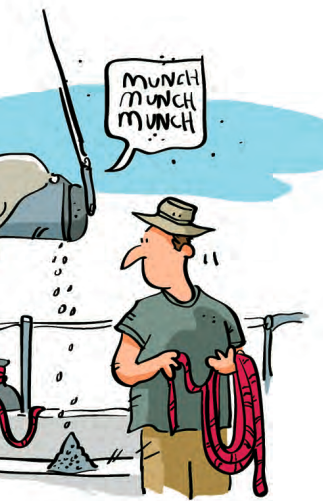
I ignored my cousin’s advice recently when I shouldn’t have. In May of last year, I noticed some white powder around the big strong stainless-steel endplate on my boom. This substantial fitting provides the attachment for the end-boom sheeting for the mainsail. It could derail a freight train and not be hurt. I had no doubts about its strength. Besides, the rig had been surveyed several times.
As I looked at the white powder, I thought it had to be a minor issue I could clean up quickly. Surely a reputable company wouldn’t mount stainless steel on aluminum without doing something to discourage electrolysis. Surely riggers would spot signs of corrosion that I might miss.
Apparently, however, companies do mount stainless steel directly on aluminum and riggers can miss corrosion under fittings. The photos show the cut-off end of the boom that was under the big strong stainless-steel end fitting. I was lucky it didn’t fall off and hit me on the head.
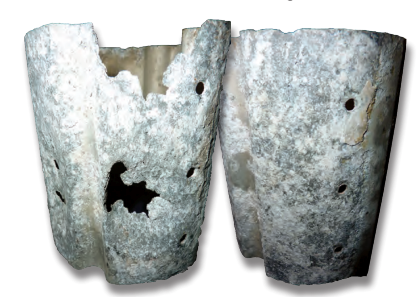
After finding the end of the boom badly corroded, I decided it might be worth checking the other end of the boom, even though the whole thing was going in the trash heap anyway. The gooseneck end had an equally large and strong stainless-steel fitting that turned out to have just as much corrosion under it. It could have broken off just as easily. Indeed, in a fit of symmetry, both ends might have broken at the same time, leaving me with a nice middle section of a boom.
In the end, I replaced the corroded boom with a used boom from a 40-footer. If you ever need to replace a boom, I can tell you from experience not to eyeball the attachments for the reefing lines unless you like drilling and tapping holes. Drilling lots of holes can reduce the weight of the boom.
But the story doesn’t end there. In the process of modifying the boom, I started looking up the mast. It also is covered with stainless-steel fittings, including the mast cap and attachment points for the shrouds and spreaders. I began to imagine corrosion monsters under every fitting.
My cousin was right. Don’t look under the bed for monsters. If you find them, you have to do something about them. Now I am going to pull the mast and remove all of its stainless-steel fittings to see what monsters lurk under them. If I hadn’t looked in the first place, I wouldn’t have to pull the mast. Yet, if I don’t do anything, the mast might take matters into its own hands and come down of its own accord.
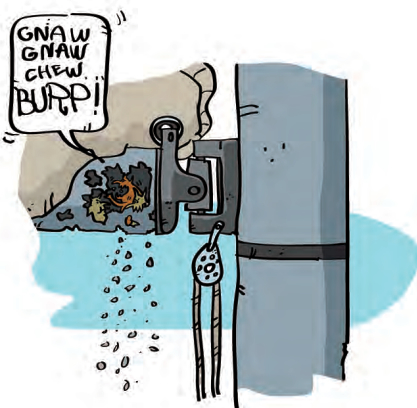
A lot of older boats have stainless-steel fittings on their booms and masts. It might be worth taking a peek under those fittings. It’s sort of like checking the oil. You really don’t want to find that the oil has gone somewhere, but it’s better than getting a really big surprise if you don’t check it.
Carl Hunt is a semi-retired economist. He lives in Colorado and has sailed for 30 years and cruised his boats from British Columbia to Mexico. He has chartered and cruised other people’s boats throughout the eastern United States and the Gulf of Mexico, the Caribbean, the Mediterranean, and other parts of the world.
Thank you to Sailrite Enterprises, Inc., for providing free access to back issues of Good Old Boat through intellectual property rights. Sailrite.com