A spacious coastal cruiser
Issue 86: Sept/Oct 2012
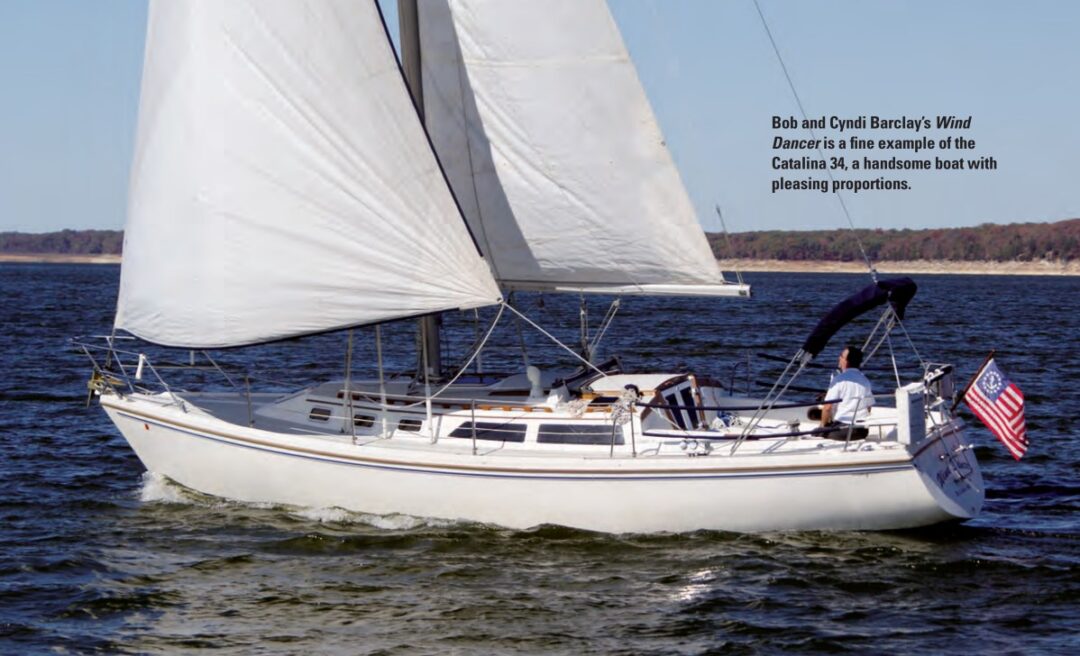
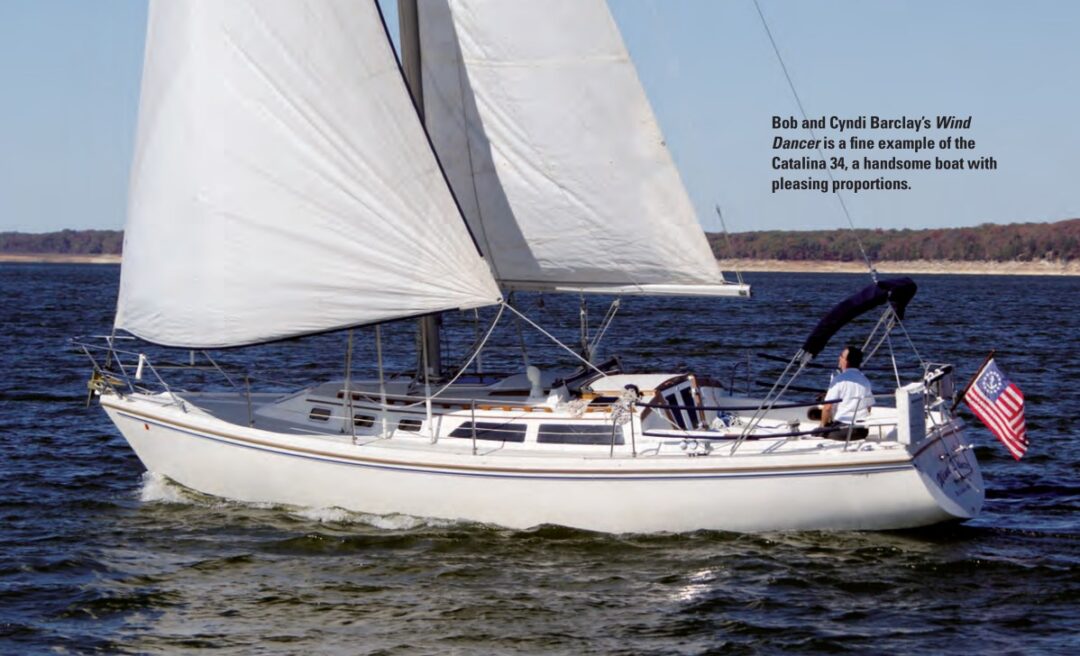
Bob Barclay, a professional home inspector, and his wife, Cyndi, owned and sailed a Catalina 28 on Missouri’s Mark Twain Lake. While they both agreed that the 28 was a nice boat, they wanted more room on board. When a well-cared-for Catalina 34 became available in nearby Illinois, Bob investigated and was sold on the boat’s quality. Since then, Wind Dancer, Bob and Cyndi’s Catalina 34, has become a familiar sight to the sailors on Mark Twain Lake and the Barclays have been enjoying the boat’s spacious interior and good sailing qualities.
History
Frank Butler began his design career in 1966 as co-designer of the Coronado 25 and followed that moderate success with his own Coronado 15 and Omega 14 designs. In 1969, he envisioned a small, swing-keel cruiser that would open up recreational sailing to many more people. The Catalina 22 was born and with it a modern success story: Catalina Yachts. Although Frank had only modest expectations for his 22, it proved wildly popular. Within two years he had introduced the Catalina 27 and by 1976 his landmark Catalina 30 was launched. The Catalina 25 followed in 1978 and the Catalina 36 began production in 1982. Each of these designs was a huge success and they catapulted Catalina Yachts into the forefront of recreational sailboat production.
In 1986, the company introduced the Catalina 34. It had spacious accommodations, satisfying performance, and an attractive price tag at around $45,000. The first boats were produced with a deck-stepped mast, but beginning in 1987 they stepped the mast on the keel. As the design evolved over the years, a sugar-scoop transom that allowed a narrow swim step was introduced and was followed by a walk-through transom in 1989. Engine options also were upgraded. In 1996, the Catalina 34 Mark II was introduced and, while its lines are somewhat different, it retains much of what was learned in the production of the original 34.
Catalina remains one of the most prolific sailboat builders in history and has sold more than 60,000 boats. The company continues to produce a great number of cruising sailboats and currently builds at least 10 models ranging from the Catalina 22 Sport to the Catalina 470. Vice president and partner Gerry Douglas designs most new models these days, but Frank Butler maintains an active role in the company he founded.
Construction
Catalina built the 34 hull using a solid hand layup of fiberglass fabric and polyester resin. Wooden stringers were added and glassed along the bilge to stiffen the hull structure. The fiberglass interior liner runs from bow to stern, with key openings in critical places to provide access below for storage, through-hulls, wiring, and plumbing.
Decks are balsa cored, with plywood core used in higher stress zones, and a low toerail is molded around the perimeter. The hull-to-deck joint is a shoebox arrangement formed by overlapping the downturned deck flange on the mating hull surface with a sealant in between. An aluminum rubrail is fastened with bolts that pass through the deck flange, hull, and liner and are secured with washers and nuts on the inside. Catalina used a trademark tan rubber insert fitted into a slot in the rubrail to cover the bolt heads. A blue cove stripe applied below the rubrail gives the boat the double-stripe look that’s a characteristic of Catalinas.
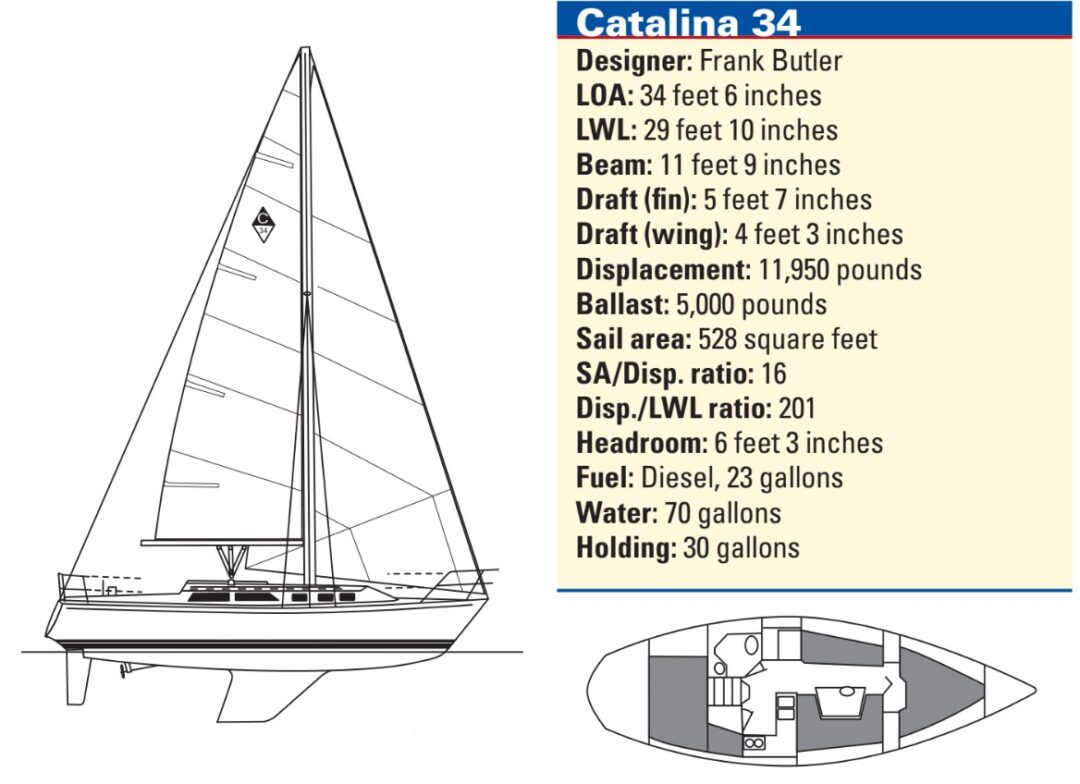
The lead keel is secured with stainless-steel bolts. A fin keel with 5-foot 7-inch draft and a wing keel with 4-foot 3-inch draft were available. The keels were faired with glass and gelcoat. One problem area has been the bond between this fairing and the underlying lead. Spade rudders were fitted with depths to match the keel configuration. Some owners have reported minor issues with water in the rudder.
Rig
The Catalina 34 rig has single spreaders with single upper shrouds and dual lowers attached to chainplates that penetrate the deck near the cabin trunk. Stainless-steel tie rods attach to the chainplates belowdecks, their lower ends secured through a heavy stringer that runs along the liner-to-hull interface. The tie rods are exposed in the cabin interior. Water leakage at the chainplates and resulting deck core damage is a common issue. Catalina Yachts has made available a redesigned chainplate that provides a much better seal at the deck.
A split backstay connects to chainplates through-bolted at the outboard corners of the transom.
The mainsheet is attached at the midpoint of the aluminum boom and leads to a cabintop traveler mounted over the aft end of the sea hood for the companionway hatch. Maxwell 30 two-speed winches are on either side of the companionway to handle lines run aft. The primary winches are Maxwell 46 two-speed self-tailers. A curved T-track runs alongside the cabin trunk aft of the chainplates for the genoa-sheet lead, and a second T-track is mounted on the molded toerail for outboard sheeting.
Deck layout
The Catalina molded non-skid surface is fairly aggressive. Together with the wide sidedecks, the inboard chainplate location, and teak grabrails along the whole length of the fairly flat cabintop, this makes the deck areas secure for crew going forward and working at the mast.
Between a hatch over the saloon aft of the mast and large smoked-Lexan fixed portlights in the cabin sides, the saloon receives ample light. Dorade vents located just forward of the traveler on either side of the sea hood and three opening ports forward on each side provide ventilation. A large hatch on the forward slope of the cabin trunk provides light and ventilation for the V-berth.
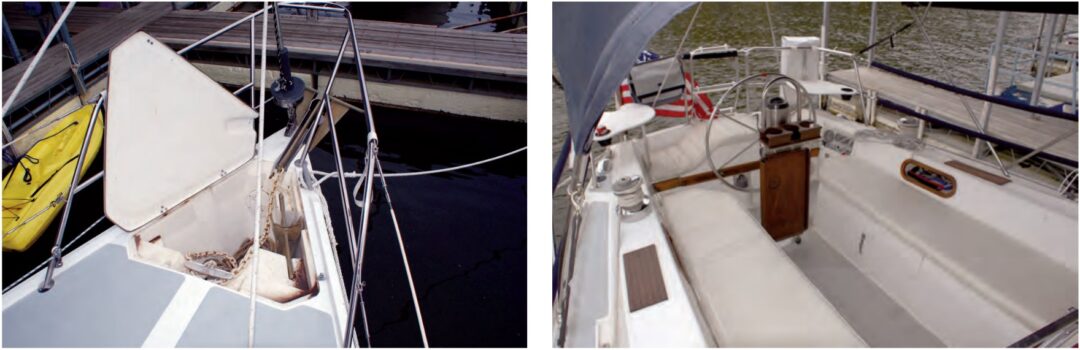
The foredeck is large and open, and the sizable anchor locker provides stowage space for a Danforth-type anchor as well as the rode and chain for a primary anchor. The primary anchor is stowed on a bow roller that’s cleverly integrated into the hull molding. A beefy cleat on a shelf at the aft end of the anchor locker provides a secure attachment point for the rode. There is no apparent provision for mounting a windlass, and doing so would require modifications to the locker area and the locker cover.
Mooring cleats of ample size are fitted port and starboard, but there are no chocks, and there appears to be little room to mount them. The stainless-steel bow pulpit effectively encloses the area where the anchor is handled.
Double 3⁄16-inch coated lifelines attach at the bow pulpit and run through stainless-steel stanchions. The stanchion nearest the aft end of the cabin trunk is braced and the lifelines between it and the stern pulpit can be dropped for dockside access. The stern pulpit is made in two sections with an opening that’s filled by a stainless-steel stern ladder in its raised position. A lifeline section with a pelican hook secures the raised ladder to close the opening when the boat is under way.
The cockpit is wide and roomy with seats to port and starboard providing actual sleeping lengths of more than 6 feet. The 40-inch wheel is mounted to a standard Edson pedestal and the T configuration of the cockpit allows access around the wheel to the helm seat aft. The arched helm seat assures secure seating at the wheel when the boat is heeled.
Wide coamings provide fairly comfortable seatbacks as well as mounting locations for the primary winches. There are convenient cubbies in the coamings for winch handles and other items. Cockpit lockers are located beneath the port and starboard seats, although the aft cabin limits their depth. There is also a locker beneath the helm seat that contains properly vented secure storage for the onboard propane gas supply.
The Catalina 34 has a raised bridge deck at the companionway entrance. In place of the standard dropboards, Wind Dancer has custom hinged doors.
Belowdecks
A primary feature of the Catalina 34 is its interior space. Forward, the V-berth is very large and accommodating. With more than 6 feet of length available and with the center insert in place, it’s a comfortable berth for two. A hanging locker to starboard, drawers to port, and a wide raised shelf over the foot of the berth provide ample storage.
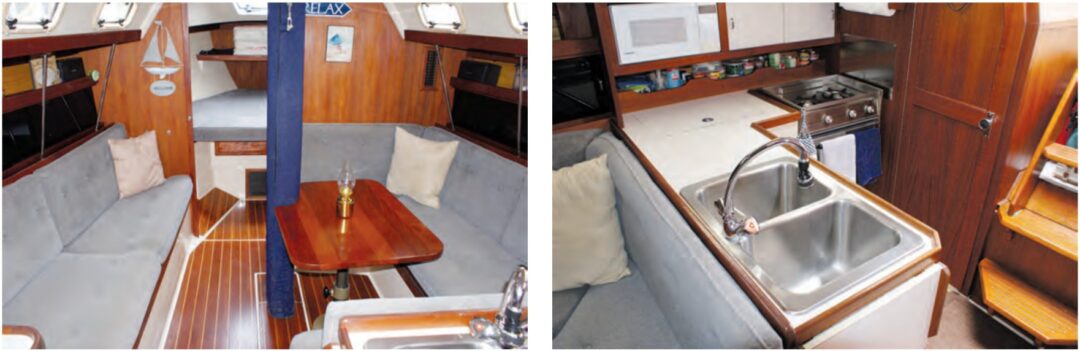
A teak bulkhead and privacy door separate the V-berth from the saloon, which is open and bright with lots of light from the large fixed ports and overhead hatch. The teak-and-holly sole, teak trim, and teak ceilings on the inner hull surface provide warmth, while exposed white sections beneath the seats and the white headliner prevent it from being overly dark. The keel-stepped mast is at the forward port corner of a teak table that serves a U-shaped settee to starboard. The table drops to convert the settee to a convenient double berth. A straight settee to port provides a single berth.
The navigation station is on the aft end of the port settee, which is also the nav seat. Storage space is provided under the hinged chart-table top and in a cabinet with a louvered door aft of the nav station. Electric panels and the radio are located above the chart table.
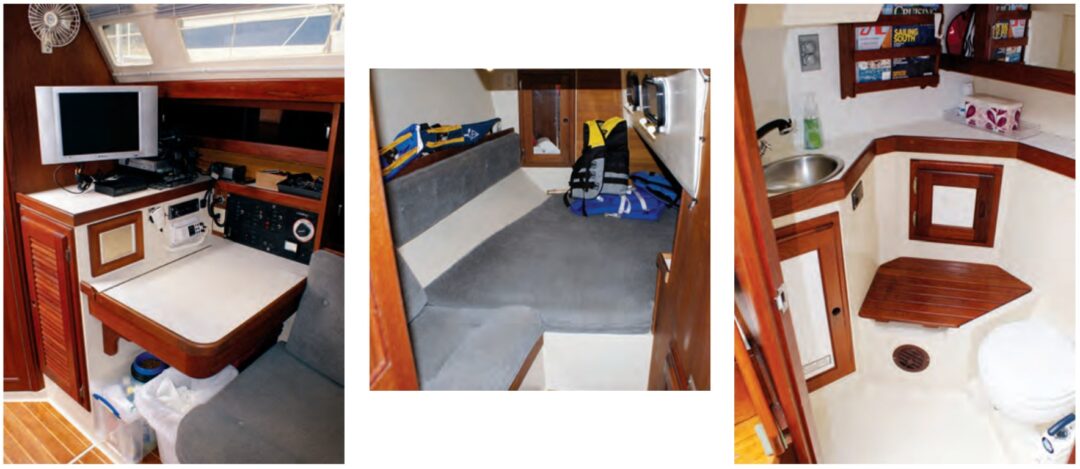
The galley lies to starboard and aft of the U-shaped dining area. The forward portion of the galley has double stainless-steel sinks inboard and counter space over the icebox compartment outboard. Hot and cold pressurized water is drawn from a 25-gallon tank forward under the V-berth and a 45-gallon tank to starboard. A folding shelf along the center aisle can be opened to add counter space to port of the sinks. A two-burner propane stove with an oven is mounted along the hull aft of the icebox, and the space above counter level and along the hull contains storage for utensils and foodstuffs.
A door just inboard of the stove provides access to the aft cabin, which is fitted with a dressing seat along the starboard hull near the door and a queen-sized berth that extends athwartships beneath the cockpit sole and the storage lockers.
The head compartment is aft of the nav station and accessed through a door to port of the companionway. It contains a marine toilet on a fiberglass liner platform, a stainless-steel vanity sink with a combination faucet/showerhead, and a teak shower seat. The sole liner in the head drains to a shower sump with a separate discharge, and the toilet discharges into a 30-gallon holding tank.
Headroom is generally 6 feet 3 inches, but a number of bolts capped with acorn nuts on the headliner bear watching if you are very tall.
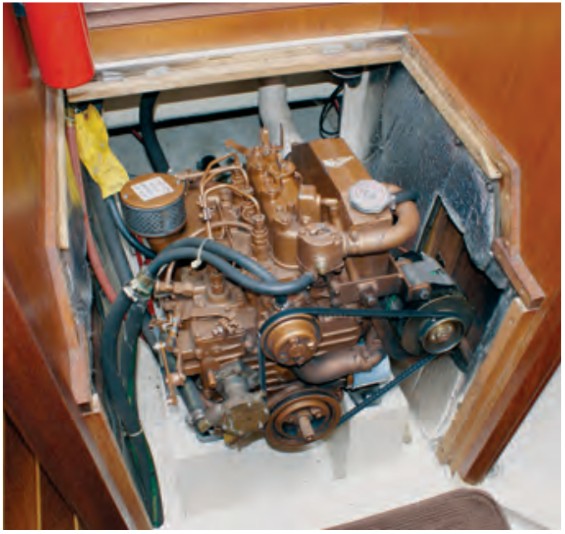
The engine is a three-cylinder Universal M-35 diesel located beneath the companionway steps with very good access. With the steps removed, most service points are easy to reach. A side panel in the aft berth provides additional access. The aluminum fuel tank holds 23 gallons.
Under way
Bob, Cyndi, and their son Dylan welcomed my wife and me for a test sail in winds of 10 to 12 knots. As we backed out of the slip we noted moderate prop walk to port, and the Universal diesel propelled the boat nicely and without undue noise or vibration as we motored out of the marina. The large spade rudder provides good directional stability and helm resistance is not excessive.
Under sail, the boat has a very solid feel and feedback through the large wheel is surprisingly good. Tending the mainsail controls requires a second crew because the traveler and sheet cannot be easily reached from the helm position. The primary winches are within the helmsman’s reach. When singlehanding in a good breeze, it’s best to ease the main to minimize the need to go forward to adjust the traveler. The boat does have a tendency to round up in gusts if the main is trimmed for speed, but a crew adjusting the traveler to meet the gusts can prevent this and keep the boat driving forward.
We put Wind Dancer on several points of sail and she performed adequately on each one. The boat will point to around 35 degrees apparent wind before losing drive. On a beam reach with the main and genoa trimmed for speed, the boat romped off at nearly 6 knots under fingertip helm control, and on a run it was well-balanced with very little tendency to roll. While the helm does not have the immediate feedback of a tiller, it’s sensitive enough for the helmsman to know what’s needed from him. We found the boat fun to sail while it gave us the secure feel of a larger boat.
We did not have conditions that could provide a sense of the boat’s seakeeping ability, but the solid feel and construction of the boat indicate she will likely do fine in most seas. A Catalina 34 makes a reliable coastal cruiser. Some owners have made offshore passages, including at least one to Hawaii from California.
Many Catalina 34 owners race their boats in PHRF fleets. From the US Sailing listings, a fin-keel Catalina 34 with the standard rig carries an average rating of around 150 seconds per mile, with tall-rig boats rating 141. Wing-keel boats with both rigs rate a few points slower. This makes the Catalina 34 a bit slower than a Hunter 34 at 138 and nearly identical in speed to the C&C 34 centerboard model.
Prices and availability
With so many boats produced, a great many Catalina 34s are for sale at any given time. In early 2012, a quick check found at least 58 available at prices ranging from $29,000 for a 1986 model to $62,000 for a 1991 model. The average asking price for these boats is around $44,000. Parts and support are widely available and the Catalina 34 remains a very popular sailboat.
Tom Wells is a contributing editor with Good Old Boat (and his musical contributions at the Annapolis boat show have also earned him the title of Troubadour). He and his wife, Sandy, own and sail a 1979 Tartan 37, Higher Porpoise. They have been sailing together since the 1970s and look forward to cruising upon retirement.
Thank you to Sailrite Enterprises, Inc., for providing free access to back issues of Good Old Boat through intellectual property rights. Sailrite.com