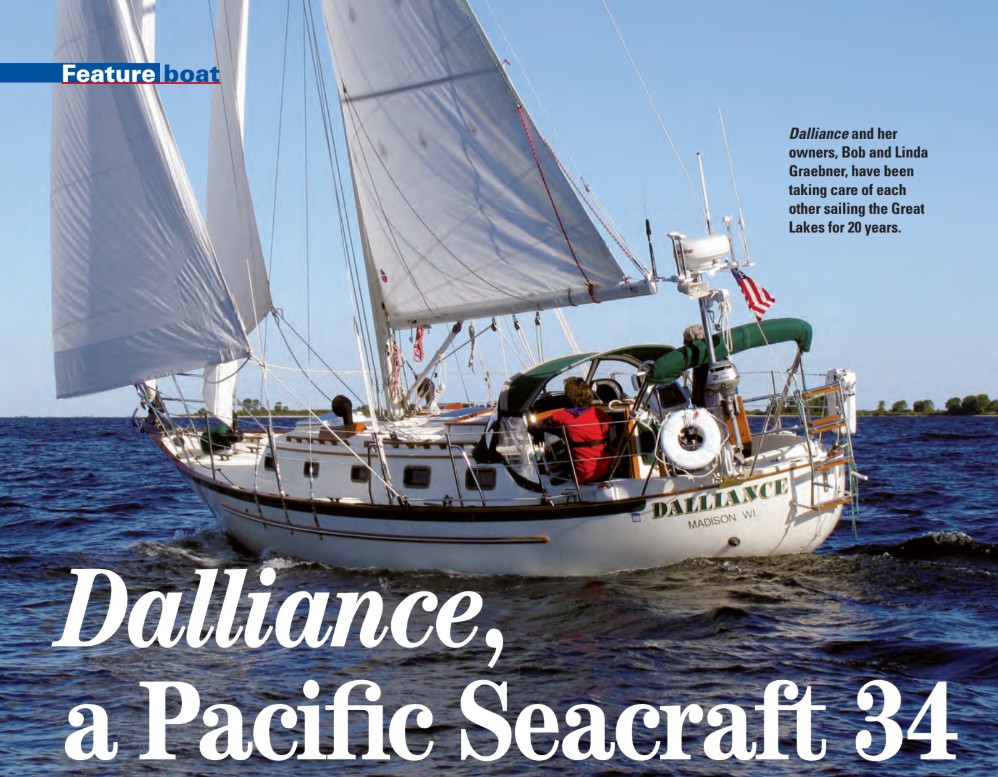
She has aged gracefully with her original owners
Issue 86: Sept/Oct 2012
When I think of a good old boat, my first thought is a “rescue,” similar to what occurs in the world of pets. A new owner adopts a mistreated pet and nurses that animal back to health. Likewise, a neglected vessel with good bones can be brought back by a new owner to live happily ever after through skilled work, replacement parts, new equipment, and tender loving care.
I also visualize prospective owners carefully searching the Internet for a specific type, size, age, or builder that matches their ideal vision of a sailboat. Their goal is to find the best-cared-for used boat of its type in the hope of reducing further investment.
But there is another way to acquire a good old boat. That is to buy a good new boat for a long-term relationship. Not many choose that path. I know. I’m an example of the boater whose vision of the right boat changes with the seasons . . . if not of nature, then of life.
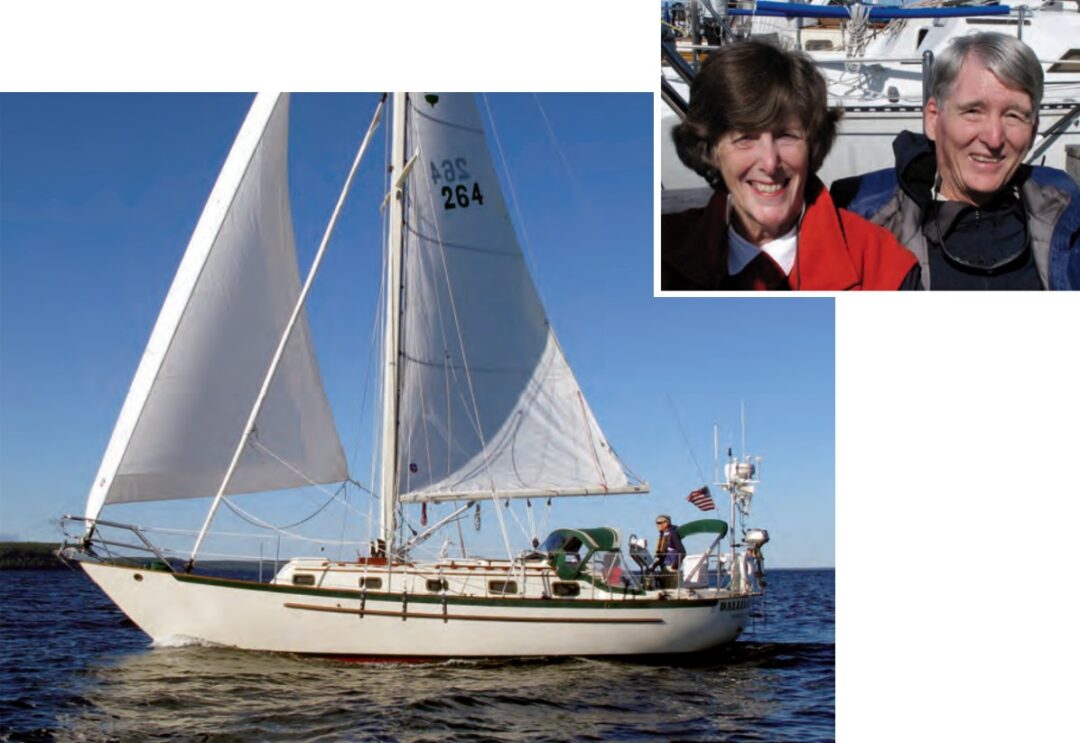
Dalliance’s owners fall into the admirable company of those who plan carefully, look beyond today’s whims, and make the right selection in perpetuity. Bob and Linda Graebner still live in the house in Wisconsin they had designed and built almost 30 years ago and in which they raised two daughters, Laura and Melissa. Bob and Linda each held one job for most of their working lives. Bob retired from a successful practice in neurology and Linda in occupational therapy. Dalliance is the Pacific Seacraft 34 they purchased new in 1992. She has since become a good old boat.
A sailing evolution
As a young man, Bob had done some recreational sailing on the small lakes of central Wisconsin. Soon after he and Linda married, they bought a Sunfish for summer sailing. When the kids arrived, they bought a Columbia 23T, one of two trailerable sailboats produced by Columbia Yachts in the mid-1970s. They transported the boat to Door County, Wisconsin, and began sailing on Green Bay. In the summer of 1980, they spent a weekend on a short cruise to Washington Island with their daughters. After a long day and night with all four below in a downpour, they decided to get a larger boat. That fall, they purchased a new Cape Dory 28.
That boat served the family’s needs well from 1981 through 1992. During that time, however, “The kids began to lose their enthusiasm for sailing,” Bob says, “as they became more interested in their friends and activities than being on a 28-foot boat with Mom and Dad.”
Bob and Linda, though not yet near retirement, began thinking about sailing for the long term. They knew they would be sailing alone most of the time and wanted to extend their cruising range within the Great Lakes. Their priorities were safety, quality, comfort, shoal draft, and the ability to sail confidently with good performance over a wide wind range. They attended boat shows and visited a number of dealers, looking at Tartans, Sabres and, finally, the Pacific Seacraft. In addition to being satisfied that the PS 34 met their main requirements, they also were attracted to her classic lines.
A sailboat’s evolution
A classic by definition is “judged over a period of time to be of the highest quality and outstanding of its kind.” This appropriately describes the Pacific Seacraft 34. Its design stems from the Crealock 37, which Bill Crealock designed in the mid-1970s for Clipper Marine after he had already designed a number of trailerable boats for the company. Before building any of the 37-footers, Clipper Marine closed. Cruising Consultants acquired the molds, introduced the Crealock 37 in 1976, and built the first 16 boats before going out of business.
As requested by Clipper Marine, Bill Crealock designed the boat with bluewater intentions. He was particularly interested in good steering and control characteristics in bad weather. In a profile article, Rod Kulbach quotes him as saying, “I’ve always felt it is a mistake to transfer a racing underbody to a cruising hull. Their purposes are so different. There were some fairly subtle features in the afterbody of the 37 intended to come into play when running at high speed.”
Pacific Seacraft acquired the molds to the 37 in 1980 and put the boat into production as the first of a number of cruising designs by Bill Crealock. In one of Pacific Seacraft’s early brochures, Bill wrote:
“The 37 is, throughout, aimed at those people who, while wanting a pleasant boat to sail locally, just might want one day a boat able to take them in safety to any part of the world; and this with as much speed and comfort as possible without detracting from seaworthiness. I consider crew fatigue to be a major enemy of seaworthiness, and this meant an easy motion, dryness, strength, windward ability, a comfort-able deep cockpit, a safe interior and, above all, ease of handling and balance with or without steering aids. With a small crew, possibly no longer athletically endowed, these are what make for fast passages.”
The Crealock 37 has continued to be successful over the years with close to 400 boats completed. It was inducted into the Sailboat Hall of Fame in 2002, featured by Fortune magazine as one of the “100 Best Made Products in the USA,” and appeared in both volumes of Ferenc Máté’s World’s Best Sailboats.
Enter the Pacific Seacraft 34
The popularity of the Crealock 37 led to a commission from Pacific Seacraft for Bill Crealock to design a smaller version with the same characteristics. Thus was the protégée, the Pacific Seacraft 34, created in 1984. The boat was perfect for the Graebners, who placed their order in the fall of 1992. The following spring, they christened her Dalliance.
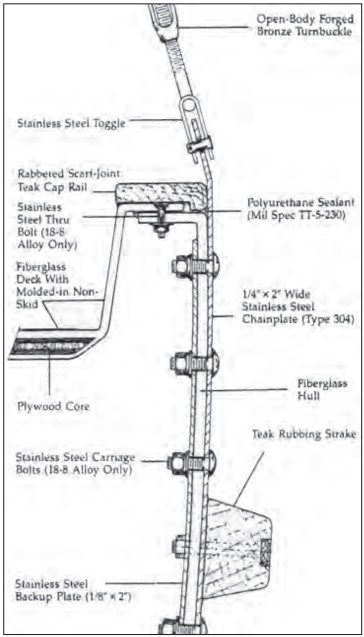
The PS 34 was constructed in compliance with ABS certification. The hull is a hand-laid solid laminate using biaxial cloth and isopthalic polyester resin. Below the waterline, the first laminate is made with vinylester resin and the exterior has a three-layer epoxy barrier coat. A bonded-in-place internal molding incorporates floors and stringers. Primary bulkheads are bonded to the hull and deck and attached with stainless-steel through-bolts to the deck beams. Deck fittings are attached through solid plywood inserts in the balsa-cored deck.
A bulwark is molded into the perimeter of the deck. The bulwark top lands on an inward-turning flange on the hull and is secured to it with stainless-steel bolts to form the hull-to-deck joint, which is covered by a teak caprail.
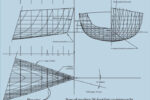
A sweeping sheerline sets off the slim hull and the canoe stern looks as if it should emerge from a full-keel underbody. However, below the water-line the hull has a long fin keel with bolted-on lead ballast and a substantial full-depth skeg that supports the rudder and shields the prop in a well-protected aperture. The boat was offered with the conventional keel drawing 4 feet 11 inches or a Scheel keel that reduced the draft to 4 feet 1 inch. Bob chose the shallow-draft version, a decision he’s glad he made as the lake levels have gone down over the years. The most recent PS 34 hull number is 336, so this design has almost equaled the PS 37 in popularity. A search of Yachtworld.com in late 2011 turned up an equal number, 13, of both the 37 and 34 for sale on the used-boat market. The prices for both models were quite similar and generally higher than for other boats of comparable size, a reflection of the inherent quality of the boats.
In 2007, Pacific Seacraft was acquired by its fourth owner. Steve Brodie, currently president of Pacific Seacraft, and his father, Reid, purchased the company and moved production and many key construction personnel to Washington, North Carolina. They continue to market the entire Crealock-designed range from 31 to 44 feet. In addition to building new boats, Steve, in recognition of the initial build quality of Pacific Seacraft yachts, began a refit program. Many owners of older boats have shown interest in this service and the yard crew has completed many projects ranging from a simple reupholstery job to a complete rebuild. The company is also the central source for parts for Pacific Seacraft boats of all vintages.
Diligent maintenance
The Graebners have had no need for anything approaching a total rebuild. Since taking delivery, Bob has kept the boat at the docks and yard of Yachtworks in Sister Bay, Wisconsin. For the past 20 years, Bob has entrusted Yachtworks with the care of Dalliance. Each fall, prior to haulout, he meets with the service team at Yachtworks to prepare the winter work order. The boat is hauled, cleaned, and stored in a heated storage facility. This protects the boat from the harsh winter weather of northern Wisconsin and keeps the interior of the boat warm and dry.
All exposed brightwork receives at least two coats of varnish each season. This is a substantial annual financial commitment, but Bob believes traditional brightwork is an essential part of the look of the boat. The hull and topsides are power buffed and waxed. The engine and all systems are inspected and winterized before storage. Routine replacement of belts and impellers is performed and logged in the boat’s service record.
Admittedly, this is an ideal maintenance program. When asked about the cost of such a comprehensive service package, Kent Pahlow, service coordinator at Yachtworks, says, “It varies with the size and type of boat, but if the owner is able to budget about 10 percent of the value of the boat, it should pay for a professional maintenance package.” That may seem excessive to many, but this level of maintenance has allowed Bob and Linda to enjoy 20 years of trouble-free sailing on a perfect boat.
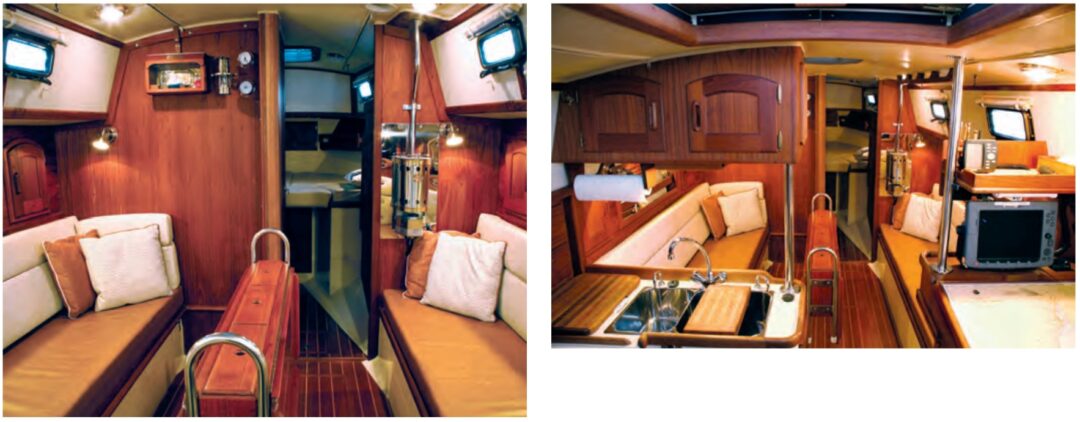
The PS 34 was offered with an option of either a bulkhead-mounted folding table or a securely fixed table in the center of the cabin. “We chose the fixed table, as it provides excellent handholds for moving fore and aft in heavy weather,” Bob says. “Besides, the built-in table storage is ideal for our wine supply.”
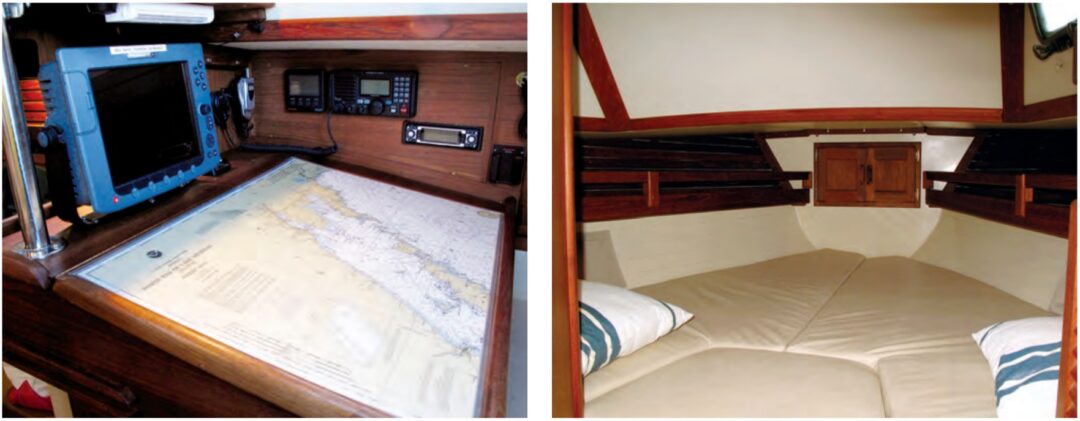
A galley to port and a dedicated navigation station round out the cabin furnishings. The quality of the joiner-work far surpasses that of most production builders. Annually, Bob oils the generous amount of teak in the boat’s cabin and Linda recently reupholstered the cushions in neutral shades of leather. A propane heater in her cozy saloon takes the chill out of late-summer evenings and 12 screened opening ports and hatches let in the summer breeze throughout the accommodations.
To add to the livability of the interior, Bob has designed and had several custom storage and workspace solutions built. He has also modified the original lighting and is gradually adapting it to new LED technology. Over the boat’s 20-year lifespan, the electronic navigation equipment has been upgraded twice. The service department at Yachtworks has also carried out other special projects, such as installing electronics, replacing sails, and doing custom woodwork.
Safe and seaworthy
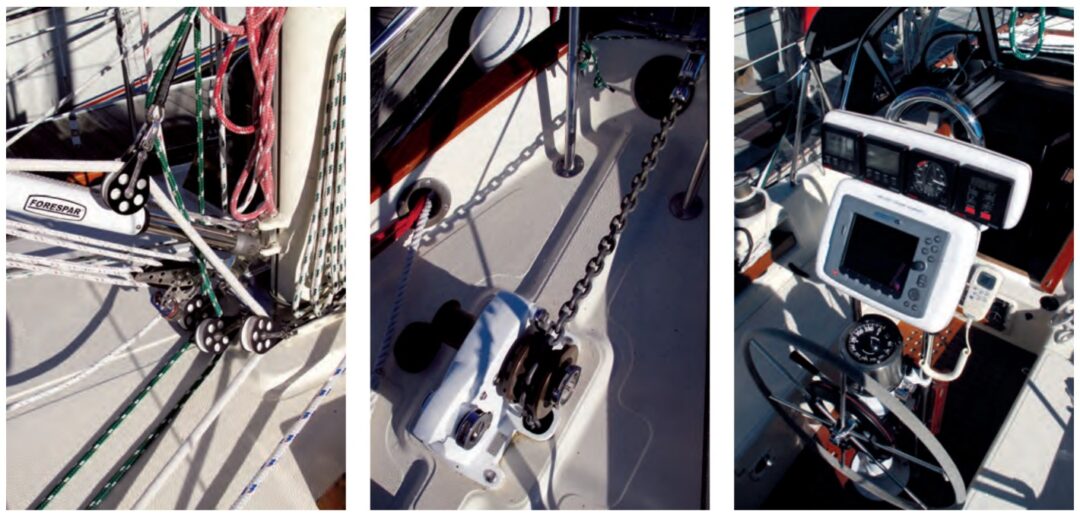
The cockpit in Dalliance is comfort-able and secure for a crew of two in the heaviest of conditions. All sail-control lines are led aft to the cockpit, providing safety at sea . . . but also creating lots of line to deal with in a tight space. The wheel specified on the boat is well-sized and securely mounted but requires anyone moving forward or aft in the cockpit to do a lateral limbo.
“One of the most requested modifications we have carried out over the past few years has been replacement of the wheel with a tiller,” Steve Brodie says. The boat is so well balanced that a tiller is fine for control. This modification opens up the cockpit and is particularly beneficial for those who do a lot of singlehanded sailing, as it greatly improves access to the sail-control lines at the forward end of the cockpit.
Moving forward from the cockpit to the bow, crew will find the sidedecks are secure with many well-located handholds, although her narrow beam requires deckhands to be agile and observant. The boat is fitted with a double-head rig (both roller furling) and the mainsail has two reefs. For a boat with so many modern conveniences, Bob’s choice of a manual anchor windlass is surprising. He feels it is more than adequate, however, and it requires little maintenance.
The Pacific Seacraft 34 appears to meet the goals Bill Crealock had in mind. “She’s a dry vessel in rough seas and her balanced helm makes it easy for the Autohelm,” Bob says.
Dalliance, after 20 years of use, proves the value of high-quality construction combined with a program of fastidious maintenance. So the choice is there: find a tired used boat and rebuild her, a well-cared-for boat that can be cleaned up, or buy a new one with the intent of sailing her for more than 20 years. In any case, the end product is a good old boat.
Bill Jacobs has spent the last 48 years in sailboats and powerboats. His marine photography is displayed in galleries, private collections, and museums and has appeared in boating publications. His articles have been published in boating publications since 2004. Bill winters in Sarasota, Florida, and cruises on a Mainship 34. In the summer he can be found sailing his Cape Dory Typhoon on Lake Michigan off the shores of Door County, Wisconsin.
Thank you to Sailrite Enterprises, Inc., for providing free access to back issues of Good Old Boat through intellectual property rights. Sailrite.com