A fast club racer that accommodates four adults
Issue 88 : Jan/Feb 2013
Rob Geisler needed a new sailboat. Not a new boat as in brand-new, but new as in bigger. He had graduated from a 13-foot Styrofoam tub to a 16-foot fiberglass daysailer and now it was time to move up again. Maybe a 22-footer? There are lots of choices in that range and for where he sails it seemed a good size.
Then a friend told him about a lightly used and largely ignored 1984 Capri 25 in his price range. When Rob first looked at it he wasn’t too sure: mold inside, pale pink outside, and mounds of rotten leaves in the cockpit. But Rob is a retired aerospace engineer and private pilot; he is not easily daunted and loves a good project. In the fall of 2009, the deal was made, the boatd elivered, and a love affair began.
Rob and his wife, Bonnie, live in northern Vermont and sail on Lake Memphremagog, a stunning 30-mile-long lake bounded by towering hills and straddling the Vermont/Quebec border. There is an active racing scene in Newport, Vermont, at the southern end of the lake where Rob could hone his sailing skills and get lots of advice. Rob also had a workshop and the skills to carry out the anticipated boat projects.
Rob spent the winter reading Don Casey’s This Old Boat and was already a subscriber to Good Old Boat. Windshadow was launched in the spring of 2010, not pretty necessarily, but sound and fast and full of possibilities.
Design
Catalina Yachts introduced the Capri line of sailboats in 1972. Frank Butler, the company’s founder, wanted to build boats geared to racers but still suitable for cruising overnight or for a long weekend. Ultimately, Catalina built Capris from 8 to 30 feet, but the most popular were the 25s. Over 300 were made from 1979 to 1989.
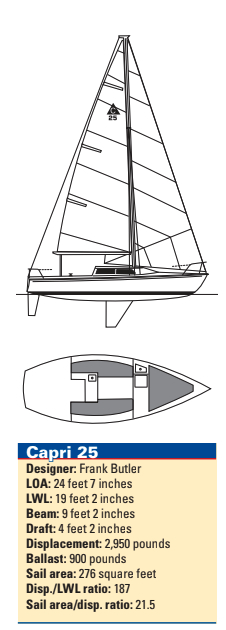
The Capri 25 is a relatively light-displacement racer/cruiser with a displacement/length ratio of 187, which means there is not a lot of volume below the waterline and little wetted surface area to cause drag. Combined with a generous sailplan that gives a sail area/displacement ratio of 21.5, the boat is fast. There’s not a lot of lateral surface area to the keel either. The spade rudder is far aft for control. Generous beam of 9 feet 2 inches decreases rapidly at the bow and stern. The tradeoff for speed is poor tracking — the helm requires constant attention.
Construction
Throughout the hull and deck, Catalina used a Dutch product called Coremat, a non-woven polyester fabric that contains microspheres and, when impregnated with resin, bulks up and stiffens the laminate. It holds up well, keeps the overall weight down, and eliminates soft spots in the deck and blistering in the hull. In the area of the cabin sole where the keel is attached, 3⁄4-inch plywood was installed between the hull and hull liner for rigidity. The keel is a molded fiberglass shell containing 900 pounds of lead. It is fitted into a recess in the hull and then bolted in place. The mast is stepped on deck with a compression post beneath.
The deck is secured to the hull every 4 inches with stainless-steel bolts and that junction is protected with a screwed-in rubrail.
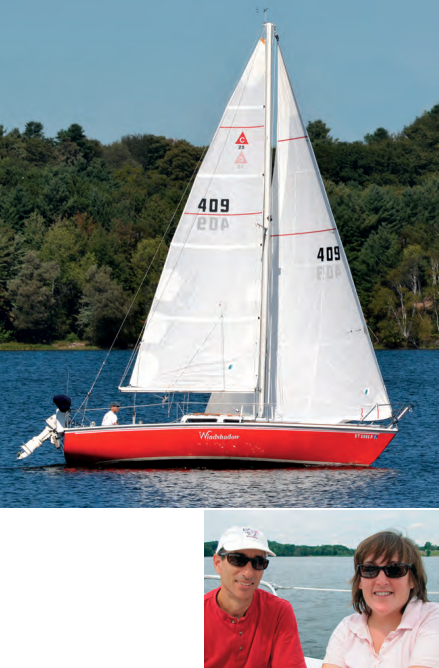
After two failed attempts to restore Windshadow’s hull from its faded pink to its original factory red, Rob sanded it down, removed a few tiny blisters, and painted it Rochelle Red from the Interlux Perfection line, a two-part polyurethane, using the roll-and-tip technique. The result is stunning.
Rig
The masthead rig has upper shrouds, double lowers, and a split backstay. It carries a lot of canvas; the foretriangle is more than 150 square feet and the mainsail 125 square feet. Rob worked with Bill Fastiggi at Vermont Sailing Partners to design a new mainsail with a fuller roach (to take advantage of PHRF rules) as well as a new 155 percent roller-furling headsail, totaling more than 300 square feet of power. All halyards (main, two jibs, and spinnaker) lead to the cockpit. Single-line reefing with two sets of reefing lines is simplified by in-boom blocks. The boat also came with a boom vang, outhaul, and adjustable backstay. Every line, halyard, and sheet needed to handle this boat is within easy reach of the helmsman.
Deck
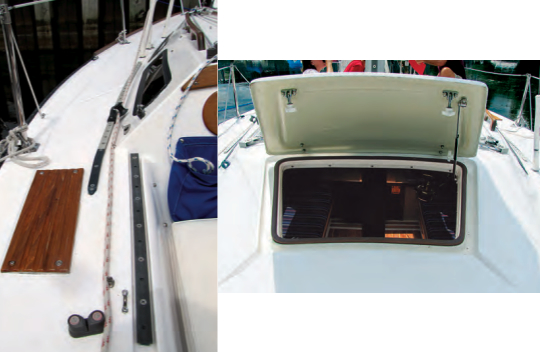
Catalina built plenty of safety features into the boat. Teak handrails run thelength of the coachroof and single life-lines lead from a generous bow pulpit all the way to the solidly built stern pulpit. The chainplates are well inboard, making access to the forward deck easy. The non-skid on Windshadow has held up nicely but it had faded a lot, so Rob painted it with Interlux Brightside. The perforated toerail drains water well and provides attachment points for snatch blocks for the spinnaker sheets. Rob replaced the old cracked boarding plates on the sidedecks with new teak ones from his wood shop.
Lots of evidence on deck points to the Capri 25’s racing pedigree, the absence of an anchor locker, for instance. As the boat was designed for hanked-on headsails, early models had three separate headsail sheet-lead tracks: a short one well forward near the chainplates, a longer one amidships, and a third molded into the cockpit coaming. Later models like Windshadow have just two tracks. This requires the jibsheet car to be moved from track to track when sails are changed, an issue not totally resolved with a roller-furling headsail. Genoa winches are mounted on the cockpit coaming and halyard winches are on the cabintop; the original winches are not self-tailing. Numerous fairleads and blocks adorn the deck, some original and some placed by previous owners to enable them to use performance-enhancing sail trim techniques when the boat was being raced. The whisker pole is stored on the foredeck.
Cockpit
This boat has one huge cockpit for a 25-footer. The seats are a full 8 feet long and, while the seatbacks are low, an NBA player could easily stretch out for a nap. The traveler runs athwartships mid-cockpit, but doesn’t interfere with the seating, especially since Bonnie had thick new cushions made to order. The tiller attaches to the rudder stock through the aft cockpit floor (a tiller pilot has been added), and there are two generous scuppers nearby. The bridge deck is low and unobtrusive. Huge lockers are under both cockpit seats. Rob keeps his outboard gas tank in one and ground tackle in the other. He plans to install shelves and hooks to make the space more efficient.
Catalina specifies a 4-horsepower transom-mounted outboard motor, but Rob has had no trouble using a 9.9-horse- power long-shaft motor.
Accommodations
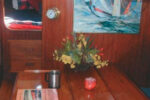
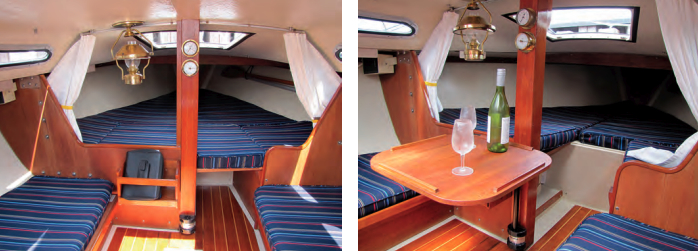
Racer/cruisers like the Capri 25 don’t offer a lot down below. Nonetheless, Rob and Bonnie have enhanced Windshadow’s interior considerably with a symphony of color. The teak-and-holly sole has been sanded and sealed with polyurethane varnish. New bright blue cushions are easy on the eyes. The hull and overhead look like they were painted yesterday, though they are the original factory fiberglass liner just scrubbed clean by Bonnie. Through-bolts for all cabintop and deck fittings are easily accessible, so rebedding them is a breeze. Many of the through-deck fittings leaked when Rob bought the boat; he removed them all and, following the advice of Good Old Boat’s technical editor, Jerry Powlas, used silicone to rebed them.
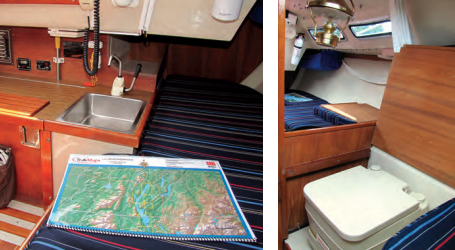
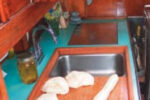
There is a cubby for a large ice chest under the single companionway step and a sink just to port with a 7-gallon freshwater tank. Two bilge pumps, one electric and one manual, handle water in the shallow bilge, which is under the cockpit. There is also enough space under the cockpit for a 12-volt battery to power house lights and running lights. The previous owner had installed a built-in gas tank for the outboard inside the cabin, right next to the battery. Rob knew that was an unsafe location (as well as an odor problem) so the tank came out and was replaced by a 6-gallon tank in the well-ventilated port cockpit locker.
The compression post is finished in teak, as are the partial bulkheads separating the main and forward cabins. The V-berth is a full 8 feet long. Midships to port is a portable toilet with a privacy curtain. The two settees extend under the cockpit and are also 8 feet in length, so four adults can sleep below. Storage abounds under the forward berth and both settees. A lovely teak table fits on the bulkhead below or it can be installed in the cockpit. A gimbaled one-burner stove clips to the aft bulkhead. Headroom is just 4 feet but a 6-footer can stand in the open companionway under the dodger.
Under way
There was no missing Windshadow as my wife, Jennifer, and I walked down the Newport docks to meet Rob and Bonnie. The glistening red hull may be a disadvantage if they’re over the starting line early in a race but is a big help in finding them in a crowded marina. The gleaming topsides and well-finished brightwork were clearly evident.
The winds were moderate and fluky on the day we took her out on Lake Memphremagog but this boat can move. As the puffs caught us, Windshadow heeled and accelerated smartly up to her hull speed of nearly 6 knots (Rob’s GPS has recorded speed over ground of nearly 9 knots on occasion). The mast-top apparent-wind indicator is set at 60 degrees and Rob could easily tack the boat through 60 degrees of apparent wind. Rarely does a boat turn in its own length but this one does, losing hardly any speed in a tack. Falling off in a puff positively launched Windshadow forward, and jibing was easy with all the sheets so readily accessible.
Rob replaced the original traveler with a Harken Windward Sheeting Car, which automatically releases the leeward cleat when the windward cleat is tensioned. This is a neat design that makes the mainsheet much more accessible and eliminates the need to scramble to leeward if the boat rounds up too much in a puff. Bonnie has to move the genoa lead from the track on the coaming to the track farther forward when they furl the headsail, but she makes it look effortless. The extra roach on the main tickles the adjustable backstay a bit, but after a summer of sailing the fabric showed no ill effects.
At two-thirds throttle, the 9.9-horse-power outboard powered us back to the dock in flat water at almost 6 knots.
Conclusion
The Capri 25 seems like a perfect daysailer or small club racer. Most fleets rate 171 to 174 PHRF, about the same as the J/24. They can be found online for $6,000 to $10,000 depending on condition and accessories. The only concerns expressed in online forums are some issues at the leading edge of the keel and water infiltration through the deck-fitting holes. Other negative remarks may be found in the sidebar, “Comments from Capri 25 Owners,” on page 25 and below. As is characteristic with so many boats built by Catalina, an active owners association maintains an extensive website.
The Capri 25 has “opportunity” written all over it. One could easily imagine the lockers filled with groceries, sleeping bags, and other gear for longer cruises.
As Rob and Bonnie have shown with Windshadow, this boat can be made not only to perform but also to turn heads in any anchorage.
Fred Bagley and his wife, Jennifer, live in Vermont but sail the upper Great Lakes out of Penetanguishene, Ontario, in southern Georgian Bay. They primarily cruise Georgian Bay, the North Channel, and Lake Superior on their Caliber 38, Catamount.
Thank you to Sailrite Enterprises, Inc., for providing free access to back issues of Good Old Boat through intellectual property rights. Sailrite.com