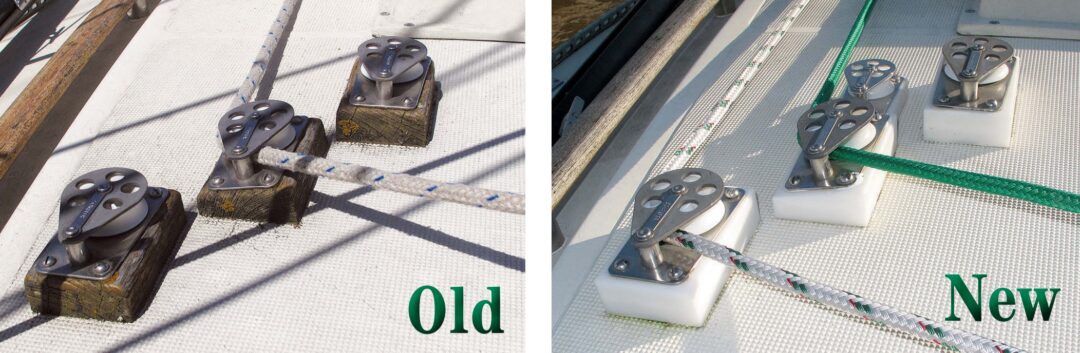
Clean new bases for turning blocks
Issue 98: Sept/Oct 2014
I’m slowly replacing the teak on my boat with materials that don’t need refinishing. There wasn’t a lot to begin with, so whether I choose to use teak or not doesn’t affect the look or personality of my boat.
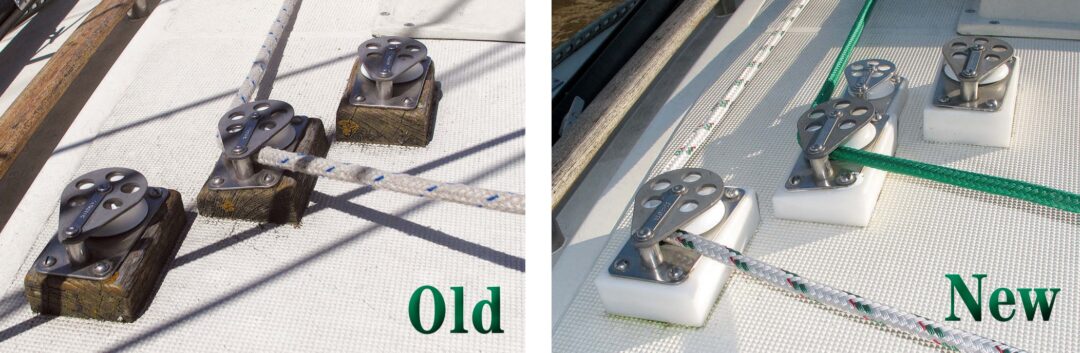
The turning blocks on my deck were mounted on teak bases to raise them or tilt them toward the exit points at the mast. The green fuzz they were growing made them look like chia pets. I had some 1-inch Delrin left over from another project and decided that would work for duplicating the wooden bases.
The flat-topped bases were easy to make just by cutting the Delrin to shape on a table saw, but the bases with angled tops were a little trickier. Delrin is a very tough material. Since I didn’t want to risk having the table saw launch a piece toward my face, I first cut the angled top on my band saw, then adjusted my table saw to the same angle and cut off just enough to give a nice finish on top. A pass around the tops and corners with a 1⁄4-inch roundover bit in my router left them with a smooth, finished look.
If you do likewise, don’t assume the existing holes in your deck match the hole patterns in your turning blocks. Whoever installed the wooden bases on my boat obviously drilled them by hand with the drill held at odd angles for each hole. I ended up filling the holes in the deck with thickened epoxy and re-drilling them.
Delrin is a nice material to work with. It’s easily shaped with wood-working tools, although it’s a bit tough for hand tools. I wouldn’t want to try carving it with a knife. If your drill bits are like-new sharp, they may “jump” when they exit the material. I have ground a few drill bits to a low-angle cutting edge at the tip and use them exclusively for plastic. It’s not a necessity, but it helps avoid that sudden jerk. Likewise, your table saw should have a sharp blade to prevent kickbacks. I bought an inexpensive carbide blade that I use only for cutting plastics.
If there is a machine shop in your area that works with plastics as well as metal, you might see if they have any Delrin “drops” (shop talk for scraps). If you can find an inexpensive source for the material, I’m sure it will find its way into some of your projects.
Jim Craighead and his wife, Annie, are primarily weekend sailors. Midweek, while their good old S2 9.2A sits alone in Schooner Bay Marina, gateway to the Apostle Islands, Jim is soldering, sewing, gluing, or welding on projects to make her “better.” While Jim and Annie know there is no better place to sail her, they are considering adding a trailer-sailer to their fleet.
Thank you to Sailrite Enterprises, Inc., for providing free access to back issues of Good Old Boat through intellectual property rights. Sailrite.com