What’s the D/L with the SA/D?
Issue 93 : Nov/Dec 2013
Good Old Boat receives frequent letters from readers asking for an explanation of the formulas used to compare sailboats. We generally refer people to articles written by Ted Brewer and published in the earliest editions of Good Old Boat. The formulas have not changed, but we thought it was time to refresh all our memories. We asked Rob Mazza to explain just four: Displacement/Length Ratio, Sail Area/Displacement Ratio, Comfort Ratio, and Capsize Screening Formula. –Eds.
A number of ratios have been used for many years to predict the comparative performance of different boats: faster or slower, comfortable or less comfortable, better-or less-suited to offshore sailing. Due to the laws of scaling, the ratios must be “dimensionless” if boats of varying sizes are to be compared with any accuracy. All things considered, a longer boat will generally be faster than a shorter boat, and longer boats have substantially larger displacements than smaller boats because the volume a boat displaces does not increase in equal proportion to its length but with length cubed. The formulas that produce the ratios use a boat’s dimensions along with some factors to “jiggle” them a bit so the resulting numbers are manageable.
Displacement/Length Ratio
Archimedes proved that the weight of the water displaced by a floating body is equal to the weight of that body. Thus the term “displacement” refers to the weight of a ship or boat. This ratio shows whether a boat is light for its waterline length (low value) or heavy for its waterline length (high value).
Displacement is also a volume measurement, that is, a cubic measurement. The length in the denominator of the formula is the length, in feet, of the Load Water Line (LWL), sometimes called Length on Waterline. To arrive at the desired dimensionless ratio, the denominator and the numerator in this fraction must have the same dimensions. If you merely divided the displacement (an L-cubed measurement) by the LWL (L), you would get an L-squared measurement, or area. This is not dimensionless.
Achieving a dimensionless result requires either dividing the cube root of the displacement by the LWL or dividing the displacement by the LWL cubed. Early scientific designers opted for the latter solution. However, to achieve a manageable number, rather than the full LWL, only .01 x LWL was used in the cubed function. As this ratio has been around for quite a while, the unit used for displacement is actually the British long ton, which is 2,240 pounds, not 2,000 pounds. Therefore, the displacement of the vessel in this formula is its weight in pounds divided by 2,240 to achieve its displacement in long tons. Consequently, the formula for the Displacement/Length Ratio is:
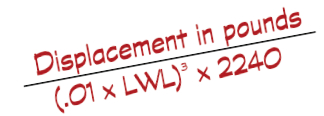
Boats that appear in Good Old Boat are typically fiberglass production racer/cruisers from the 1960s to the 1990s and into the 2000s. For these boats, the range of D/L Ratios goes from about 200 on the “light” side to about 350 on the “heavy” side, but extreme designs can be as “light” as 60 to, occasionally, as “heavy” as more than 400.
Of course, once the LWL became important as a measurement in rating formulas, clever designers started to fudge the rating by shortening the measured LWL and adding longer overhangs and fuller ends to achieve a heeled waterline that was considerably longer than the static, upright LWL. Therefore, the D/L Ratio may not be a completely realistic ratio when dealing with boats with long overhangs and full ends (scows, for instance) that achieve longer sailing waterline lengths when heeled.
Sail Area/Displacement Ratio
Sails deliver the power for a sailboat and the SA/D Ratio is an attempt to achieve a dimensionless power-to-weight ratio. Sail area is calculated using the I, P, J, and E spar measurements rather than the area of the actual sails used.
This means the genoa overlap and the roach of the mainsail are ignored, as are the areas of spinnakers and staysails. In double-headsail cutter rigs, the entire foretriangle, defined by the I and J measurements, is used in the calculations, rather than the totalled individual areas of jib and staysail. Cutter rigs with long bowsprits, such as the Westsail 32, may therefore end up with a higher SA/D ratio in theory than in practice. As with the D/L Ratio, the Sail Area/Displacement Ratio needs to be dimensionless. Simply dividing Sail Area (L squared) by Displacement (L cubed) would give us a strange dimension of 1/L, so some adjustments are necessary.
Rather than taking the square root of sail area and the cube root of displacement, the scientific designers of the past decided to take the 2⁄3 root of displacement in the formula. To confuse things even more, displacement in this ratio is not measured in long tons, as in the D/L formula, but in cubic feet.
Since displacement is always published in pounds, to find displacement in cubic feet, the published displacement in pounds must be divided by the density of salt water (64 pounds/cubic foot). For consistency in the numbers, the density of seawater, rather than fresh water (62.4 pounds/ cubic foot), is always used. This higher density of seawater, of course, explains why boats float higher in salt water than in fresh.
Consequently, the final formula for the SA/D Ratio is:
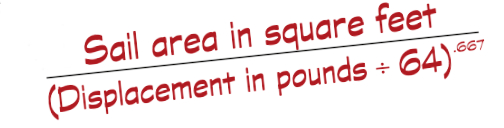
Heavy under-canvassed boats have SA/D Ratios in the 14 to 15 range. The average racer/cruiser has an SA/D Ratio in the 16 to 18 range, and anything higher that that is considered to be a lightweight flyer.
I have mentioned in past boat-comparison articles that the most problematic number in yacht design and the yachting industry is the published displacement. Both of these ratios can be skewed a lot if the published
displacement is wrong, as it often is for some of these older boats. It’s inevitably lighter than reality, not only because boats always get heavier as they get older and accumulate much more “stuff,” but also because the published displacement is often the designed (wished for) displacement, rather than the actual (oh, nuts!) displacement observed when the prototype sat low on its lines after it was launched.
It is often the more optimistic (and more marketable) designed displacement that appears in the brochures. Also, the designed displacement might be calculated based on half-full water and fuel tanks with no provisions on board or on a completely empty boat (racing trim). The end result is that a fully laden boat in cruising mode can be, and usually is, much heavier than its published displacement.
Comfort Ratio
Ted Brewer developed an ingenious ratio as a way to measure “motion comfort.” Ted describes the origin of this ratio in a past article in Good Old Boat (see “Resources,” page 28) and on his website, www.tedbrewer.com. Ted based his formula on the premise that a boat that exhibits quick upward motion in a seaway will be more uncomfortable (or vomit inducing) than a boat in the same conditions that exhibits slower upward motion. Ted surmised that the speed of upward motion is inversely related to the yacht’s displacement (a heavier boat will react more slowly than a lighter boat in the same sea state due to its greater inertia). Although its amount of travel might be greater, the speed or frequency of travel will be less.
Ted surmised further that the speed of upward motion is directly related to the area of the waterline plane (beamy boats will react faster than narrow boats). He hypothesized that beam not only affects the waterplane area but it contributes an additional factor of increased form stability that also results in a faster motion. For this reason, Ted accentuated the beam factor in the formula by raising it to the 1.333 power. The formula Ted derived is essentially the displacement in pounds divided by an estimate of the waterplane area, with an additional exponential applied to the maximum beam. The area of the waterplane is calculated by multiplying the length of the waterline by the beam and, since most boats are pointed at each end, assuming that the actual waterline plane is only 65 percent of that number. However, he also recognized that the waterplane of a boat is not static in a seaway and increases with the boat’s pitching as the bow and stern overhangs become immersed. For length, therefore, Ted chose a statistical average by using 70 percent of the LWL plus 30 percent of the LOA.
The Comfort Ratio formula is:
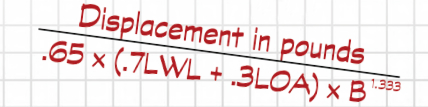
As you can see, this is not a dimensionless formula, since it is essentially L cubed divided by L to the power 2.333, which results in the dimension of length to the power 0.667. If Ted had used B squared in the formula, rather than B raised to the power 1.333, the dimensions would have worked out better, but beam would have played far too significant a role in the formula, not unlike the way it did when a 19th-century measurement rule produced the plank-on-edge cutters. Therefore, Ted is quick to point out that it is useful to compare the Comfort Ratios of boats of similar sizes and types but, in Ted’s words, “not to compare that of a Lightning Class sloop with that of a husky 50-foot ketch.”
Ted points out, “Ratios will vary from 5 for a light daysailer to the high 60s for a super-heavy vessel, such
as a Colin Archer ketch. Moderate and successful ocean cruisers, such as the Valiant 40 and Whitby 42, will fall into the low-middle 30s range.” However, the Comfort Ratio is entirely a relative expression, as Ted further acknowledges. “Do consider, though, that a sailing yacht heeled by a good breeze will have a much steadier motion than one bobbing up and down in light air on leftover swells from yesterday’s blow, also that the typical summertime coastal cruiser will rarely encounter the wind and seas that an oceangoing yacht will meet. Nor will one human stomach keep down what another stomach will handle with relish, or with mustard and pickles for that matter! It is all relative.”
Capsize Screening Formula
After the disaster of the 1979 Fastnet Race, stability, capsizing, and inverted stability became the subject of great focus. The Capsize Screening Formula derives from an attempt by the Cruising Club of America to quantify a boat’s “bluewater” capability. This formula compares the vessel’s maximum beam to its displacement on the assumption that excessive beam is undesirable and, especially when combined with low displacement, can potentially result in the boat staying inverted for a good period of time after turtling.
The resulting rather simple Capsize Screening Formula is the maximum beam of the boat divided by the displacement. In this formula, the cube root of displacement in cubic feet (obtained by dividing the displacement in pounds by 64) is used to achieve a dimensionless number that’s reasonable to deal with.
The Capsize Screening Formula is:
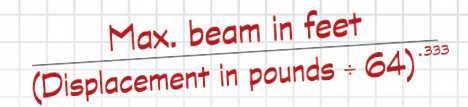
Any value of CSF of 2 or less is deemed acceptable. The lower the number, the better. However, if you have no intention of taking a boat offshore and are only interested in coastal cruising, numbers slightly above 2 may well be acceptable.
This beam and displacement argument goes back to the “cutter cranks” of the 1880s, who were advocating the greater safety of the narrow-beam heavy-displacement British cutter compared to the wide-beam light-displacement American sloop, which often did capsize (see my article, “What is a Cutter?” November 2012). There really is nothing new under the sun!
Rob Mazza is a Good Old Boat contributing editor. As well as being a lifelong sailor, he spent much of his adult life designing sailboats. Since he began his design career at C&C Yachts when that company was building boats that are still very popular, he knows firsthand what makes an old boat good.
Thank you to Sailrite Enterprises, Inc., for providing free access to back issues of Good Old Boat through intellectual property rights. Sailrite.com