A solo sailor is active in mind and body
Issue 98: Sept/Oct 2014
In 1974, I owned a varnished wooden Folkboat in Branford, Connecticut. On my first try at sailing solo I was wracked with anxiety, not so much about the sailing (the day was calm) but about the docking afterward. As I motored out past neighbors that included a globe-girdling William Atkin ketch, a Dutch sloop that had just crossed the Atlantic, and an offshore yawl whose lines made me sigh, I wondered where this first tentative step might lead. I remember every detail of that day. By the time I returned, I felt I’d flown and landed a Boeing 727 all by myself. Sometimes the smallest steps are the biggest.
Plan every action
The fundamental rule for going solo is to plan ahead. Before you dock, anchor, or make a sail change, think through every move you’ll need to make and visualize how the boat might respond. Think about what could go wrong. Visualizing banishes most (but not all) of the unexpected and is initially the hardest part of solo sailing.
It’s also important to take your time and never rush. There’s no backup when you’re by yourself. A trip and fall could be far more serious alone. Wear your PFD or safety harness on deck and have a system for moving about the boat securely. On small boats, chest-high lifelines can be easier to use and safer than jacklines on the deck.
It’s a good idea to have a boarding ladder or other arrangement that can be deployed from the water and will enable you to climb back aboard. This can be as simple as a footrope in a bag with a release line.
Can you leave the helm for more than a few seconds? You need a way to either lash the helm or engage an autopilot or windvane to allow the boat to stay on course when you need to work elsewhere.
Be organized, be prepared
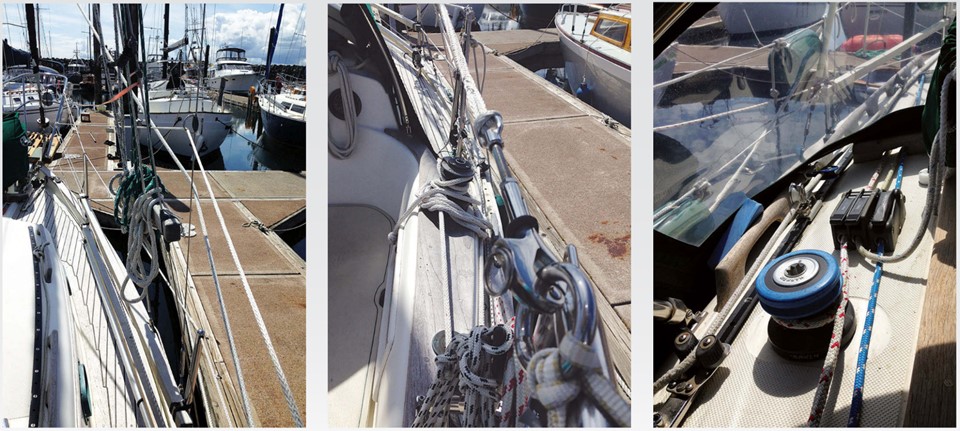
Go over your boat’s rig looking for chafe, bad leads, and other problems and make repairs and improvements. Do halyards, sheets, furling lines, or other items get thrown in tangled piles in the cockpit or on deck? Is a jibsheet likely to snag when you come about? Are all your rigging leads fair and do they run smoothly? Bad leads chafe line and will wear you out with unnecessary effort. Can you prevent accidental jibes?
Notice what is inconvenient or unsafe on your boat and upgrade it. For example, having certain lines within reach from a secure position is a safety issue. If reefing is inconvenient or difficult, you might be tempted to delay it.
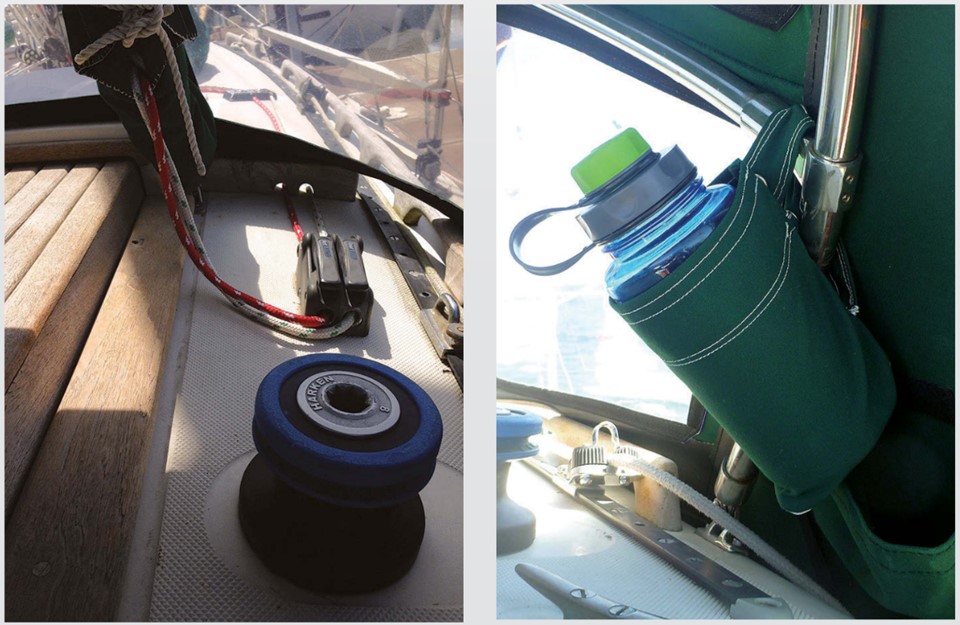
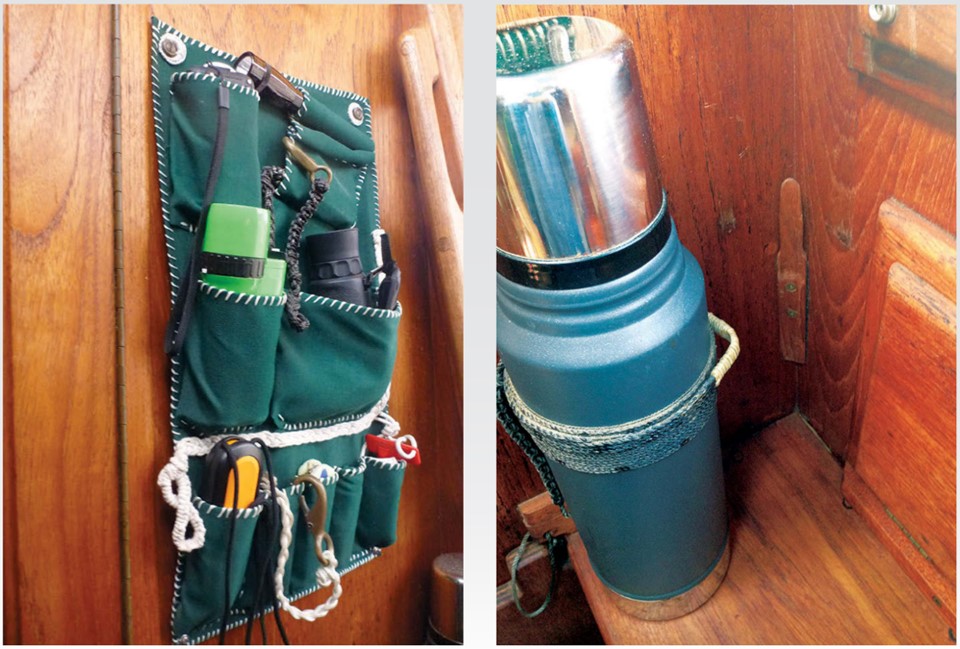
Organize the cockpit so charts, binoculars, water bottles, or other items you need are within easy reach. Small custom-made (or homemade) canvas pockets will repay you handsomely.
Talk to other solo sailors; most are glad to share ideas.
Be methodical
Plot your courses on a paper chart as backup in case your electronic chart plotter fails. If you’re ever forced to wing it, it will be easy to grab the paper chart, and the discipline you’ve practiced will go a long way toward reducing anxiety when you have to make decisions in difficult conditions. In unfamiliar waters, use more than one source of information, such as charts, cruising guides, electronic aids, and local knowledge when you can get it. Read the guidebook in advance and note any danger points. Don’t use your chart plotter as a reference map only. Plotting your course on it gives you the comfort of a line to follow and allows you to see how far you’ve gone and how far you have to go. It also pinpoints your position relative to your course.
As I sailed Alaska’s Inside Passage alone, it was a lot of work plotting each day’s course on paper charts as well as creating waypoints on my GPS. But doing this visually fixed the day’s run with its courses, distances, danger points, and potential bailout anchorages in my mind. I used the airplane pilot’s golden rule: always scan for an alternate landing place, in case some emergency forces you to seek shelter. Just to be sure, before I went into any new harbor I took a long look at the chart to memorize the main characteristics of its entrance.
Be extra alert for changes in the weather. Anytime you’re faced with unfamiliar waters or challenging weather, the extra work you did will pay dividends in confidence and safety.
Being methodical can also mean preparing your lunch and a thermos of coffee before getting under way in the morning. You might not have the luxury of time away from the helm when you get hungry later.
Keep a good lookout
Solo or not, the need to keep a constant and good lookout never changes. Radar, radar alarms, and AIS (automatic identification system) are excellent aids, but are no substitute for a pair of eyes. In 15 minutes, a large ship that’s a distant hull-down shape on your horizon can materialize into a close-quarters encounter. Near the coast, a small wind shift could cause your boat to change course and sail into danger. A visual 360-degree sweep of the horizon every 10 minutes in clear weather (more often in fog) is more than some are willing to do, but that’s what I choose. In crowded coastal waters, being alert will keep you out of trouble. Let your ears and nose help too. Sometimes in poor visibility you can smell a ship before you see it and, if you’re not motoring, you can often hear engine and propeller noises a mile away through your hull.
Another strategy that works well in bad visibility, or in a situation where you can’t identify a ship’s lights or the direction it is traveling, is to make a Securité call in which you identify your boat and state your position, speed, and course. Big ships appreciate it when an unidentified blip on the radar screen proactively speaks up. If you’re crossing or sailing near shipping lanes, give Traffic Control your position, course, and speed. They will often broadcast them to every ship in the area if the visibility is poor.
When sailing offshore and away from shipping lanes, have a plan for getting sleep on passage. You can take longer intervals between horizon sweeps. A friend who sailed solo to the South Pacific from Puget Sound uses an alarm rigged for 20-minute intervals. If he sleeps through the first alarm, a loud klaxon goes off, a noise so unpleasant he’ll avoid having to hear it by getting up, as he’d intended.
Don’t assume the other boat sees you. On our recent Pacific crossing we met only two sailboats. One of them did not see us less than half a mile away . . . until we called it on the radio.
Get familiar with your boat
Learn how your boat behaves under power and sail and don’t default to relying on the engine to keep you out of trouble. Go out and practice all your skills in good weather until you feel confident. Then go out in weather that’s more challenging. The confidence you’ll gain is immeasurable.
Karen Sullivan sailed with her partner, Jim Heumann, from Port Townsend, Washington, to New Zealand in their Dana 24 from 2011 to 2013. Before that she cruised in Alaska’s Prince William Sound and soloed down the Inside Passage in her previous Dana. A long time ago she sailed between Maine and the Caribbean in various boats. She is at work on a book about their Pacific crossing. Read more at: http://karenandjimsexcellentadventure.blogspot.com.
Thank you to Sailrite Enterprises, Inc., for providing free access to back issues of Good Old Boat through intellectual property rights. Sailrite.com