Sophisticated mechanisms that use a simple principle
Issue 93 : Nov/Dec 2013
Windvane steering was pioneered by Blondie Hasler in the 1960s and is the autopilot of choice for many bluewater sailors. It relieves the stress of constantly being at the helm. Although it can’t steer a compass course, when the sails are properly trimmed it does an excellent job of steering a heading in relation to the wind direction while using only the wind and the boat’s motion through the water for power.
Choosing a windvane steering system is not simple. Several basic mechanisms are used and manufacturers add their own variations and innovations. The choice is also affected by practical considerations dictated by aspects of a boat’s design.
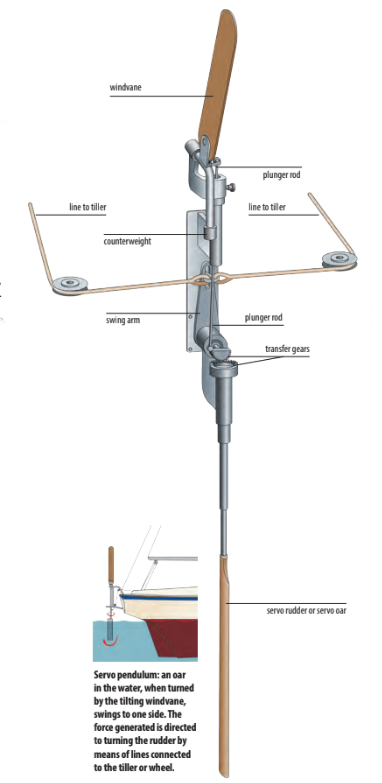
How it works
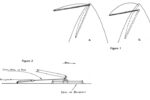
All windvane steering systems share a common principle. A small windvane, usually made of thin plywood, aluminum, or fiberglass, is aligned edge-on to the wind. When the boat goes off course or the wind direction changes, the wind puts pressure on the side of the vane. This pressure is used to adjust the boat’s course.
When setting a course using the windvane, the boat is brought to the desired heading and the sails are trimmed to balance the helm. The vane is then set edge-on to the wind and the connection to the steering mechanism is engaged.
The windvane is on a pivot at the bottom and a counterweight holds it upright when it’s edge-on to the wind. When the wind gets on one side of it, the pressure tilts the vane around its pivot point. Since the vane is small, the force that results from the wind pressure on it is also very small and has to be mechanically amplified. This can be done in several ways.
Three basic windvane systems are in common use: the servo pendulum, the trim tab, and the auxiliary rudder. The choice of the windvane system and manufacturer is often determined by the configuration of the boat on which it will be used.
For a tiller-steered boat, the servo-pendulum type is a good choice. A boat steered with a wheel having multiple turns from stop to stop might do better with the auxiliary rudder, since the windvane would not have to interact with the boat’s main steering system.
Servo pendulum
A servomechanism controls large amounts of power output by means of very small amounts of power input while automatically correcting in response to feedback. In the case of the windvane, the mechanism uses the small amount of wind power from the windvane to activate the large amount of power needed to steer the boat.
In the servo-pendulum system, the base of the vane is connected to a servo rudder, or servo oar, that’s in the water. This is a small balanced or semi-balanced blade and it’s on a pivot so it can swing (as a pendulum) from side to side. When the windvane is upright, this blade is centered, edge-on to the water flow. When the windvane is deflected by the wind, it turns the blade. The pressure of the water flow on the turned blade makes it swing to the side with considerable force, depending on how fast the boat is moving through the water. This large force, transmitted by means of lines connected to the tiller or to a drum on the steering wheel, is used to turn the boat’s rudder and bring the boat back on course.
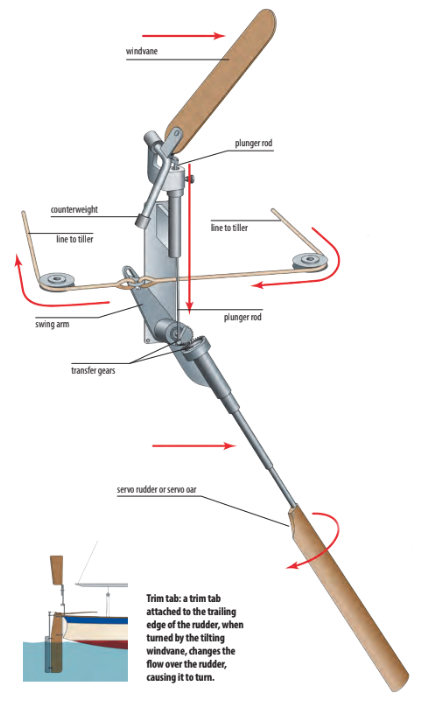
Trim tab
In this system, a trim tab is mounted to the trailing edge of the boat’s rudder or mounted on an extension fastened to the rudder so the trim tab is well aft of the rudder’s trailing edge. The trim tab is balanced or semi-balanced and requires little force to turn it. When the windvane deflects, it turns the trim tab. This causes the main rudder to turn and bring the boat back to the desired heading.
Auxiliary rudder
The auxiliary rudder system uses a completely separate, smaller balanced rudder to steer the boat. First, the sails are trimmed for balance and the boat’s rudder is locked in a position that keeps the boat on a straight course. The auxiliary rudder, which is coupled to the windvane, is then used as the steering rudder. Since the balanced auxiliary rudder is easy to turn, the windvane can drive it directly.
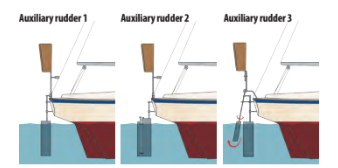
In some applications, a trim tab is used on the auxiliary rudder while in other systems a servo pendulum is used to turn the auxiliary rudder.
Advantages
For bluewater passages, windvane steering has advantages over an electric autopilot steering a compass course. It can eliminate luffing when going to windward or accidental jibes when running, both of which result from changes in wind direction, and it does its job without consuming the boat’s limited power.
Don Launer, a Good Old Boat contributing editor, built his two-masted schooner, Delphinus, from a bare hull. He has held a USCG captain’s license for 40 years and has written five books. His 101 articles through November 2011 are available for downloading as a collection from the Good Old Boat download website, www.audioseastories.com. Look under Archive eXtractions.
Thank you to Sailrite Enterprises, Inc., for providing free access to back issues of Good Old Boat through intellectual property rights. Sailrite.com