A race for chariots and classics alike
Issue 95 : Mar/Apr 2014
While I’ve sailed and cruised much of my life, I’ve never been a racer, never even attended a race. So the day before the start of the 2013 Swiftsure International Yacht Race last May, when I set out to meet the skippers and their crews, I didn’t expect to find folks with whom I’d have much in common.
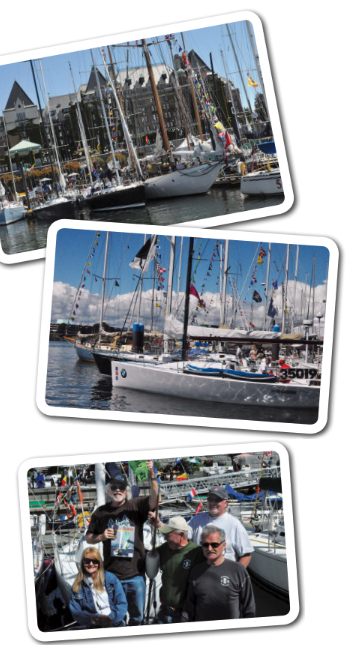
The Swiftsure Race, the grand dame of yacht racing in the Pacific Northwest, has been a fixture for more than 70 years. Crowds in the Inner Harbor of Victoria, British Columbia, were swelling and buzzing; something big was happening. Tents were up, banners were flying, and merchants were selling — offering Swiftsure discounts and hawking Swiftsure shirts and souvenirs.
At the nearby customs dock, sailboats from U.S. ports like Portland, Seattle, and Port Townsend tied up one after the other to check in. Canadian boats from Vancouver, Nanaimo, and all around Victoria went directly to the city docks in front of the Empress Hotel. All winter long these docks had been home to only a dozen boats, but now there were more than a hundred, most rafted, many three-deep, all dressed with burgees and pennants strung up the masts.
A race around a lightship
In 1909, the United States anchored a lightship on the 100-foot-deep Swiftsure Bank, 15 miles northwest of Cape Flattery at the northwestern tip of Washington state. This lightship served as an aid to navigation at the dangerous and confusing entrance to the Strait of Juan de Fuca. From 1930, the lightship served as the rounding point for the occasionally run Swiftsure Lightship Cup race. After WWII, in 1947, the Swiftsure Trophy Race was officially organized and the anchored lightship spent the final 20 years of its service life as the mark for the 139-mile yacht race from Victoria. These days, the Canadian navy ceremoniously anchors a ship in the same spot to serve as the rounding mark for the sailboats and as a safety resource.
The Swiftsure Race attracts a couple hundred boats that race simultaneously on four courses, ranging from the 139-nautical-mile Lightship Classic — an overnight race that runs the length of the Strait of Juan de Fuca, around the Swiftsure Bank northwest of Cape Flattery, and back — to the 19-mile Inshore Classic that begins in Victoria, runs along the south coast of Vancouver Island, and ends at the Royal Victoria Yacht Club on a course that varies, as it is set each year according to wind and tide. While a host of sexy, big-dollar sleds competes in the long-distance Lightship Classic race, the short Inshore Classic race, introduced in 2004 and sponsored by Good Old Boat magazine, boasts the most entrants (about 60). This shorter race is sailed almost exclusively by owner-skippers — serious racers, I assumed, who don’t suffer non-racers gladly. It quickly became clear, however, that Swiftsure is for every type of sailor.
Sailboat racing takes place year-round in the straits and sounds of the Pacific Northwest and it isn’t for the faint-of-heart. Floating logs, crab traps, strong tidal currents, and sometimes very light winds — especially at night — are a challenge for Swiftsure competitors. The Swiftsure Inshore Classic has classes for boats with and without flying sails, making it accessible to all sailors. For the three long-distance courses, part of the challenge is the likelihood of light winds at some time during the race, often during the night, when “Driftsure” conditions prevail.
Swiftsure regulars
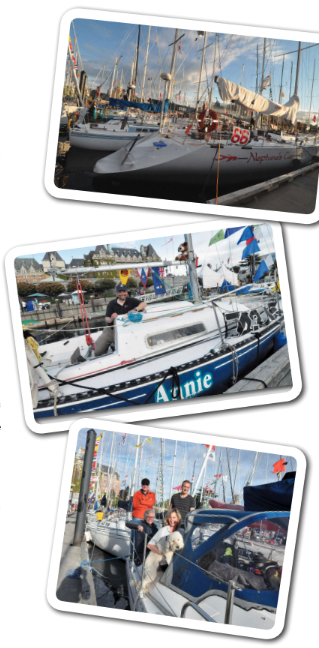
The first Swiftsure competitor I encountered was Annie, a 1977 C&C 24. There were duct tape repairs on her hatch, her companionway slat was unfinished plywood, and a teddy bear sat in a bosun’s chair halfway up the mast. Skipper Roger Aubin beamed from the cockpit.
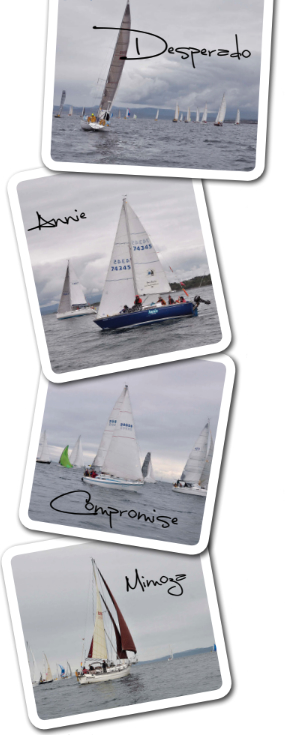
“I’ve been racing Swiftsure for 11 years,” he told me. “We won our division in 2009.” Annie takes part in the 79.7-nautical-mile Juan de Fuca course, the third-longest course, that always takes his modest craft at least 24 hours to complete. Roger credits his success to Swiftsure-itis, a condition he claims allows him to forget everything but the beginning and the end of the race so he returns each year, forgetting the cold, damp night that awaits him. “That’s the hardest part of this race.”
He says one of the greatest things about the race is the volunteers. “There are hundreds of them, always helpful, always excited to see you — they make all the racers feel like rock stars.”
Roger won the Swiftsure in 2009 using his anchor. “Toward the end of the race,” he says, “we had a strong opposing tide and only zephyrs that everyone was trying unsuccessfully to capture. We dropped the hook and waited for hours while everyone slipped miles behind us.”
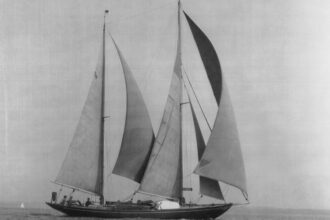
Annie wasn’t the kind of raceboat I expected to see — and Roger wasn’t the kind of skipper I expected to meet. Wandering into the crowds packing the docks, I was surprised by the diversity of racing boats. Some were sleek, open-transom, dual-helm thoroughbreds. But there were also 100-year-old wooden schooners, heavy-displacement cruising boats, and lots of 1970s- and ’80s-vintage good old boats. I stopped and smiled when I saw skipper Glen Shippam’s Newport 27, Compromise, valued at about $8,000, rafted up to Neptune’s Car, a pristine Santa Cruz 70 valued at about 100 times as much — both boats in Swiftsure, their crews partying together.
And though Compromise is no sled, her 72-year-old owner/skipper and age-diverse crew of four, some in their 20s, often race together on Wednesday nights and win. They’re obviously an effective and happy team. After the race they told me about how one of Compromise’s halyards jumped the masthead sheave 10 minutes before the starting gun. They all laughed, each eager to tell how they quickly hauled crew-member Jordan Lothrop up the mast, fixed the problem, and brought him down in time to shut off the engine seconds before the four-minute preparatory signal flag was raised.
Another Annie participating in Swiftsure is a 1988 Robert Perry-designed Nordic 44. The 28,000-pound cruising boat is owned and skippered by Judy Nasmith, a yacht broker and former Hobie 16 Women’s National Champion. She and her crew of eight — all friends and including her dog, Bailey — won Swiftsure two years in a row. It probably has something to do with the friends she keeps, top-notch racers like herself and instructors at Canada’s International Sail and Power Academy (IPSA). Judy says she returns to the race year after year because it’s “a fun thing to stick on the calendar, to get to know people, to reconnect with people from previous years, and to kick off summer.”
Brian Arthur is the owner/skipper of Cheetah, a 1973 Islander 36. “I’m an Islander guy!” he says. “Before this I owned an Islander 28 and I’ve owned two Islander 24s.” Brian is a Swiftsure vet who won the race overall in 1985 and placed third two years ago. But his fun-loving crew of four doesn’t let him take himself or racing too seriously. “Ask him how old he is!” they shout at me from the cockpit, taunting Brian, who waves his arm at them to keep quiet. “He’s 80!”
“Not until July,” corrects the skipper with the long, white hair and surfing T-shirt.
Across the dock I found Brian Countryman, who has raced Swiftsure 15 times aboard his 1983 Hans Christian 33, Mimoza. While he returns to the Swiftsure every year, this Washington state winemaker doesn’t race otherwise. “We do the Swiftsure because we love it. It’s a great vibe, there’s an international spirit and, even among the really competitive types, everyone’s friendly.”
Last year’s trophies
The camaraderie among skippers is evident at the packed pre-race skippers’ meeting at a local nightclub. Swiftsure chair, Vern Burkhardt, says from the podium, “This is the only race I know that has a party before the race and congratulates its winners a year later!” With this, the room erupts in applause and beers are raised. Everyone’s there to have a good time and applaud the winners from the previous year as they accept trophies. “We’d love to celebrate after the race,” he adds, “but we can’t depend on everyone being able to stick around.”
Swiftsure happens each year during the U.S. Memorial Day weekend. Race check-in and pre-race festivities take place on Thursday and Friday. After the skippers’ meeting Friday evening, a band entertains until 11 p.m. in the Swiftsure Lounge (a large tent near the race docks). Early Saturday morning, rafted boats begin peeling off and there’s an exodus as boats leave the harbor. Bleary-eyed skippers have to motor their boats about 5 miles to the starting area for the 9 a.m. start of the first race. Racers entered in the 19-mile Inshore Classic will arrive at the finish line in front of the Royal Victoria Yacht Club later on Saturday in time for a late-afternoon barbecue. Boats competing in the three longer courses won’t finish until Sunday or even Monday morning (the deadline for finishing is 6 a.m. Monday).
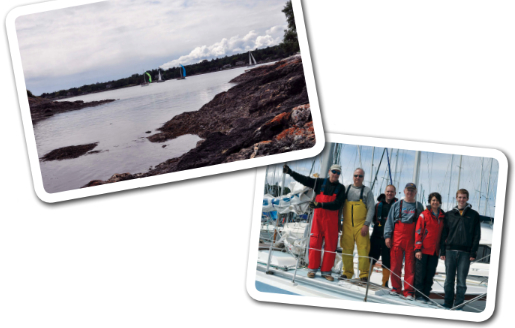
Jerry Barnes and Elaine Bock of Portland, Oregon, were among the early finishers at the barbecue. The couple met on a daysail five years ago and have been together ever since. Jerry races Desperado, a New York 36, often, though conservatively. “I tell my crew my job is to make the boat safe, their job is to make it go fast, and when the two goals don’t align, my goal prevails.”
Of the race they have just completed, he says, “It was just a really, really fun day — just perfect. One of the ‘funnest’ races I’ve ever done.”
I nod, lost in thought. My 1978 Fuji 40 is no match for a Santa Cruz 70 nor any of the snazzy J/Boats, but it would have been fun to tweak and trim a little, maybe see if I couldn’t keep up with Jerry and Elaine, and perhaps inch my way to the starting line ahead of Desperado. Heck, my 31 feet of waterline should allow me to sail right by the Hans Christian 33, Mimoza. All I’d need is a good blow to charge past the crew of whippersnappers aboard Compromise and the 24-foot Annie . . .
I need to reexamine our cruising plans for next year, maybe plan to get our Del Viento up north again in time for Memorial Day weekend and maybe see what it might take to enter the Swiftsure. It would be a blast.
Michael Robertson and his wife, Windy, bought a cruising sailboat in Mexico, sold their home in Washington, D.C., and dropped out of their high-pressure lives in 2011 to voyage with their daughters, Eleanor (10) and Frances (7). After more than a year cruising the North Pacific coastline from Cabo San Lucas to Alaska’s Glacier Bay aboard their Fuji 40, Del Viento, they are currently in Mexico, enjoying the beautiful Sea of Cortez. They document their journey at www.logofdelviento.blogspot.com.
Thank you to Sailrite Enterprises, Inc., for providing free access to back issues of Good Old Boat through intellectual property rights. Sailrite.com