A bow-to-stern hull-to-deck repair
Issue 96 : May/Jun 2014
Don hailed us from his car as he stopped next to us in the boatyard. “Well, I’m done for the day,” he said, “I’m heading home to take my wife to a movie so I don’t get accused of spending all my free time working on the boat.” With a smile and a wave, he drove off. As we waved back, I tried to recall when my husband, Steve, and I had done anything with our free time besides work on our project boat, Levity. We were spending so much time at the boatyard that our friends began stopping by on our lunch breaks when they wanted to see us. Meanwhile at home, the lawn grew shaggy with weeds and paint peeled from the house.
For the past year, Steve had devoted himself to working full time on Levity and I’d arranged to work with him part time. Levity’s restoration had become the center of our lives, and my role gradually shifted from bystander, watching while Steve tackled the major projects, to co-star in the drama. It was an interesting transition for a middle-aged woman accustomed to working in an office in front of a computer. My contributions on the spring and fall weekends I’d spent helping Steve maintain our previous sailboat were light years away from the type of work involved in resurrecting Levity, a Nicholson 35 sloop.
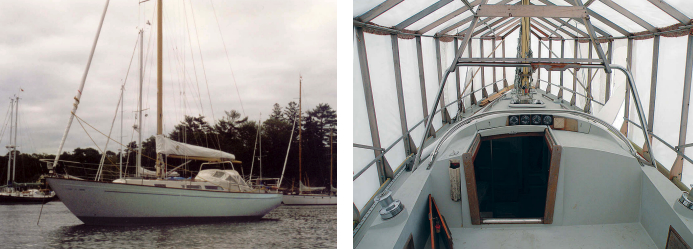
Levity, was built by Camper & Nicholsons in 1973. Designed by the C&N in-house team as an offshore cruising sailboat, the Nic 35 became one of their most popular models. The first was completed in 1971 and 228 vessels had been built by the time production ceased in 1985. Ted Brewer reviewed the Nic 35 in the September 1999 issue of Good Old Boat, and a history of Camper & Nicholsons appeared in the July 2004 issue.
We’d purchased Levity with longterm living aboard and cruising in mind. I thought she was perfect for us the first time I saw her, from her spoon bow to her narrow transom and long keel. A throwback to an earlier design era, her hull shape uncompromised by racing rules, she sailed like a dream, and although her interior was small by modern standards, we agreed she was just right for a couple. Levity wasn’t fancy, but we were confident she could take us anywhere we wanted to go. She was nearly 30 years old with many miles under her keel when we bought her, and we planned to go through her carefully from stem to stern, repairing or replacing anything that was worn out or not up to the task at hand. Our budget and desire for self-sufficiency dictated that we would do most of the work ourselves, and we drew up a list of repairs and upgrades to be accomplished over the next three to five years.
From inside to outside
From inside to outside Steve began by updating Levity’s antiquated plumbing and electrical systems. Next, he replaced her worn interior with wood paneling that he had milled himself and lined her storage compartments with aromatic cedar. Under his direction, I carefully sanded and varnished her lovely teak caprail and scrubbed decades of grime from her deep bilges and chain locker. I compounded and waxed her chalky topsides until my arms ached, and was rewarded when her original ice-blue hull color emerged. When we weren’t working on Levity, we lived on her for weeks at a time, exploring the coastal waters, bays, and islands of New England. Getting to know our good old boat was a wonderful experience. Our summer cruises were times of excitement and discovery as we learned how responsive she was in light air and how well she took care of us in heavy weather.
Warning signs
One day I noticed some books on the shelves near the chart table had somehow gotten wet. Then Steve discovered other signs of water ingress behind Levity’s interior cabinetry. We knew Levity had suffered a hull- to-deck joint failure nearly a decade earlier. The previous owner had hired a well-known New England boatyard to repair the failed joint and, after a thorough pre-purchase survey, we’d concluded all was well. But as the leaks continued — ruining not only our books but expensive equipment — we became uneasy, then alarmed. After all other possibilities were ruled out, we finally acknowledged with sinking hearts that the earlier joint repair had failed and we now owned a boat with a very serious problem.
After we dried our tears, Steve and I discussed Levity’s problem with other boat owners, surveyors, and builders. On most U.S.-built boats, the hull is bolted to the deck, but Levity, a British-built boat, had a bonded hull-to-deck joint that would affect our repair options (see “The Nicholson 35 Hull-to-Deck Joint,” page 42). Was the original joint failure a fluke, perhaps the result of a bad batch of resin, or did it point to a basic flaw in her construction?
The Nicholson 35 hull-to-deck joint
On most U.S.-built coastal-cruising sailboats, the hull is bolted to the deck. A structural adhesive, such as polyurethane, is used between hull and deck to provide a secondary attachment and ensure the watertightness of the joint. With this type of construction, the bulkheads are glassed to the hull, but are not generally glassed to the undersides of the deck.
On the Nicholson 35, the hull-to-deck joint is a bonded joint, meaning the primary structural attachment is achieved through adhesives rather than bolts. In contrast to the typical coastal cruiser, her bulkheads are fiberglassed to the undersides of the deck as well as to the hull. This adds strength and rigidity but limits repair options, since it would be difficult to separate the deck from the hull to make repairs in the event of a joint failure.
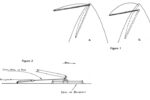
The bulwarks on the Nicholson 35 are 5 1⁄2 inches high at the bow, tapering down to 3 inches at the stern. They are formed by the extension of the hull above deck level and a matching vertical flange on the deck itself. A space approximately 3⁄4 inch wide between those two vertical elements is filled with adhesive material. The type of adhesive used in Levity’s original construction was epoxy. Her deck sits on a flange that runs around the entire inside perimeter of the hull. This joint is also filled with epoxy adhesive.
On Levity, the only fittings that actually penetrate both deck and flange are the chainplates. Most of her hardware was held in place by machine screws tapped into aluminum plates embedded in the deck core. This left very long expanses along the perimeter of the hull where the structural integrity of the hull-to-deck joint relied exclusively on the epoxy adhesive. Levity’s joint problem was a result of a failure in the epoxy adhesive at the juncture between the hull and the deck.
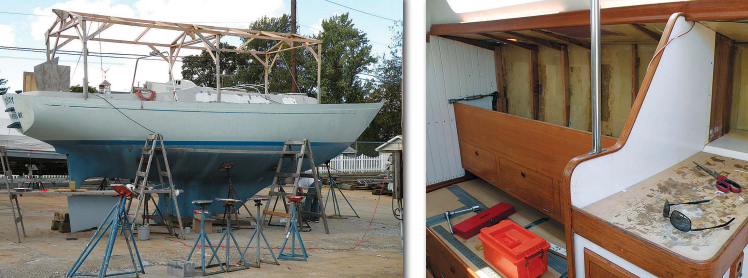
The builder had provided the previous owner with directions for repairing the failed joint. Were the instructions adequate and had the boatyard followed them properly? There was only one way to find out. It was time to remove Levity’s caprail and do some exploratory surgery. There was something profoundly unsettling about cutting into her deck, but a cancer lurked inside our beautiful boat that had to be cured.
A major commitment
Steve’s investigation convinced him that the boatyard’s repair work had not been extensive enough to correct the failed joint and the botched attempt had created additional problems, allowing moisture to migrate into the deck core over the years. Now we had to decide how to proceed. After much discussion and soul-searching, we agreed Steve would repair the damage himself instead of hiring it out. This decision required a leap of faith on our part as, despite his extensive carpentry skills and knowledge of marine construction, Steve had no practical experience with this type of repair.
Could an amateur correct a problem that had eluded the professionals at a reputable boatyard? We felt as
if we were about to dive into the deep end of the pool, but we knew nobody cared as much about Levity as we did. We wouldn’t cut corners or say “This is good enough” unless it were true. We had one more advantage over a commercial boatyard: we didn’t have the pressures of impatient customers, launch schedules, or the bottom line.
Repairing Levity’s failed joint was a huge undertaking, but Steve would have some help. Chris, a close friend who was eager to learn more about marine construction, offered to work with him. Together they began cutting out the failed joint material and rotten deck core while experimenting with various repair techniques. Our friend’s help was invaluable, but he was planning an extended cruise on his own sailboat so his time was limited. All too soon, he was preparing for departure, and then he was gone, leaving Steve to continue alone.
Up to this point I had merely been an observer but, as I watched the joint repair in progress, I realized how much of the work required a second pair of hands. Clearly it would be very difficult and slow for Steve to do it all himself. Could I be his helper? When I approached Steve with my idea, he was skeptical. I was not used to the type of physical labor involved and barely knew my way around a toolbox. But we worked so well together as a team in other areas of our lives it was worth a try.
Steve explained in detail what was involved and what my role would be at each stage. I didn’t have the strength or dexterity to control the larger power tools. Steve would handle these. But we were both surprised to discover that, initially, my hands were not strong enough to manipulate the industrial scissors we’d purchased for cutting fiberglass cloth. We had assumed I would be able to handle this task by myself, and I was flooded with doubt. Could I really help with this project in any meaningful way?
Setting up, suiting up
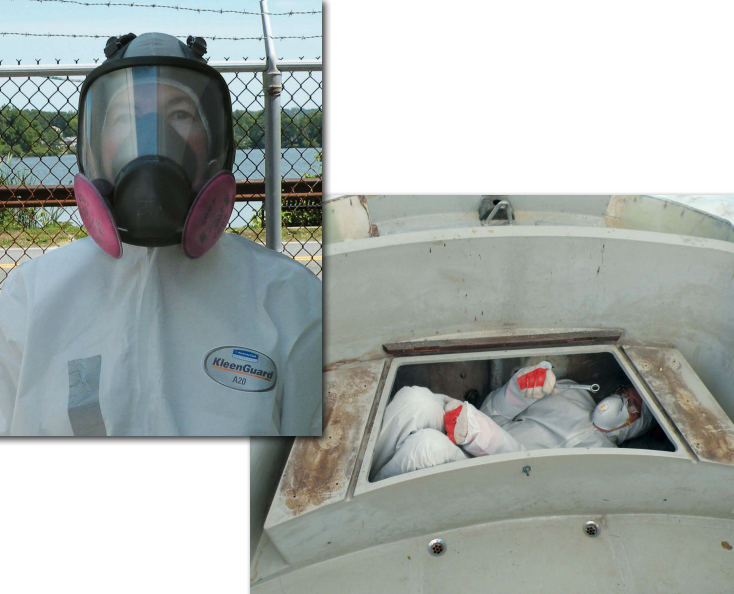
My first day on the job began with multiple trips up and down the ladder to set up our equipment — power tools, vacuums, and dust collector — and running electrical cords to outlets located across the boatyard. Then we disappeared into our protective gear: Tyvek suits with hoods, work gloves, ear protectors, and full-face respirators with changeable cartridges. The baggy moonsuit was uncomfortably hot, and as soon as I fitted my respirator and tightened the straps, my nose began to itch. As hard as I tried, I couldn’t ignore it. To relieve it, I had to remove and refit the respirator several times, while Steve waited patiently. Then the real work began.
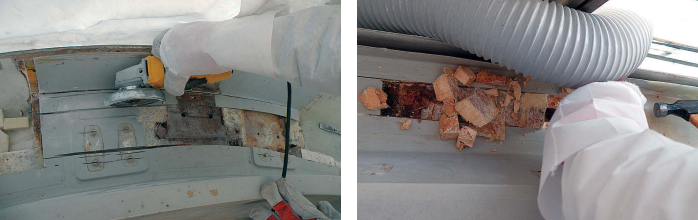
The failed material first had to be cut out from the bulwarks, while (ideally) preserving the outer fiberglass skin along the entire length of the boat. Then the joint had to be completely cleaned to a depth of 4 to 6 inches below the tops of the bulwarks. The failed material also had to be removed from the horizontal flange, or shelf, beneath Levity’s deck. Using a large, heavy-duty right-angle drill, Steve experimented with grinding blades while I handled the dust collection system, vacuum, and drop lights. The dust collector removed the finest dust as it rose into the air. My mission was to capture as much as possible of the debris of all sizes while keeping equipment, cords, and other hazards out of Steve’s way.
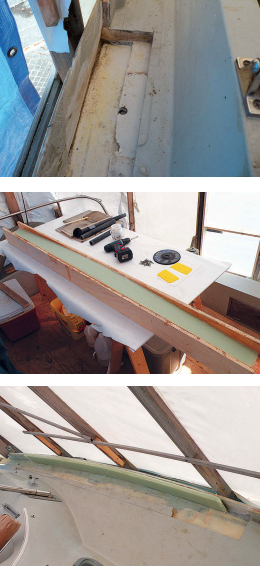
Working as a team in close proximity on deck under Levity’s winter cover and frame posed some challenges. There were frequent collisions as I struggled to control unruly hoses, position the funnel over Steve’s immediate work area, and follow the grinder with the vacuum to collect the larger particles. We gradually developed a rhythm as I began to anticipate his movements and position the equipment accordingly. The pace of the work was excruciatingly slow and the screech of the grinder overwhelming.
Since normal conversation was impossible, we improvised with hand signals, head shaking, and pantomime. I could tell by his expression when he needed something. But did those bizarre gestures mean he wanted the needle-nosed pliers or a wrench? Was he asking for his drill or for a new blade for the grinder? Day after day, we knelt together on the wasteland of Levity’s deck in our teletubby suits, shaking our heads and waving our arms at each other while we worked. Slowly, my confusion diminished as I became familiar with the work and learned which tools were needed for each step of the process.
Grueling work
During the grinding phase of the project, we worked in 2-hour shifts then stopped for a break. Although the work was tedious, it required absolute mental focus, and I had never worked so intensely. By the end of each day, I was beyond worn out and longed for a hot shower and sleep. Every morning, as I got out of bed over the protests of my aching muscles, I wondered how I could possibly keep up with Steve, who seemed to function quite well for hours on end without food or breaks.
My learning curve was steep and included important lessons on safety. High-speed power tools made me nervous, and I often broke into a cold sweat when we worked together inside the confining spaces of the cockpit lockers, braced against the curvature of the hull as we ground the failed adhesive material from the flange. Working up on deck was a relief by comparison, but I learned that I could never let down my guard or allow my mind to wander. Once, during a moment of distraction, the tip of one of my oversized work gloves caught in the tool Steve was operating, twisting my hand around the rotating tip. In an instant, Steve shut down the machine and freed my hand, but I could see my own fear reflected in his eyes as he removed my shredded glove from the jaws of the tool.
Midway through the grinding phase of the project, poor Levity looked like a derelict. Her once-gleaming topsides were chalky and streaked with dirt and her deck, a patchwork of repairs, was as hazardous as a rocky shoreline. It was as if her “before” and “after” photos had been reversed. Inside, much of her interior paneling and cabinetry had been removed to allow access to the flange, and her settees were covered with toolboxes and equipment. Molly, who ran the boatyard store, told Steve she’d warned off several curious passersby who boarded Levity, assuming she was abandoned. Seeing Levity in this state was extremely difficult. I had to remind myself that the mess and chaos were temporary. When I looked in the mirror at the end of a typical workday, I didn’t look much better. My face was etched with lines from my respirator, my hands roughened, and my legs bruised from collisions with obstacles littering the deck.
Foot by foot we ground out the bulwarks and removed the failed joint material. There were days when everything seemed to go wrong and the work stretched out endlessly ahead.
The boatyard community supported us through some of our darkest hours when we despaired at our slow progress and wondered if Levity would ever see the water again. Friends and strangers stopped by to observe and offer encouragement. Coffee and chocolate chip cookies materialized at just the right times and bolstered our flagging spirits, as did the generous offers of help we received. Our boatyard friends invited us along for daysails. Some even offered us their sailboats for an afternoon, a day, or longer if we wished. We were touched by their kindness. We spent several tranquil days sailing the Hudson River on a borrowed boat, recharging our batteries and remembering why we were putting ourselves through this ordeal.
Turning the corner
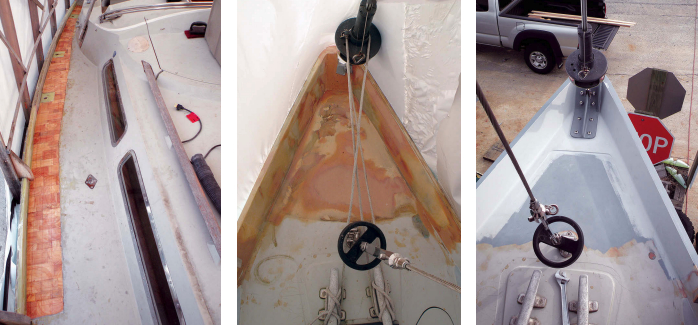
We persevered, and the tide began to turn in our favor. Unusually mild weather allowed us to continue working in the winter. By early spring, the destructive phase of the project was complete and we were focused on Levity’s reconstruction. I was now on a first-name basis with most of the tools and equipment. My skills and confidence had improved and Steve and I worked comfortably as a team. The physical activity agreed with me. I became stronger and more agile and moved around on Levity’s hazardous deck with assurance.
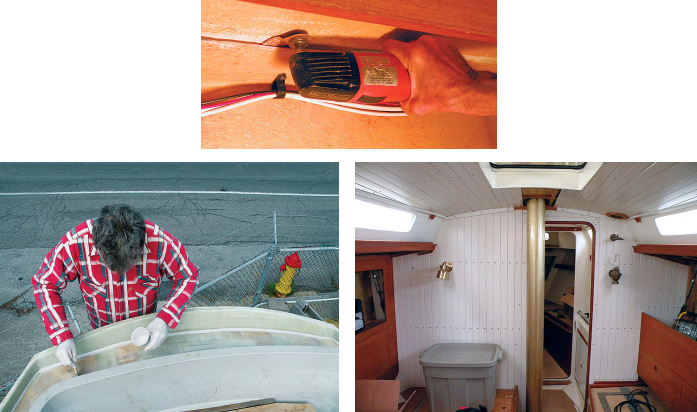
As we progressed into the reconstruction phase, I discovered with surprise that I enjoyed fiberglass work. Well, perhaps enjoy is too strong a word, but after the mind-numbing tedium of grinding, it was refreshing to learn about the different weaves of fiberglass cloth, the various types of epoxy resins, and how we were going to use them to rebuild Levity’s bulwarks and deck.
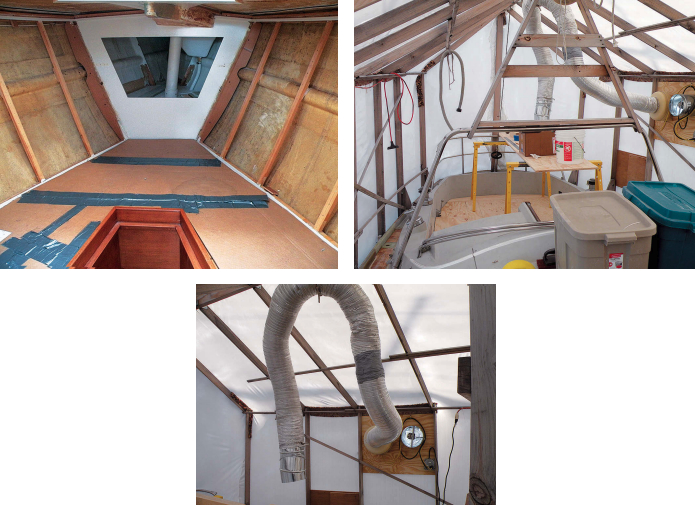
Because cure times depended on temperature and humidity, the work required careful judgment. At first this terrified me but, as I gained experience with the materials, it became a challenge I enjoyed. The hours flew by as we measured and cut fiberglass cloth, combined the epoxy resin with the hardener, and applied the mixture to layers of cloth in the custom forms Steve created for rebuilding each section of the bulwarks.
Fiberglass work has some drawbacks. Epoxy resin, as insidious as honey, defeated most of our efforts to contain it. The sticky liquid dribbled off rollers onto the deck and we couldn’t change our latex gloves often enough to keep it off our tools. On windy days, it blew horizontally off our brushes, landing wherever it pleased. If we didn’t wipe it up right away, one of us invariably stepped in it. When a breeze blew a loose strand of hair across my face, I brushed it away with an epoxy-soaked glove, spreading the sticky stuff onto my hair and glasses. I spent the next half-hour bent over the sink in the boatyard restroom while Steve removed the resin from my hair with hand cleaner. But despite the messiness, our morale improved steadily as Levity’s bulwarks and deck began to re-emerge under our hands.
Fresh air at last
Once the winter cover and frame were removed, we found ourselves working together on deck in the fresh air and sunlight, surrounded by a sea of boats. It felt liberating to see the sky again and watch the clouds rolling toward us from across the river as we finished rebuilding the bulwarks and began re-coring sections of the deck. By June, the entire hull-to-deck joint repair was finished and the deck was closed in. We were almost speechless with joy. We had succeeded and, for the first time in more than a decade, the hull-to-deck joint was sound. A formidable list of projects still remained to be completed and, of course, I planned to remove all traces of the offending epoxy drips. We would be spending most of our free time at the boatyard for the foreseeable future, but after everything we had been through and learned, the projects that remained held no terrors for us.
I stood on deck late one summer afternoon as we finished putting away our tools for the day. Coiling an electrical cord, I paused to survey our work and felt a surge of pride. Despite our initial doubts, we had accomplished so much together and our love for Levity and for each other had emerged stronger for the experience. Behind us lay the shoals and reefs of a project that had once seemed almost insurmountable. Ahead of us, the river and the seas beyond her beckoned.
Mary Broderick has been sailing and messing about in boats for nearly 30 years with her husband, Stephen Perry. Mary and Stephen both hold USCG Masters licenses and are looking forward to launching their Nicholson 35, Levity, this summer and spending as much time as possible on the water.
Thank you to Sailrite Enterprises, Inc., for providing free access to back issues of Good Old Boat through intellectual property rights. Sailrite.com