A quick-and-dirty repair gets the boat home
Issue 99 : Nov/Dec 2014
Many resources are available to help owners of good old boats complete their projects in the best possible way: seaworthy, beautiful, and long-lasting. However, I was recently faced with a project that demanded different priorities: quick, cheap, and strong enough for a brief trip.
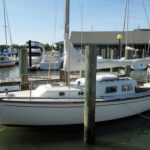
A neophyte sailor had enlisted my assistance in finding and purchasing a suitable boat. After looking at a number of models, he chose the Alberg 30 as his dream boat for a possible voyage to distant places. After much searching, we located one in his price range within a reasonable distance away — 750 road miles. She had a newer diesel engine and was reported to be in sailing condition. The voyage home would be 600 miles, mostly in the Intracoastal Waterway, but there would be an unavoidable 150-mile passage across open water. Overland shipment would have been a budget buster.
He put down a deposit and made arrangements to inspect her. My work schedule limited me to a Friday night departure and a return in time for Monday morning duties. After an overnight drive, we arrived early Saturday in a light rain and met the seller, who had an obligation later that morning. So, after a brief walk-through, we did the sea trials first. Upon our return, the port upper shroud appeared to be considerably more slack than it had been before we left the slip.
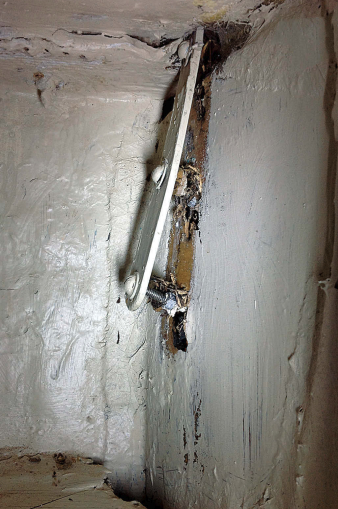
A quick look below revealed that the chainplate was dislodged and hanging by a single bolt head. A thorough inspection revealed only minor issues otherwise, none of which required immediate attention prior to the planned return voyage or were expensive deal-breakers. But, if the boat was to be sailed home, that chainplate had to be secured, which meant reinforcing the bulkhead. We had to come up with an immediate and low-cost solution, even if it would be only temporary.
A problem with a past
The deck seal around the chainplate had clearly leaked in the past, leading to rot in the entire upper corner of the plywood main bulkhead. At some point, the bad section had been cut away and a new piece fitted and fiberglassed in. The repair was amateurish and did not line up too well with the existing bulkhead. The biggest flaw, however, was that the deck leak had not been rectified and the repair had rotted as well.
That Saturday evening, we studied the problem to determine how the chainplate load could be transferred to the hull structure and what materials we would need to accomplish that. As a trip to the nearest Home Depot was 30 minutes each way, we reviewed our shopping list several times in the hope of avoiding a second trip. The structural challenge was to find a way to transmit the shroud forces to the hull. The inboard portion of the bulkhead and a part of the lower section were soft, but not too far gone. The deck and hull-to-deck joint were rock solid. Our plan was to reinforce the rotted area with plywood and enlarge the metal component of the chainplate. Following the reasoning behind backing plates, we decided that a “fronting plate” would prevent the chainplate from sinking into the soft wood. In addition, we planned to pick up some load-bearing area against the underside of the deck on both sides of the bulkhead.
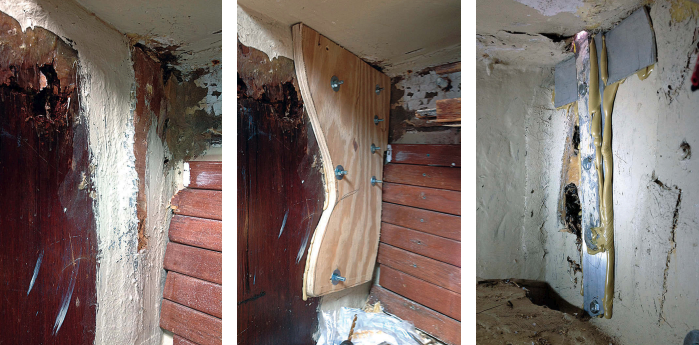
A simple and rapid repair
Borrowing a drill and jigsaw from the seller, we set about our task early Sunday morning. A nearby dumpster yielded cardboard for a template for the plywood reinforcement. Not surprisingly, the old chainplate was easy to remove. Fortunately, 3⁄4-inch exterior plywood was available in a 2-foot x 2-foot panel. We cut this to shape, taking some care to fit the upper edge to the deck.
While, ideally, a chainplate would be aligned with its shroud, the hole in the deck was not easily altered, so we repositioned the chainplate to place the bolts in a more solid section of the bulkhead. This also brought them farther from the edge of the plywood. We slid a 2-inch-wide strip of 1⁄8-inch aluminum behind the chainplate vertically to effectively lengthen it, and we placed an additional strip athwartships, tight against the underside of the deck, to prevent it from pulling out even if the bolts failed to hold.
After positioning all the pieces, we drilled all the bolt holes and dry-fitted the assembly. Since the previous repair piece had been installed slightly out of plane with the bulkhead, the backing plywood did not sit quite flush, but it seemed to snug down well enough. Knowing this repair was temporary, we used regular steel bolts, but we did splurge a few pennies on fender washers for their surface area.
Once we were happy with the design and fit, we disassembled everything and gave it a generous coating of Liquid Nails. While not an ideal marine adhesive, Liquid Nails was developed for panel adhesion and, of significance to us, it dries quickly. We tightened the bolts until the adhesive squeezed out nicely. We used an additional glob to waterproof the chainplate hole in the deck.
Reattaching the shroud and tuning the rig followed uneventfully. We declared the job complete after just two and a half hours. The total cost was less than $40 and we had some time left for me to complete several other tasks aboard before I had to depart for home.
A safe arrival
The new owner made his 600-mile trip home successfully, including an eventful 150-mile offshore passage. Upon arrival, the chainplate did not show any signs of movement. The bulkhead replacement project is currently under way, but with much less urgency, an eye toward permanence, and particular attention to getting a watertight seal at the deck.
John Churchill grew up in Indiana as a boat-crazy kid. He built a raft at age 6, sailed Snipes as a teenager, and worked his way toward salt water and bigger boats as an adult. He has sailed a Cape Dory 26 singlehanded to Bermuda and back and a Bristol Channel Cutter transatlantic with his father. Now in Florida, John races and daysails Nurdle, a former repo Bristol 35.5, while rehabbing her for extended cruising after he retires.
Thank you to Sailrite Enterprises, Inc., for providing free access to back issues of Good Old Boat through intellectual property rights. Sailrite.com