Adapting a boat to a lightweight crew
Issue 96 : May/Jun 2014
At the age of 55, I decided it was time for me to have my own boat so I could do what I wanted . . . in my own way. Although I’d been living on and sailing boats for the previous 35 years, I had never been a singlehander. I realized this would be a very different situation from sailing with someone else.
I’m 5 foot 1, small-boned, and not particularly strong. At 55, I was also past the first flush of youth and, although fit, had to be aware that I was unlikely to get much fitter or much stronger in the next few years. On the other hand, I could see no reason for my health to suddenly deteriorate as long as I continued living aboard.
For some time, I looked at how other people got around the problems of handling gear on their own, particularly in such situations as dragging the anchor. There seemed to be two approaches. The first and more popular these days was to use technology to assist. The second approach was to fit the boat and type of sailing to the sailor’s physical circumstances.
The first approach has two drawbacks: the gear is expensive and it leaves you terribly vulnerable if it should fail. For example, I might choose to fit roller-furling gear to my jib to avoid the physical labor of lugging sailbags around and the problem of trying to muzzle a large sail in a sharp, unanticipated squall. So long as my roller furler works, this would be a good solution, but if it failed, I’d be left with a very large sail, completely out of control and, because it’s in a groove rather than held on with hanks, a sail that’s very hard to lower on my own.
Another apparently obvious piece of gear is a windlass. These days, manual windlasses are rare, but an electric windlass relies on a fully-charged battery at a minimum and its own perfectly functioning electric motor. If it goes wrong, I wonder whether I’d be able to haul up the anchor and chain without a problem. What’s more, all windlasses come with a high price tag.
So I considered the second approach, which fits in better with my general approach to life and with my budget. I began my search for a boat I could handle with the minimum of sophisticated technology and within the constraints of my size and strength.
Capable and manageable
This boat had to be a capable wee cruiser. Not only might I get caught offshore, but I might also want to venture farther afield in the years ahead. I needed a place to sleep apart from the saloon, a head, a galley in which I could cook proper meals, and a saloon large enough for company. I wanted a pleasant cockpit so I could enjoy sunny afternoons with a book. I wanted a reliable engine so I could get into an anchorage when the wind died. I wanted to be sure that once the hook was down, it was going to stay put. Furthermore, I needed a rig that was easy to handle and capable of dealing with winds of up to gale force if necessary, but also one that would be a pleasure to sail in the light conditions I prefer.
Ground tackle
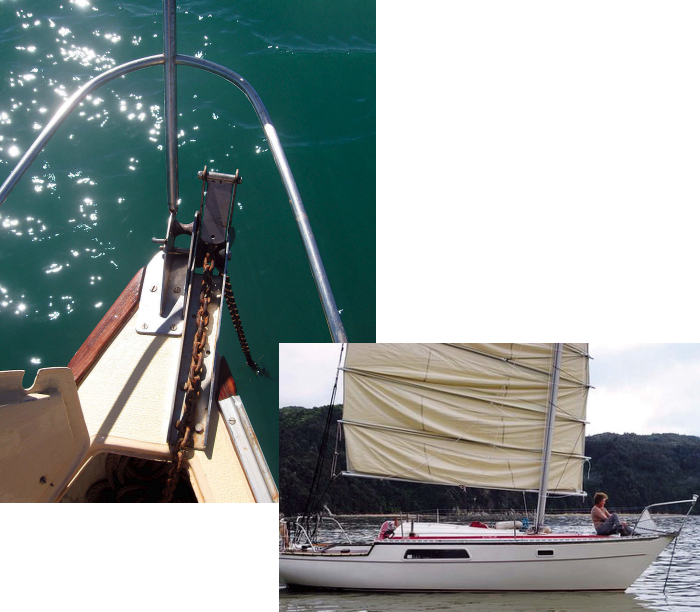
I decided the boat would be of moderate to light displacement and no more than 28 feet. This would mean I could fit over-sized ground tackle that I could handle without a windlass or undue risk to my hands. (My fingers tend to get nipped by 3⁄8-inch chain). Coming from an offshore background, my instinct is for good heavy anchor gear. I chose a 25-pound Manson Supreme anchor and 80 feet of 5⁄16-inch chain (backed up by lots of 1⁄2-inch nylon).
Thus far, I have been anchored in some pretty windy conditions and never budged. My surprise at this is less than it was. Looking at other boats, many are 10 feet longer with three or four times the displacement of my Raven 26, yet they use the same size chain and an anchor only 10 pounds heavier. It is wonderfully reassuring to have good gear down when the wind gets up, yet it’s easy for me to haul it up. In deep water, I take the nylon rode back to a self-tailing winch on deck and crank away until the chain comes over the chain pawl at the bow roller.
The chain pawl is the real key to handling my anchor safely and easily. As I pull in the chain, the pawl skitters along the links, but the moment I stop and ease away, it jams between two links, securely holding the chain. That way I never have to hold the weight of the anchor and chain. I expend only the amount of energy needed to raise it 2 or 3 feet at a pull. It’s a brilliantly simple system.
Junk rig
The next thing I needed was a simple rig. A quick glance at what was available soon made me realize that my choice was Bermudan, Bermudan, or Bermudan. As I noted in “Building a Junk Rig” in the March 2013 issue, I belong to the tiny minority of sailors who don’t like Bermudan rigs. I was repeatedly told it was an easy rig to sail and I’d have no problems. While this may be true for most people, after owning the boat for several months, I realized I was never going to be converted. My alternative was to convert the boat instead.
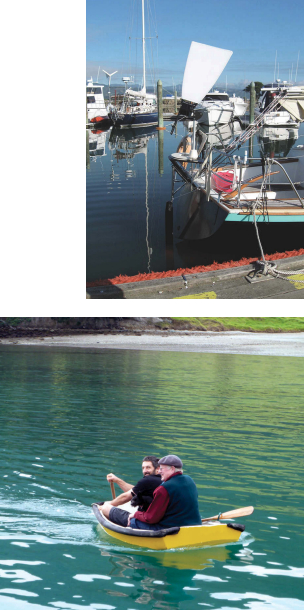
When it comes to making the boat easy and safe to handle, fitting a junk rig is the best thing I’ve done. The first half of the sail is easy to raise and this gives me sufficient sail area to be able to sail out of my anchorage. I have a small self-tailing winch fitted to the coachroof and generally use this to pull up the rest of the sail while I steer with my foot on the tiller!
To reef, I lower away on the halyard until I have the sail area I want, and then sheet it in again. Before anchoring, I usually drop a few reefs to slow down and then maneuver my boat to the chosen spot before lowering the rest of the sail and walking forward to drop the anchor. To complete the stow, I haul in the sheet and tidy away the rope ends.
Self steering
Saving strength is not only about lifting, pulling, and hauling. It’s about general over-exertion. For me, one of the more important pieces of gear that prevents me from getting too tired is good self-steering gear. Fantail came with a very good and useful electric autopilot. But it can’t work with a flat battery or be repaired on board, so I wanted the simplicity and security of windvane gear. My good friend David Tyler, on Tystie, is an expert on this topic and, after foraging around in his lockers, came up with several bits and pieces to get me started.
I made a drum from glass and epoxy and sewed a piece of nylon to cover a framework. This produced a lightweight vane that gives me a marvelous hand at the tiller whenever I want to do something other than steer. It also helps when sailing off my anchor.
Since the junk rig is self-tacking, I set up the self-steering gear to take me out of the harbor on my tack of choice. I haul the anchor, pulling in the slack as the chain snubs the bow. As the anchor comes off the bottom, we start sailing. If we’re on the “wrong” tack, the self-steering puts Fantail about while I cat the anchor and wash down the mud. Back at the helm, I raise the rest of the sail at my leisure, trimming the self-steering gear more accurately.
Perhaps the best thing about my windvane gear is its tireless concentration when sailing to windward. In this situation, I want the boat to be sailed as effectively as possible, and the self-steering does a far, far better job than I do, distracted as I am by pilotage, watching the scenery, the need to get something to eat or drink, or getting out of the sun or rain.
A handy dinghy
Getting to and from the boat is another topic that has caused me a lot of thought and not a little expense. I intended to spend a lot of time hanging on my anchor, so a good dinghy was essential. Inflatable dinghies are safe and, at least in the smaller sizes, light. But they are neither pleasant nor efficient to row. If you fit an outboard motor, you lose the advantage of a lightweight tender and are once again relying on technology to get you safely back on board. I chose a 6-foot 6-inch dinghy, but it was far too heavy.
An ingenious friend designed and helped me build a folding dinghy. However, in an effort to produce some-
thing that would row well, we made it too long. The end result was effective and could be assembled in a couple of minutes, but it was too big for me to handle ashore and getting it on board one dark and rainy night (when I had foolishly left it in the water) was fraught with anxiety. I had to pull it about a foot farther than I really could manage to get it past its balance point and safely on deck, and if I didn’t manage that, water would sluice over the stern and flood it.
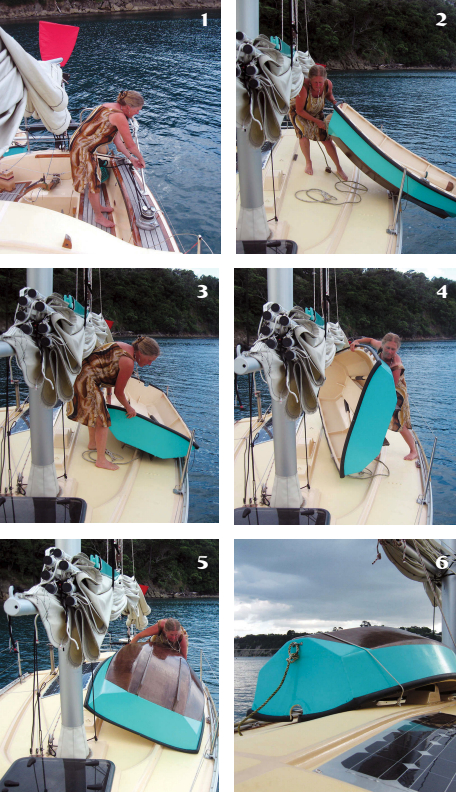
Fortunately, I happened to mention the problem to Kiwi designer John Welsford. With a twinkle in his eye, he said, “Well, I think I may have the solution to your problem.” And so he did. It was a 5-foot 1-inch dinghy that’s perfect for me and so lightly built I can rest it on my shoulder to carry it up the beach. It’s a real dinghy, though. It rows well even in a lot of wind and has carried two large men (and a dog!) without difficulty.
The trick of getting such a dinghy on deck without using a halyard was one I picked up from Maurice and Katie on Nanook of the North: drop the lifelines and pull it in over the rail, protected with plastic tubing. Once on deck, this tiny cockleshell can easily be positioned with plenty of room to walk around it.
Accepting limitations
I realize that Ellen McArthur isn’t much taller than I am, yet she can sail a 60-footer singlehanded without batting an eyelid and climb the mast in a gale of wind in the Southern Ocean. But I’m not Ellen. I’m an ordinary woman who wants to live independently afloat. Some people might feel it unlikely that 26 feet could provide a comfortable home, but my boat suits me perfectly.
It seems more sensible to work around your limitations than to try to circumvent them with gear that could possibly let you down at a crucial moment. The simplicity of living as I do is extremely satisfying and, because there is less to maintain, I have more time for sailing . . . or simply loafing in the cockpit with a good book!
Annie Hill has lived aboard since 1975 and doubled the Atlantic before the age of 21. She has sailed more than 160,000 miles and crossed the Atlantic 17 times. After crossing the Pacific in 2006, she settled in New Zealand in 2009 and bought her 26-foot Fantail. After some time in South Island, she sailed to North Island where she happily lives and sails singlehanded, at times in the company of other junk rig “junkies.” Find her at http://anniehill.blogspot.com.
Thank you to Sailrite Enterprises, Inc., for providing free access to back issues of Good Old Boat through intellectual property rights. Sailrite.com