A sturdy sailing motorsailer
Issue 96 : May/Jun 2014
Capital Yachts, the builder of the Gulf 32, was formed in 1971 by Jon Williams and Bill Smith when they bought the tooling for the Newport line of boats from Elgin National Industries in New York. They set up a plant in Harbor City, California, and engaged Gary Mull and Cuthbertson & Cassian to help them update and expand the line. In the early 1980s, Capital Yachts diversified from its staple racer-cruisers into the Gulf line of motorsailers. As with so many yacht manufacturing companies, the history of Capital Yachts is brief. The company went out of business in 1996.
While the literature of Capital yachts does not identify the designer of the Gulf 32, the boat is, without a doubt, the 32-foot design created by William (Bill) Garden in 1964 for Gulf Products. The Gulf 32 is featured in Bill Garden’s book Yacht Designs, which contains copies of his original drawings that are works of art. They reveal an extraordinary personal involvement with the work from design concept to the smallest detail. How Capital Yachts acquired the design or the tooling for the boat is unclear.
Bill Garden had spent much of his career designing and building work- boats that had to keep the sea night and day, in fair weather and foul — tugs, trawlers, gillnetters, sardine boats, and even a pile driver or two. Those workboats, which had a beauty of their own, often served as inspiration for many of Bill’s pleasure boats. Examples are his famous canoe yawl design, the slippery Eel, and the powerful world-cruising 160-ton, 85-foot Nereus.
Bill called the Gulf 32, of which about 400 were built, a “sailing motorsailer.” It has a full keel and attached rudder but is best recognized by its pilothouse. Anyone interested in the type should compare this boat with the Rawson Pilothouse 30, another Bill Garden design (reviewed in the January 2011 issue), and seagoing relatives such as the Vancouver 32, Endurance 35, several designs by Ted Brewer, and similar pilothouse boats. Two more articles of interest are Rob Mazza’s “Defining a Pilothouse,” in the September 2013 issue, and “Pilothouses and Performance,” in November 2013.
Design
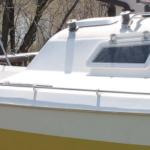
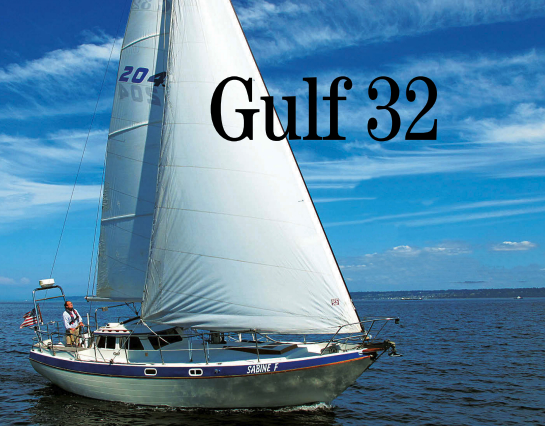
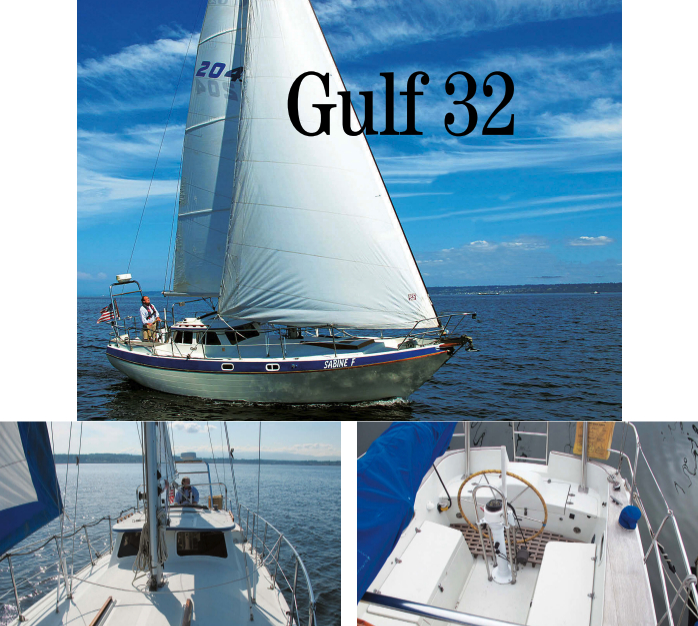
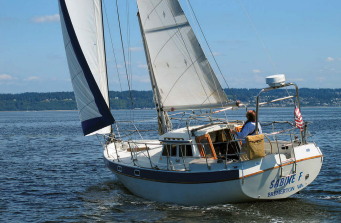
Approached from dockside, Sabine F, the 1986 Gulf 32 owned by Jack and Barbara Bryce, is remarkable for her imposing freeboard. A 2-inch oval teak rubrail runs the length of the hull a few inches below deck level, establishing a secondary sheerline with a sweep of its own. The hull above the rubrail is a contrasting color and the eye is also drawn to it by a line of portlights. The effect is to lend a little more spring to the sheer as it diminishes the apparent height of the freeboard and general bulk of the boat. This effect is enhanced by molded-in strakes that follow the curve of the rubrail. In addition to offering some protection to the hull, the rubrail covers the hull-to-deck joint.
The pilothouse is well integrated into the overall design and doesn’t obstruct crew movement fore and aft along the sidedecks. The roof overhangs the front and sides of the pilothouse. The large windows can cause problems. In addition to the issue of vulnerability in a seaway, acrylic or polycarbonate pilothouse windows become crazed with age. The visibility problems this creates are of more significance than with smaller portlights used mainly for admitting light. Some owners have replaced the plastic windows with 3⁄8- or 1⁄2-inch tempered glass.
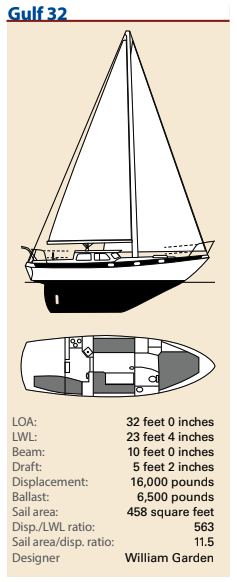
Consistent with the motorsailer type, the Gulf 32 has a heavy displacement; its displacement/length ratio is 563. This means it has a lot of volume below the waterline that provides ample space for tanks and stowage. Since it also has a small rig, the boat is not a sprightly performer under sail.
On deck
Sheeting hardware for the mainsail is located on top of the pilothouse where it’s out of the way. Molded-in toerails outboard of the wide sidedecks are an important safety feature, as are the stainless-steel railings used in place of wire upper lifelines. Bulwarks almost a foot high surround a large recessed foredeck area, that Bill Garden called the “well deck,” where much of the work of anchoring and sail changing takes place.
The cockpit is surprisingly large for a 32-footer with such a commodious interior. A molded-in hump in the helmsman’s seat improves the view over and to either side of the pilothouse and the crew seats, which are separated from the helmsman’s position, are deep and comfortable. The very wide (up to 14 inches) teak-covered coaming top provides additional seating with the liferails as backrests.
Engine controls are located in the pilothouse, but a throttle, gear lever, and the engine stop cable are also mounted on the steering pedestal in the cockpit. When one of the steering stations is engaged, a station exchanger disengages the other. An emergency tiller can be connected to the rudder head abaft the steering pedestal.
Good stowage is located under cockpit seat hatches and the wide teak coamings contain open compartments for winch handles. On Sabine F, a 5-gallon compressed natural gas (CNG) bottle (which was not standard equipment) is stowed under the hatch to port of the helmsman’s perch. The opposite hatch to starboard is used for general stowage. Because of its ample displacement and freeboard, the Gulf 32 lends itself to carrying a dinghy on davits. This is a welcome convenience to the cruising sailor and many Gulf 32s are so equipped.
The rig
The standard Gulf 32 was rigged as a masthead sloop, and it could be given a double-headsail rig with the addition of an optional club-footed staysail. The deck-stepped mast is supported from beneath by a 2 1⁄4- x 13-inch wooden compression post that abuts the main structural bulkhead.
The basic rigging is a standard arrangement of forestay, split backstays, single spreaders, a single upper shroud, and double lowers. The lowers on Sabine F attach to internal stainless-steel chainplates.
Line handling is simplicity itself. Two-speed Lewmar 30 jibsheet winches are mounted on the cockpit coamings, and two Lewmar 7 single-speed winches fitted aft of the mainsheet traveler on the pilothouse roof are used for the mainsheet and boom vang. Provision is also made for cruisers who have a yen to fly a spinnaker, but Sabine F is not so equipped.
With just 458 square feet of sail area, the sail area/displacement ratio is a low 11.5. This is a motorsailer, remember, so the engine will be running much of the time . . . even when the sails are up.
Construction
The hull of the Gulf 32 was molded with alternating layers of hand-laid multi-directional mat and woven roving. The interior was built, according to the owner’s manual, “. . . as a unitized one-piece molded structure” with layers of mat, after which “A layer of woven roving (was) applied to all high-stress areas including water and fuel tank areas, motor mounts, etc.” Cabin soles, countertops, and other horizontal surfaces were stiffened with plywood. The interior molding was then fitted into the hull and bonded to it with mat and woven roving at bulkheads and other high-stress areas. The ballast is lead, fitted internally.
The deck is attached to the hull by means of an external flange with rivets on 2-inch centers, a neoprene gasket, and a covering of resin and fiberglass mat. The assembly is concealed by the teak rubrail.
Full-keel sailboats are commonly criticized for being slow and maneuvering indifferently. It is said they require too much bottom paint and so forth. These points may be so, but there are advantages to full keels. They tend to contact rocks more sympathetically than do fin keels. In the case of the Gulf 32, the internal ballast is kept low, as is the weight of the engine and the fuel and water tanks.
Accommodations
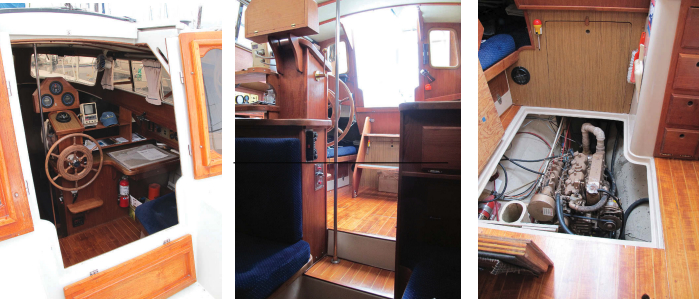
The companionway closure is made up of a pair of teak-framed glass doors and a lower teak flap that can be opened or shut to thwart incoming water. Three steps lead down to the pilothouse.
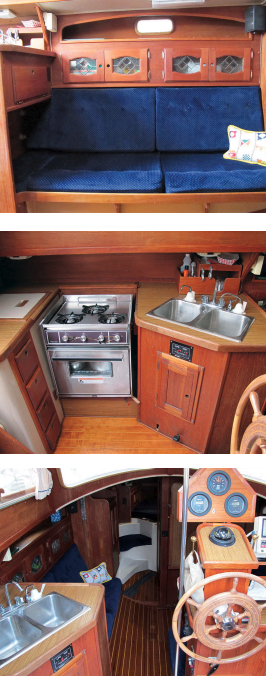
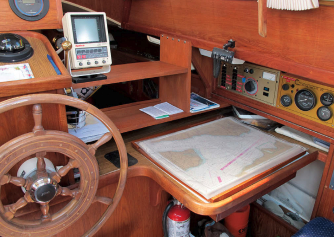
At the inside station, the helmsman can stand behind the wheel or sit on a chair mounted to a post that passes through the sole and fits inside a hefty steel enclosure in the bilge. A small navigation table with circuit breakers, battery switch, and engine instruments is to starboard and close at hand just forward of the 6-foot 6-inch quarter berth. Headroom in the pilothouse is 6 feet 2 inches.
Opposite the nav station, a small galley contains a large and heavily insulated icebox with provision for loading ice through the port cockpit locker. A three-burner gas stove is fitted outboard and a small double sink is fitted in a counter that angles toward the boat’s centerline.
In the saloon, just two steps down, headroom increases to 7 feet 7 inches. A single settee to port extends under the galley sink to form a 6-foot 6-inch berth, and another settee to starboard extends under the helm station to form a double berth of the same length. Together with a fold-down table, this area becomes the dinette. Stowage is located in cabinets with hinged doors, on shelves behind the settees, and under all the seats. Aside from a vertical stainless-steel rod at the step-down between pilothouse and saloon, there is a conspicuous lack of handholds throughout the accommodations.
It is interesting to compare Bill Garden’s drawings with the boat as built by Capital Yachts. Sabine F has a 6-foot 6-inch double V-berth in the forward cabin with an accompanying seat. Bill’s drawings show two overlapping single berths. His drawings also show an octagonal seating arrangement around a drop-leaf table that’s nothing like Sabine F’s settee plan.
After 1994, a version designated the Gulf 32 Mk II was built. Among other changes, the dinette was moved up into the pilothouse, the galley was moved down into the lower saloon, the head was made larger, and the well deck was eliminated to allow more headroom in the forward cabin.
Mechanical
A 36-hp Universal 4-cylinder diesel engine is located below the pilothouse and accessed by lifting hatches in the sole. This provides a virtual engine room complete with automatic fire extinguisher and bilge pumps. A large manual bilge pump at the lowest level is operated from the cockpit, a heavy-duty electric pump is set at a little higher level, and a smaller electric pump clears the bilge of all but a small amount of water. A 75-gallon fuel tank was originally fitted abaft the engine, but upon discovering a leak, Jack replaced it with a 45-gallon tank forward of the 75-gallon freshwater tank.
Performance
We took Sabine F out for trials on a picture-perfect summer afternoon in Kingston, Washington. Wary of the boat’s bad backing habits, we eased her out of the slip and I gave her a good push in the right direction before hopping aboard. Once we were clear of the ferry landing, I took the helm and headed into the wind while Jack went forward to hoist the mainsail. I stopped the engine, set the steering brake, and together we rolled out the jib.
The wind was light but steady, making 1-foot waves. I expected the boat to be rather sluggish in low wind speeds — the opinion of several owners but not all. However, I found this not to be the case. The anemometer recorded a wind speed of between 7 and 8 knots and the GPS recorded our speed over the ground to be right around 6 knots. She had the slight weather helm of a well-balanced boat, pointed high enough, came about smartly for a full-keeler, and held her course as if she were on rails.
When it came time to head home, we rolled in the jib and rigged the lazy-jacks. The mainsail dropped as it should and Jack tied in a good harbor furl as I skirted the crab pots in Apple Tree Cove.
The Gulf 32 does have a few PHRF ratings countrywide and they range from 264 to 310 seconds per mile. A run-of-the-mill Cal 33 rates 152, a Catalina 320’s rating is 156, and a Pearson 32’s is 171.
Conclusion
On our daysail we didn’t experience the higher wind speeds and choppy seas that have established the Gulf 32’s reputation for being tough and seakindly. However, I did find the boat very handy under the light-air conditions common to Puget Sound in high summer. The 27-year-old full-battened main and jib seemed to draw well and the boat carried no provisions, stores, or other excess weight. Her bottom was clean — a diver had just scraped a colony of barnacles from the shaft and prop.
The pilothouse didn’t obstruct views of crab pot buoys or Mt. Rainier any more than a dodger would. The dodger height on a Catalina 30 is 5 feet 4 inches above the cockpit sole while the Gulf 32’s pilothouse measures 4 feet 1⁄2 inch from the helmsman’s grate to the pilothouse deck. Without a dodger, you’ll steer from the pilothouse in bad weather.
The accommodations are well thought out with a lot of usable space. Good use is made of stowage opportunities and access for servicing the engine is exceptional. Deck safety is also well considered. As Capital Yachts said in its brochure, the Gulf 32 “. . . is not perfect and subject to minor defects,” and I did find a certain lack of craftsmanship in some of the finish work. Both inside and out, the boat is a product of its era, reflecting design preferences of the 1980s, when it was built, as well as Bill Garden’s own sensibilities that date to when he designed it in the 1960s. For some people, that is a great part of its appeal.
An Internet search returned asking prices ranging from $36,500 to $43,900. Information on boats built by Capital Yachts can be found at www.capitalyachts.info.
Richard Smith, a contributing editor with Good Old Boat, is an architect. He specializes in designing and building very small houses and has built, restored, and maintained a wide variety of boats. He and his wife, Beth, sail their Ericson Cruising 31, Kuma, on the reaches of Puget Sound.
Thank you to Sailrite Enterprises, Inc., for providing free access to back issues of Good Old Boat through intellectual property rights. Sailrite.com