Bid farewell to flutter
Issue 96 : May/Jun 2014
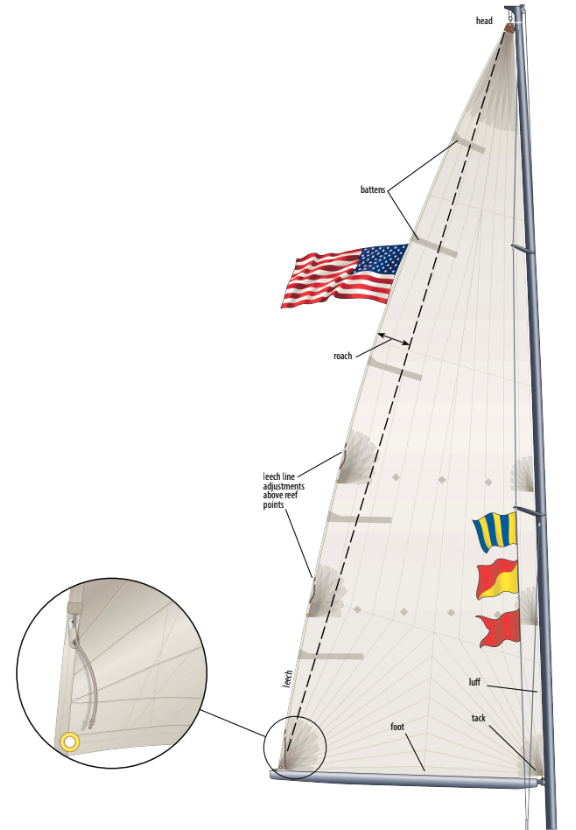
A Bermudan or Marconi mainsail is seldom a straight-sided triangle. On many sails, the leech — the aft edge of the sail — is made convex to add more sail area than the simple triangle would yield. The sail area added outside the straight line from head to clew is called roach.
This extra sail area provides extra power and makes the sail more efficient. However, it would fold over and flap uselessly if it did not have something to support it. That’s the job of the battens, which are slipped into batten pockets sewn into the sail. Battens serve a dual function: they stiffen the leech of the sail to support the roach and they prevent the leech from curling.
Leech flutter
For the sail to be efficient, the leech should be as flat as possible and not flutter. Even on a new sail, the leech may flap like a flag in the wind, and this fluttering increases as the wind becomes stronger. As the sail ages and stretches, it will have a greater tendency to flutter. Leech flutter can reduce the life expectancy of the sail and affects its performance as well. It will eventually result in sail damage and the noise can be very annoying to skipper and crew. Leech flutter cannot be controlled with outhaul or halyard tension, but it can be silenced with a leech line, which is probably the least used and least understood line in all the running rigging.
Leech line
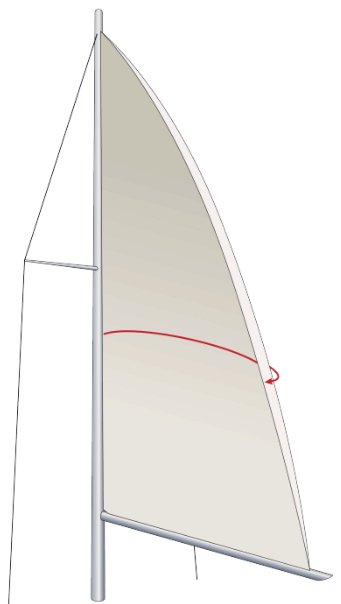
A leech line (also called a leech cord, leech drawstring, or pucker string) is a small-diameter line that runs the length of the leech. When tensioned, it prevents the leech from fluttering.
A leech line is found on most jibs and mainsails. It runs inside the leech tabling, the broad hem that finishes the edge of the sail from the head of the sail to the clew.
While a leech line is used principally to reduce leech flutter and save the material from fatigue, it can also affect the sail’s draft, or curvature. When the leech line is tightened, the leech stiffens and curves to windward, giving the sail a little more draft. Tensioning the leech line is particularly helpful in light wind and is increasingly more effective the farther off the wind you’re sailing, when the sheet is no longer pulling the sail straight down. The leech line should be used in conjunction with the mainsheet to eliminate flutter and maintain sail efficiency. But it must be used with caution, since it can create a poor sail shape when incorrectly adjusted.
When tensioning the leech line to reduce flutter, the procedure is to first sail with properly trimmed sails. With headsails, be sure to position the jibsheet leads correctly. A lead that’s too far aft can make flutter worse. Once the lead is set, adjust the tension on the leech line to reduce or eliminate the flutter — but keep an eye on the leech to make sure you’re not over-tensioning and causing the dreaded leech-hook. It’s better to have the leech flutter slightly than hook sharply to windward. When proper tension has been reached, cleat off the leech line.
Leech line variations
Leech lines are run two ways. The most common has the leech line fastened at the head of the sail, usually to the headboard, and running down inside the leech tabling to a point just above the clew, where it exits the tabling. A small cleat or jammer for securing the line is often fitted near the clew.
In a less common configuration, the leech line is fastened to the clew and runs inside the tabling to the head of the sail, around a small turning block fastened to the headboard, and down the luff of the sail. This arrangement makes the line adjustable at the mast, rather than at the end of the boom where it’s often difficult or impossible to reach. The leech line could also be led from the mast to the forward end of the cockpit.
Don Launer, a Good Old Boat contributing editor, built his two-masted schooner, Delphinus, from a bare hull. He has held a USCG captain’s license for 40 years and has written five books. His 101 articles through November 2011 are available for downloading as a collection from the Good Old Boat download website, www.audioseastories.com. Look under Archive eXtractions.
Thank you to Sailrite Enterprises, Inc., for providing free access to back issues of Good Old Boat through intellectual property rights. Sailrite.com