A rare cat ketch and uncommonly good coastal cruiser
Issue 97 : Jul/Aug 2014
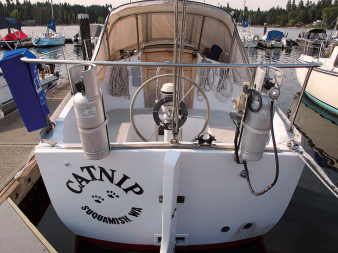
Tom Curley pulled into the marina parking lot on his Victory motorcycle. We stood there admiring this eccentric machine, its form obediently following its function to the smallest detail. Walking down the ramp and along the dock we came upon the stern of Tom’s Freedom 28, Catnip, the subject of this review. Twin 2-gallon propane tanks slung over the stern pulpit suggested a sense of purpose. It appeared that the design and arrangements of this boat were, like those of the Victory, inspired by practicality.
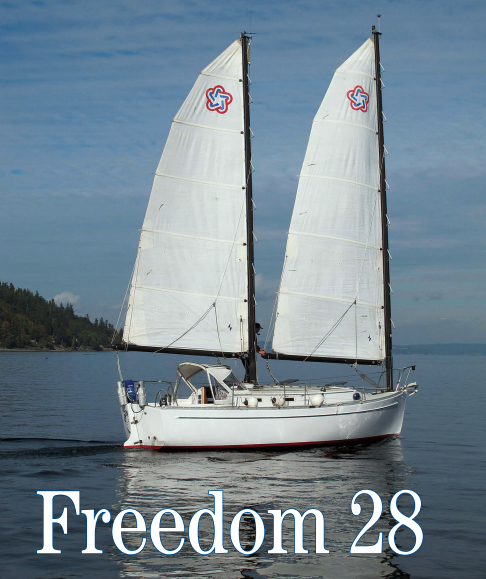
The most obvious eccentricity of the Freedom 28, brainchild of innovator and passionate sailor Garry Hoyt, is its cat ketch rig with unstayed masts. Garry was dissatisfied with what he took to be the unnecessary confusion of rigging and the complicated handling of modern sailboats. The Freedom’s rig eliminated the profusion of shrouds, stays, turnbuckles, chainplates, and associated parts. In collaboration with Everett Pearson of Tillotson-Pearson Industries, he brought the concept right up to date with free-standing carbon-fiber masts.
In the mid-1970s, Garry asked Halsey Herreshoff to design the hull of the Freedom 40, the first boat in the line, as a platform to test the spars and to work toward his vision of a new sailboat. He eschewed the fin keel and spade rudder concept and, in a bold move, eliminated the headsails, dividing the sail area between a mainsail and mizzen of almost equal size. Like L. Francis Herreshoff, Garry wanted to use 16-foot oars instead of an engine, but later gave up that idea as unmarketable. The sails were self-tacking and wishbone booms were offered as an option on the 40.
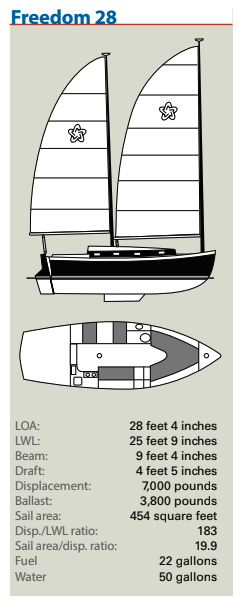
Following the 40, Garry introduced a whole new line of Freedoms: a 33, a 44, and the 28 — all with carbon-fiber free-standing masts as standard. As with the 40, the original Freedom 28 had a long shallow keel and a centerboard, making it an ideal gunkholer.
A simple singlehander
Catnip, hull #37, was built in 1983 and Tom has owned the boat for 13 years. He has sailed her north through the Gulf Islands and along the coast of British Columbia. Though often sailing with crew, he prefers to cruise solo and finds the Freedom 28 ideal for this purpose. Tom finds the size just about right. It’s small and handy enough to work into unfamiliar and crowded marinas and, with its 4-foot 6-inch draft, he anchors in places inaccessible to larger boats. At the same time, with all lines led aft to the cockpit, the single-line reefing system, and a single self-tailing winch, he’s more than able to cope with the open water in the straits of Juan de Fuca and Georgia. Catnip’s mizzen weathercocks the boat and she will readily heave-to with the mizzen reefed. Good bluewater boats, Freedoms have crossed the Atlantic and the North Sea.
As Tom sees it, the main advantage of the Freedom 28 to the solo sailor is the cat ketch rig. Tacking requires only that the helm be put over until the boat is on the new tack. There’s no jib to mess with. Main and mizzen sails can be set wing-and-wing for balanced downwind sailing and a staysail can be rigged between the masts to add more area. The mizzen also makes a good riding sail when at anchor, keeping the boat head to the wind. Catnip is fitted with two sets of lazy-jacks (some say lazy lifts) to hold up the booms and reduce the perils of furling.
Cockpit and deck
The Freedom 28’s cockpit is Spartan though comfortable. The port seat locker, being above the quarter berth, is shallow, but a great place to stow the companionway dropboards. Opposite to starboard is a large, deep locker that contains the manual bilge pump and allows access to the rear of the engine, the transmission, and the dripless shaft seal. A bridge deck helps keep cockpit water out of the cabin and, as part of the main bulkhead, stiffens the hull. The engine controls are placed conveniently for the helmsman. A slotted scupper in the transom is large enough to drain large quantities of blue water from the cockpit in a hurry but small enough to keep out the brunt of following seas. The outboard rudder is virtually foolproof, especially with the emergency tiller readily at hand in a cockpit locker. Tom says he removes barnacles from his propeller and shaft by leaning over from his dinghy.
All the running rigging, including sheets and halyards for both main and mizzen, vangs, and reefing lines, is led to the cockpit and tended by one Barient 23 two-speed, self-tailing winch and a bevy of clutches. An Autohelm autopilot is handy when sailing singlehanded.
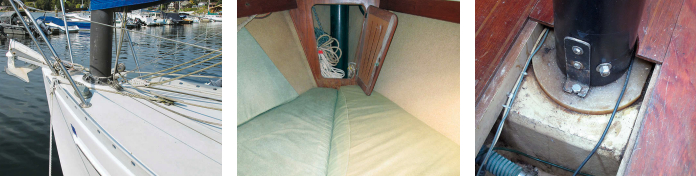
The wide sidedecks are bordered by heavy slotted-aluminum toerails outboard and a low, high-crowned cabin trunk inboard. In the absence of shrouds, they are obstruction-free. The mainmast and its collar, as well as a pair of heavy 10-inch mooring cleats, and chocks, greatly limit foot room on the bow when docking and anchoring. The shaft of Catnip’s 33-pound Bruce anchor, stowed on the solid 1-inch aluminum anchor sprit, is lashed to the deck between the deck hardware. Fitting a windlass on this fore- deck would be a challenge.
Construction
The hefty carbon-fiber masts are 6 1⁄2 inches in diameter at the base, tapering to 3 3⁄4 inches, and are said to be as much as four times as strong as aluminum. Each one is bolted to a beam above the ballast with steel angle brackets. Freedom offered wishbone spars as an alternative to Catnip’s more conventional aluminum booms.
The hull is a hand-laminated fiberglass sandwich with an end-grain balsa core. The deck is similarly constructed and the deck hardware is well backed up. The aluminum toerail and deck flange are fastened to the hull flange at 6-inch intervals with 5⁄16-inch bolts and 3M 5200 adhesive sealant.
Other than the shower pan in the head, the Freedom 28 does not have an interior liner. Bulkheads and furniture are built of plywood and secured to the hull by tabbing. Handrails, ventilators, and other deck fittings are bolted through the deck with fasteners that are exposed in the cabin and readily accessible.
Belowdecks
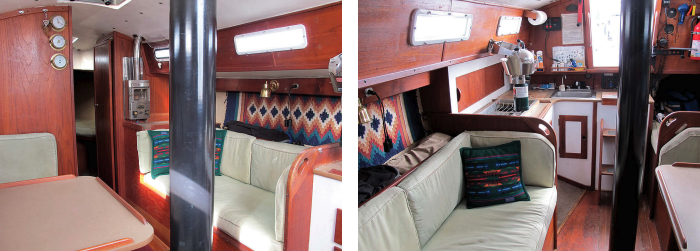
The small forepeak is mostly filled by the mainmast, though Tom fits 60 feet of 1⁄4-inch chain and 250 feet of 1⁄2-inch 8-plait nylon rode there. In the forward cabin two 6-foot 6-inch berths can be joined with an insert filler. There is stowage beneath, and a door closes off the cabin from the rest of the boat.
Aft of the cabin are some lockers to starboard and, on the port side, the head, which has a vanity sink, adequate stowage lockers, and a toilet that’s plumbed to a 25-gallon holding tank. A Beckson opening port ventilates the compartment.
In the saloon, which is traditional in design, a 6-foot 6-inch settee to starboard provides a berth with the feet tucked in forward under a shelf. A 50-gallon water tank and the water pump are fitted beneath this settee. A U-shaped dinette on the port side seats four and, when the table is lowered between the seats, makes a double berth. Compared to the 6-foot berths on many boats this length, the extra 6 inches are a luxury, and a necessity for a 6-foot 3-inch sailor like Tom Curley.
Storage wells run outboard of the settee and dinette areas. The saloon is lit by two deadlights on each side and an opening portlight forward on the starboard side. Some people might find the large mizzenmast intrusive, stepped as it is between the saloon and galley, but it’s handy to grab hold of or lean against in a seaway.
Ample teak creates a warm, snug feeling in the saloon while contrasting white surfaces in the galley differentiate the work space from the lounging area. A teak-and-holly sole runs throughout the boat. Hatches allow access to the bilge. Partial bulkheads separate the saloon from the galley and quarter berth and provide welcome handholds.
The L-shaped galley occupies the starboard side next to the companionway. It is fitted with a two-burner propane stove, but Tom prefers the single-burner Force 10 Sea Swing gimbaled propane stove he mounted above the counter. A 5-cubic-foot well-insulated icebox occupies the corner and a deep sink is adjacent to the ladder. Lockers and deep drawers to starboard of the companionway ladder provide adequate stowage. A 22-gallon fuel tank is located below the quarter berth, abaft the low dinette bulkhead.
The engine
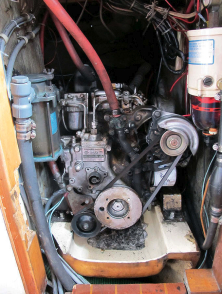
A Yanmar 2GM powers the boat and, as in most boats of this size, it’s a tight fit in its sound-deadened box. Removing the companionway ladder is the primary means of access. A 16-inch 2-blade propeller is a good match for the boat.
Under way
I couldn’t wait to sail this boat and see for myself how she behaved. It was early autumn, sunny, cold, and breezy — ideal conditions for a trial sail. We cast off and headed for deep water. We came into the wind and Tom hoisted the mizzen, winching it up the last foot or two. Catnip was then weather-cocked, and it took very little to keep her head up. We shut down the engine, quickly raised the main, and trimmed for a broad reach.
We were in a 2-foot chop and headed toward whitecaps. In the 12- to 15-knot wind, with sharp gusts upward of 20, Catnip made 5 to 6 knots. She had an easy motion, neither pitching nor rolling excessively. I had the feeling that she would be similarly seakindly in heavier weather. The remarkable thing was how well she steered herself. With the wheel locked, the boat changed course as the wind changed and, for long periods, we didn’t have to touch the wheel.
Bringing her close-hauled, Tom showed me how he trimmed by the main and adjusted the mizzen to avoid luffing. The cat ketch is not an especially close-winded rig and, without travelers for the sheets, the booms cannot be brought amidships, but Catnip footed well to weather nevertheless. Still, this is not a boat that can be pinched to gain a few degrees on the wind.
Heading for home, we ran wing-and-wing. She would wander a bit either side of the wind direction, and when we fell off a wave we jibed. I was grateful that there were no shrouds for the boom to slam against.
Conclusion
The Freedom 28 is a well-conceived, robust boat with bluewater capabilities. The cat ketch with free-standing masts offers advantages in simplicity, safety, and lower maintenance that conventionally rigged sailboats cannot match. It’s a joy to sail, particularly in heavier weather and shorthanded. Some sailors will find the boat’s speed broad reaching and downwind refreshing, but others will miss the weatherliness and speed around the buoys of conventional sloops. The large mast in the cabin may put off some potential buyers while others may value the generous berths and traditional no-frills layout.
As for appearance, some will be put off by the free-standing masts; others will revel in the non-conformity — the very strangeness — of the boat. There aren’t many Freedom 28s out there; not many Victory motorcycles either.
Richard Smith, a contributing editor with Good Old Boat, is an architect. He specializes in designing and building very small houses and has built, restored, and maintained a wide variety of boats. He and his wife, Beth, sail their Ericson Cruising 31, Kuma, on the reaches of Puget Sound.
Thank you to Sailrite Enterprises, Inc., for providing free access to back issues of Good Old Boat through intellectual property rights. Sailrite.com