. . . and two high-production contemporaries
Issue 99 : Nov/Dec 2014
The Hunter 35.5 was one of the many boats built by Hunter whose design credit reads “Warren Luhrs and the Hunter Design Team.” Over time, the Hunter Design Team saw a number of chief designers, but Warren Luhrs, who was the driving force behind Hunter Marine, greatly influenced all the boats that were built.
Since the 35.5 Legend, introduced in 1989, was a development of the earlier 35 Legend, introduced in 1986, it most likely involved the design talents of Cort Steck and Ola Wettergren. It was still in production during my tenure at Hunter between 1992 and 1995.
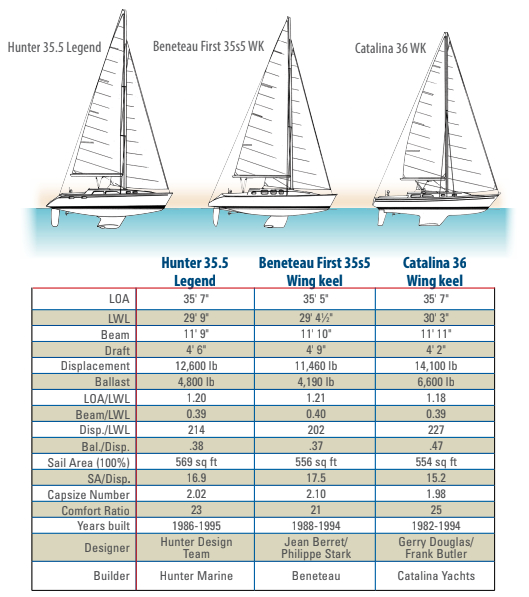
Hunter Marine was one of many high-volume builders of production sailboats in North America in the mid-to-late 1980s. This was a stressful time in the sailboat industry, with a number of builders on the verge of bankruptcy. C&C went under for the first time in 1986 and many others followed. Since the three dominant high-volume builders at the end of this period of consolidation in North America were Hunter, Beneteau, and Catalina, I thought it made sense to compare the Hunter 35.5 and the equivalent models from the other two surviving competitors. I chose the Beneteau First 35s5, introduced in 1988, and the Catalina 36, introduced in 1982 but thoroughly updated in 1994 as a Mk II. All three of these boats had long production lives that extended into the mid-1990s. In each case, I have shown the shoal-draft wing-keel configuration, which was standard on the Hunter but optional on the Beneteau and the Catalina.
The first thing to note is how similar these boats are in overall dimensions. However, both the Catalina and the Beneteau incorporate partial rudder skegs, vestiges of the girth measurements in the IOR Rule, that may or may not be incorporated in the published LWL. This slight extension of the LWL has little effect on performance but can skew the design ratios that involve LWL. At C&C, we got around this problem by using DWL (Designed Waterline Length) for all comparative calculations and publishing the LWL figure, which included the skeg.
The largest difference in the published figures is displacement, with the Beneteau being the lightest, at 11,460 pounds, and the Catalina the heaviest, at 14,100 pounds. This difference is almost entirely in the keel weights — the Beneteau has 4,190 pounds of ballast and the Catalina has 6,600 pounds. When ballast weights are subtracted from total displacements, the hulls are within 500 pounds of each other. I would note, also, that when a wing keel is listed as an option, it should be heavier than the deep-draft keel to achieve the same stability. Catalina published the weight of the wing keel, but I could not find a published weight for the two wing keel options offered on the Beneteau, so have used the only published keel weight I could find.
This difference in displacement and ballast weight has a significant impact on the relative performance of these three boats. Specifically, the lighter displacement of the Beneteau, combined with a sail area similar to that of the Catalina, gives the Beneteau the highest sail area/displacement ratio (SA/D), meaning superior performance in light to moderate winds. However, the Catalina has the highest ballast ratio, the highest displacement/length ratio (D/L), and the lowest SA/D. All this means that the Catalina will have the edge in heavier air, especially upwind where her greater stability will allow her to carry more sail area and she will not have to reef as soon as the others, especially the Beneteau. The Catalina’s greater stability will also help on close spinnaker reaches but may not be as much of an advantage off the wind, where the lighter Beneteau will have the edge.
The greater displacement also gives the Catalina a more favorable capsize number and comfort ratio, although the other two boats are not that far removed. However, while the Beneteau may well have the better light-air performance, and the Catalina better heavy-air performance, the Hunter, falling between these two extremes, may have the better all-round performance. That is, she might not win any individual races but would do well in a series sailed in a variety of conditions.
The other thing to note is that the Hunter and the Beneteau have fractional rigs while the Catalina has a masthead rig. The larger headsail in the masthead rig will require more work to control, but the larger spinnaker may well make up for the displacement difference downwind.
These 35/36-footers represent three very interesting production cruiser/ racers from the Big Three of sailboat production in North America at a time when their dominance was just being established.
Rob Mazza is a Good Old Boat contributing editor who, in his long career with C&C and in other design offices, contributed enormously to the enjoyment of those who sail and own good old boats.
Thank you to Sailrite Enterprises, Inc., for providing free access to back issues of Good Old Boat through intellectual property rights. Sailrite.com