Make the engine suck its own antifreeze
Issue 99 : Nov/Dec 2014
Up north, after pulling the boat out in the late fall, winterizing an engine is a mandatory and often unpleasant chore. Draining a raw-water-cooled engine like mine is recommended, but I’ve never been convinced that all the water makes its way out. So for years, I instead pumped antifreeze through the motor.
This involved pulling the engine intake hose from the seacock and forcing into its end a straight barbed connector with a hose on the other end long enough to reach the bottom of the antifreeze bottle. But before joining them, I had to suck a fair amount of antifreeze through the hose without either choking on it or getting it all over the place. Then — quick like a bunny — I would make my first attempt at sticking the hose onto the fitting fast enough to set up a siphon. The trouble is, on my 33-foot Albin Nova, Mahdi, and I’m sure with many boats, the hoses involved are stiff and nearly impossible to get hold of with both hands at once. They also have a knack for generating bloody knuckles while they are being muscled apart.
And besides, I have little doubt that the less stress I put on hoses capable of sinking my boat, the better.
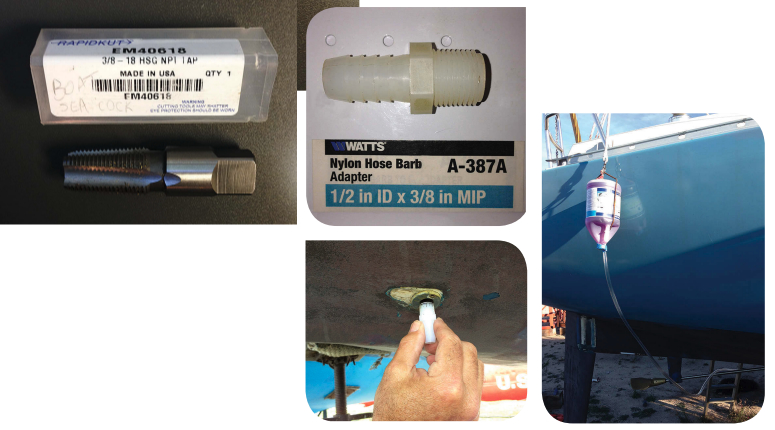
After trying many other methods, I hit on one that’s an absolute cinch. It involves first tapping a thread in the intake through-hull for the engine. My seacock has a 3⁄8-inch inside diameter, so I chose a 3⁄8-inch MIP tap that matches barbed nylon fittings widely available in hardware stores (1⁄2-inch barb x 3⁄8-inch MIP). I found this tap by taking the barbed fitting into an industrial tool supply shop.
Now, when it comes time to winterize, I just screw this fitting into the through-hull from the outside (my boat has already been hauled out, of course). I then stick a plastic hose onto the barb and lead the other end up to an inverted antifreeze bottle hung from the rail. To provide a vent and to make the bottle self-prime, the bottle’s cap has a smaller fitting next to the one for the main hose. To this, I’ve attached a small hose that extends to the bottom of the bottle. I will use this cap again next year on the next antifreeze bottle.
All that’s left to do is to run the engine until the appropriate amount of antifreeze has run out of the bottle (a half gallon in my case). The job is done without my ingesting any antifreeze or spraying it all over the place — and no bloody knuckles.
Greg Steimel sails the Straits of Mackinac in a 1984 Albin Nova named by a previous owner, for no apparent reason, after a character in the novel Dune. He is a financial analyst, writer, attorney, and occasional political consultant who looks forward to the day he moves to a full-time unpaid position in a boatyard (retirement).
Thank you to Sailrite Enterprises, Inc., for providing free access to back issues of Good Old Boat through intellectual property rights. Sailrite.com