A pedigreed early center-cockpit design
Issue 103 : Jul/Aug 2015
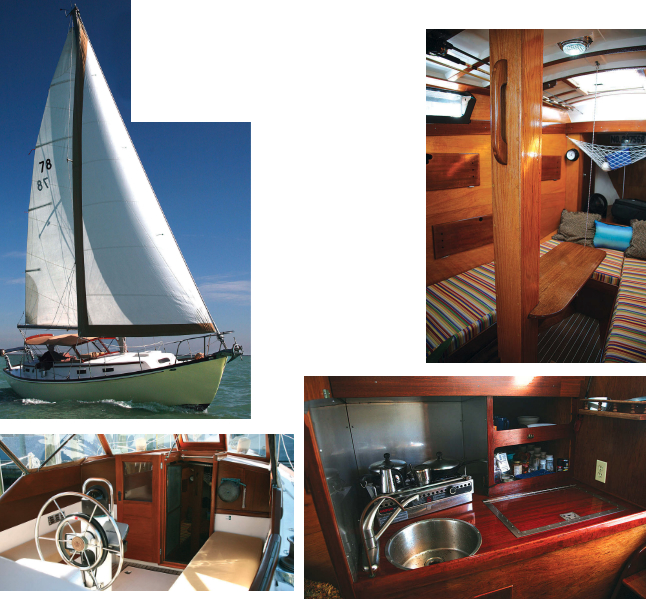
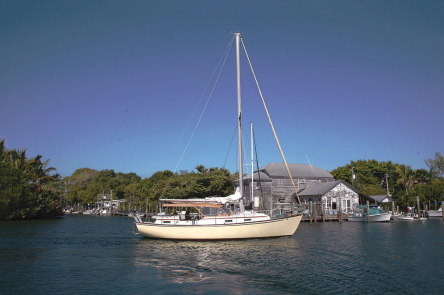
Calypso music played in my head as I photographed Yellowbird, a 1972 banana-colored Chris-Craft Sail Yacht 35. Abeam of the photo boat, her hull created golden rippling reflections in the turquoise waters of Charlotte Harbor . . . a shimmering tropical scene on the west coast of Florida just four days before record-breaking cold swept the entire United States.
“Yellow bird, up high in banana tree
Yellow bird, you sit all alone like me
Did your lady friend leave the nest again?
That is very sad, makes me feel so bad
You can fly away, in the sky away
You’re more lucky than me”
–Alan & Marilyn Bergman
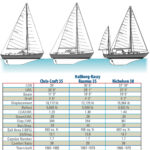
The Chris-Craft Sail Yacht 35 was the first of several sailboats built by the highly respected powerboat builder. The project was initiated when an investment firm led by famous sailing yachtsman Cornelius Shields purchased a majority stake in Chris-Craft Corporation in 1962. Legend has it that company staff members were “as contemptuous of sailing yachts as Corny Shields was of ‘stinkpots’.” Altogether, 62 Sail Yacht 35s were produced. The boat was designed by Sparkman & Stephens, as were nine other Chris-Craft sailboat models ranging from 26 to 42 feet.
The 35’s hull, deck, and cockpit are built of solid fiberglass-reinforced polyester while the cabinhouse is constructed of mahogany. The hull-to-deck joint is bonded with FRP and mechanically fastened with bolts.
An extensive review by Theodore Jones in the July 1963 issue of Popular Boating concluded: “What will surprise most sailors, as it did me, is the excellent performance of this boat. She sails beautifully. She is stiff in a breeze, balances well, has an easy motion, and appears to move like a racehorse on the home stretch.”
John Foster, Yellowbird’s owner, related the same impressions to me. John had dreamed of owning a Chris- Craft 35 as far back as 1999. At the time, he was living alone on a 27-foot wooden sharpie powerboat in Boca Grande, Florida. He was attracted to the 35 for a variety of reasons: the nice spring to its sheer, a large deep center cockpit, a fixed windshield, a separate sleeping cabin aft, a forward cabin containing an enclosed head, galley, and saloon. In addition, it was designed by Sparkman & Stephens and built by the legendary Chris-Craft.
The design was ahead of its time in many ways, as not many center-cockpit sailboats were built in the ’60s. By modern standards, however, her long overhangs and narrow beam limit the amount of room inside. Also, there is no room under her low deck profile for an interior passageway between the cabins: going from one cabin to another entails passing through the cockpit. (See “Atelier” in the May 2015 issue for another example of the Sail Yacht 35.)
Longtime liveaboard
An experienced boat owner, builder, marine mechanic, and electrician, John was born and bred on the water. His skills are legendary on the small island of Gasparilla on Florida’s west coast. Its relatively isolated location makes it a popular destination for all manner of cruising vessels. When they arrive with a boat problem at any of the limited number of marinas — and they range from the most sophisticated to the most rustic — John is the man on call. He also maintains, and sometimes captains, many of the vessels that call the small town of Boca Grande their home port.
After living on the sharpie for 17 years, he purchased an older Gulfstar 35 trawler so he could have more space. After he met his partner, Terry, who was interested in sailing, the two began thinking about a sailboat.
They looked at a number of boats but weren’t too enthusiastic about any of them. Then a broker told them about a Chris-Craft 35 weathering away in a slip in Longboat Key, about 50 miles north. When they went to look at the boat, John was shocked to find two Chris-Craft 35s located in the same small canal; one was the very boat that had intrigued him many years before. The boat that was for sale was in rough shape. The engine would barely run, the mahogany cabin trunk had dry rot in places, most of the electrical system did not work, the head was leaking, and much of the rigging looked questionable.
John and Terry negotiated a fair price based on the poor condition of the boat. They were able to get her home to Boca Grande by temporarily mounting an 18-horsepower outboard on the transom.
Showing her age
After some basic repairs to the rigging, hull, and engine, the boat was good enough for a few daysails, but each time they went out, it seemed that another problem popped up. Chief among them was that the engine was marginal and quit on a few occasions. John eventually replaced the original engine with a used Mercedes 220 DP diesel rated at 55 horsepower.
On another outing, the forestay broke, but the wind was light enough that the luff wire in the jib allowed them to jury-rig support with a couple of halyards and return home without losing the mast
Upon careful inspection, John noticed a slight bend in the stainless-steel compression post under the mast. He reinforced it by cutting a steel pipe in half lengthwise, drilling and tapping the post, and fastening the two halves around it with machine screws. Confident in the additional support, he enclosed the reinforced post in a varnished teak column that complements the interior finish of the boat.
The cabin trunk is made of wood and John found rot in significant portions of it. He cut out the rot and installed new pieces of plywood to fill the holes. After carefully sanding the patches, he sealed them with epoxy. Then, because of the extent of the repairs to the mahogany sides, he painted all the surfaces.
Steady work
For the next two and a half years, John and Terry lived aboard his trawler while he worked on Yellowbird from dawn to dusk almost every day. With the help of a jury-rigged collapsible workbench, John was able to work next to his boat right there on the ancient dock.
Both boats were docked at the historic Whidden’s Marina in Boca Grande, where little has changed since Sam Whidden built it in 1926. The buildings and grounds are well worn by time, weather, and the comings and goings of family members, who have lived there and operated the marina ever since. Anyone interested in one of the few remnants of “Old Florida” should pay a visit.
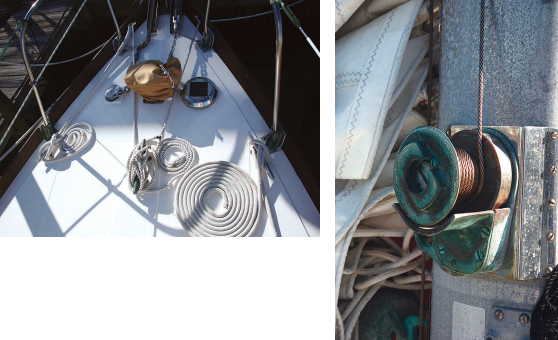
John replaced all the standing and running rigging and removed every piece of deck hardware, including the lifelines and stanchions, either refinishing or replacing each item. He spent almost six full weeks refinishing and repainting the hull while the boat was in the water. He painted the hull down to the waterline from a dinghy and a homemade float, using an industrial linear-polyurethane paint, Mothane, from BLP Mobile Paints. They chose the yellow hull color and the name for sentimental reasons, as Terry’s father had owned a number of sailboats named Yellowbird. They then had the boat hauled at a nearby yard where they could redo the bottom and boot stripe.
John fitted Yellowbird with new sails and custom canvas from Knighton Sailmakers (now UK Sailmakers) in Sarasota. The Bimini top attaches to the fixed windshield and extends well beyond the cockpit to provide shade to the aft cabin. In foul weather, the cockpit can be enclosed with removable side curtains.
Making do and making better
John reports that the fixed windshield has both positive and negative aspects. Because the cockpit is quite far forward and relatively close to the water compared with later center-cockpit designs, the boat can be wet in windy conditions. The fixed windshield, and the side curtains when needed, can provide a great deal of protection from spray. On the other hand, the fixed windshield limits the amount of fresh breeze in the cockpit when the weather is hot and sultry. John has considered modifying the windshield with a center opening, but has not yet found the right hardware.
The work on Yellowbird has continued, with John adding a CPT autopilot, Engel cold-plate refrigeration, a composting toilet, and an antique ship’s bell from an old ferryboat. The bell, mounted on the forward bulkhead of the cockpit, adds a uniquely decorative but functional flair.
The split cabin, one of the attractions of the boat, needed some further modification. When John installed the composting toilet in the main head, he removed the original marine manual toilet that was located in the aft cabin between the two bunks. He felt it was not worth retaining it in this unlikely and annoying location. He converted the space to a nightstand with storage beneath. The obvious disadvantage is that using the main head means climbing up the ladder into the cockpit and then back down the main companionway.
The forward cabin contains the galley, the enclosed head, and the saloon. John eliminated the upper bunks in favor of a cluster of enclosed cabinets that provide multiple storage spaces. All the cushions have been reupholstered and a folding table swings down from the mast enclosure. All the work John has performed over the past seven years has been to the highest standard. His versatility and experience as a craftsman are evident throughout the vessel.
Sailing is the reward
Once John had completed the basic work, he and Terry began daysailing more frequently in the excellent sailing waters of Charlotte Harbor. They have made more than a half dozen trips through the Florida Keys and one crossing to the Bahamas.
Now that the work is complete — if work on a boat is ever complete — John and Terry have moved Yellowbird a short distance away to a small private marina. The protection is better and the amount of boat traffic is drastically less than at Whidden’s Marina. My guess is that sooner or later John will need a new project.
Seeing this extensive renovation of a Chris-Craft Sail Yacht 35 and her like-new condition transported my mind back to the 1970s and a simpler world. Yellowbird’s classic lines and pleasing proportions suggest a time when market forces did not drive the quest for living room-like spaces aboard cruising sailboats. Instead, it was left to designers to create boats that would combine good seakeeping and adequate performance with creature comforts sufficient for cruising. And if that design resonates with a contemporary owner like John, the result may even be a full-time residence floating in a tropical lagoon within a stylish island called Gasparilla.
Bill Jacobs has been racing and cruising for 50 years and writing about boats for the last 10. He currently sails a Cape Dory Typhoon in Baileys Harbor, Wisconsin, and spends winters in Sarasota, Florida, sailing a 55-year-old wooden Luzier 27.
Thank you to Sailrite Enterprises, Inc., for providing free access to back issues of Good Old Boat through intellectual property rights. Sailrite.com