Heat the food, not the cabin and crew
Issue 104 : Sept/Oct 2015
I should put this on the table right now: I am a vegetarian. When every other boater in the harbor is preparing dinner on an outside grill, I am inside boiling water and sautéing veggies for pasta primavera. You can imagine the cabin heats up fast, which has led me in search of other, less hot, approaches to cooking.
Carrie Rose has a propane Seaward stainless-steel two-burner stove with an oven. It is a gem. It makes great pizzas and, as anyone who uses propane knows, it delivers a lot of heat. This is a problem on a hot steamy day. For years, as an alternative, I used a butane cooktop — the one with threatening warnings not to cook with it for fear of death that remind me of the caution on chartbooks: “This chart is not intended for use in navigation.”
I carefully stored the butane canisters in the vented propane locker. As soon as I was finished cooking, I disengaged the canister from the device, put the cap on it, and placed it outside. The overhead ventilation fan was on whenever I was using the cooktop, but I still felt guilty about cooking with it.
One day, I noticed an article in the New York Times about innovative young chefs in Brooklyn, one of whom was shown cooking on three $700 single-burner induction cooktops. This got my attention. Induction cooking has been around a long time in commercial applications but has only recently become affordable for good old boaters.
Induction cooking uses alternating magnetic fields to produce electromagnetic energy to heat ferrous (as in iron) material. If a magnet sticks to the bottom of a pan, the pan will work with an induction cooktop. The classic is a cast-iron pan, but there are pans made of ferro-magnetic stainless
steel specifically designed to work with inductive cooktops.
Here is the take-home message: with induction cooking, the only thing that heats up is the pan and the food in it . . . and it heats up fast. Heating occurs when the pan is in contact with the cooktop. Pick it up and the heating stops.
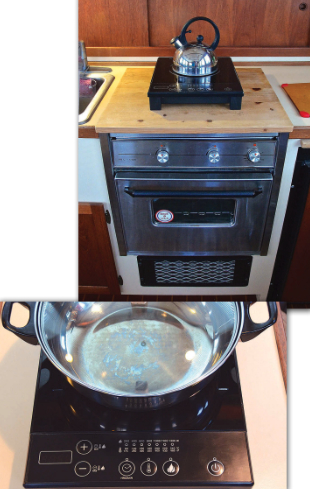
I bought a Salton for about $80 simply because it was the only one available at the Wal-Mart in Smith Falls, Ontario. It came with a cheap, but surprisingly functional, pan (after I fixed the cover’s broken handle with a piece of scrap wood, that is). Before you buy one, remember that this device needs 120 volts to operate, so you will need to be plugged into the marina’s power, have an AC generator, or a sizable bank of batteries and an inverter.
The control display provides two ways to adjust the heat level: watts and temperature. There is also a timer. The wattage starts at 200 (175°F) and rises, mainly at 200-watt intervals, to 1,300 (465°F). At 200 watts, it is just keeping the pan warm. At 1300, whatever is in the pan is being seared.
The Salton comes in basic black. The cooking surface is glass. It measures approximately 12 x 14 and is 2 1⁄2 inches high. I doubt it weighs 5 pounds. Though I have not found this to be an issue, if you are concerned about magnetic-sensitive gear, keep it at a distance.
The pan heats up quickly, so there should be something in it before it is turned on. Water boils and oil sizzles fast. At the opposite end of the scale, a frittata has the time to slowly cook through. If you choose the temperature setting, the heating process pulses on and off to keep the temperature constant.
Other than right under the pan, the cooktop does not get hot. The pan gets hot, what is in it gets hot, but everything around it does not get hot. No residual heat is associated with it. Once it’s off, it’s off. A fan stays on as long as the cooking surface is 120°F or hotter. Finish cooking, take the pan off, and the fan stops within a minute.
This induction cooktop is fast, precise, unobtrusive, clean, and will not catch your boat on fire. Do not let its looks fool you into thinking it is an electric cooktop. It is nothing like an electric cooktop. These days I cannot wait to get up in the morning and boil water!
Dean Raffaelli started to sail at the age of 11 in Montrose Harbor, Chicago. Later, he sailed a Hallberg-Rassy Monsun 31, and then, with thoughts of doing the Great Loop, bought a 32-foot Nordic Tug. At present he is on Grand Isle, Vermont, preparing to head for the Atlantic.
Thank you to Sailrite Enterprises, Inc., for providing free access to back issues of Good Old Boat through intellectual property rights. Sailrite.com