Fun and utility in a lightweight package
Issue 105 : Nov/Dec 2015
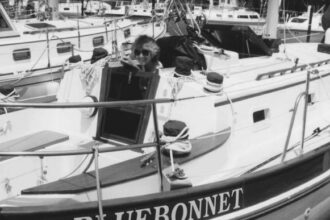
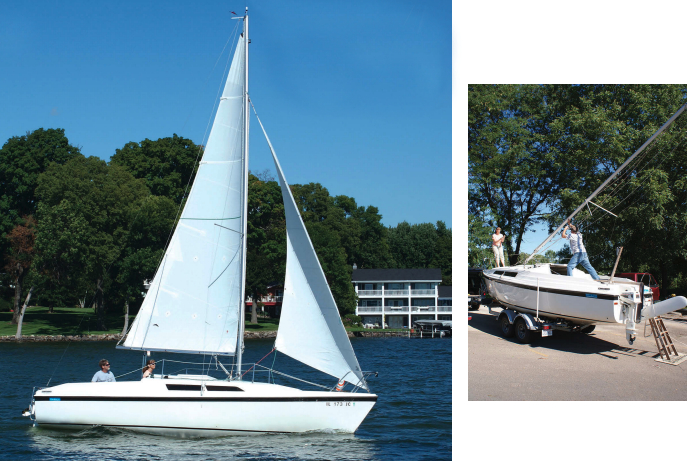
When we were looking for a MacGregor 26D to review, we found one nearby — a 1989 model that Allen and Ruth Penticoff bought new and named Thebote. Allen is one of Good Old Boat’s contributing editors but, because it’s not the magazine’s policy for contributors to review boats they own, I drew the assignment. My wife, Sandy, and I traveled to Lake Mendota in Madison, Wisconsin, to meet Allen and Ruth for a day of sailing and fun.
Lake Mendota lies on the north side of Madison and much of its south shore is home to the University of Wisconsin campus. There is a lot of activity on the lake, including racing fleets and parks with convenient launch facilities around the lake. We met Allen and Ruth at Marshall Park on the lake’s west end.
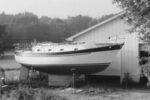
Allen’s sailing fleet has included several boats over the years. In addition to Thebote, he currently has an American 14.5 and a classic 42-foot Beister steel cutter, Coppelia, which currently resides in a large pole barn at their Rockford, Illinois, home under long-term restoration. Winter doesn’t stop Allen from sailing as he owns a DN iceboat.
Ruth and Allen like to travel and have taken Thebote to a lot of interesting sailing venues, including all of the Great Lakes, Kentucky Lake, Mark Twain Lake in Missouri, and the Florida Keys to name a few. They are often accompanied by their expert sailing dog, Berghie, a miniature Schnauzer.
MacGregor Yachts
Roger MacGregor might just be sailing’s Henry Ford. From the 1960s until he retired in 2013, his MacGregor Yacht Corporation produced more than 38,000 affordable, easily rigged and handled boats that brought sailing within reach of anyone with the itch to learn.
Roger formed the company in 1964 as a master’s degree project and began producing a line of smaller fractionally rigged trailerable sloops, ranging in size from a 17-foot daysailer to a 24-footer with reasonable accommodations for overnight or weekend cruising. The MacGregor facilities in Costa Mesa, California, became a very busy operation.
In 1974, MacGregor introduced a 25-foot swing-keel Venture model with improved accommodations and
standing headroom in the saloon under a pop-top. In 1980, the cabin trunk was widened and the sidedecks eliminated to provide greater space below. The Venture name was retired and the boat became the immensely popular MacGregor 25, of which the company produced more than 7,000.
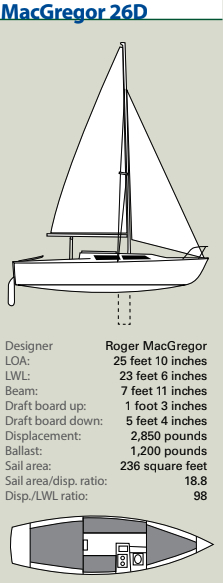
Always looking for ways to improve his customers’ experience, Roger ceased producing the MacGregor 25 in 1987 and introduced a 26-foot boat with a similar hull form and nearly identical rig but with a daggerboard and water ballast instead of the heavy cast-iron swing keel. A modification in 1990 gave it a lightweight swing keel/centerboard. The daggerboard version, like Thebote, is informally called the 26D, while the swing-keel model is often referred to as the 26S.
Roger kept his costs low, and the base price for the boat and trailer remained at around $9,900 throughout production, which continued until the launch of the 26X in 1995. The new boat was a radical departure from traditional sailboat design, being more of a hybrid sail and power craft developed from an earlier 19-foot attempt at a hybrid boat. (A review of the MacGregor 26X appeared in the May 2013 issue.) A refinement of the 26X was introduced as the 26M in 2002.
MacGregor Yachts also produced a 36-foot trailerable catamaran, a 65-foot race-oriented boat, and a 70-foot racer-cruiser, but the bulk of production was always the smaller trailerable cruising sloops. When Roger retired in 2013, his daughter Laura MacGregor Sharp and her husband, Paul, started Tattoo Yachts in Florida, offering a boat quite similar to the MacGregor 26M. They have since introduced a new 22-foot model.
Construction
MacGregor 26D hulls are a solid fiberglass layup with a gelcoat outer surface. Owners report occasional gelcoat cracking and crazing — as occurs in many fiberglass boats. The layup is not overly heavy, but the hull, fiberglass interior liner, and stringers together make up a fairly stiff composite structure. In earlier boats, including Thebote, the deck is cored with plywood, and in later models with balsa, except in high-load areas. The hull-to-deck joint is a through-bolted shoebox lap joint with an aluminum extrusion covering the bolts. A neoprene rubber section snaps into a groove in the aluminum extrusion to finish the rubrail assembly. A dedicated motor well inboard of the transom on the port side eliminates the need for a bolt-on motor mount, but it lacks a fuel-tank locker.
The transom-hung rudder is a fiberglass blade section mounted in an aluminum channel that extends upward to provide the tiller attachment. The rudder is hollow and fills with water to give it negative buoyancy. It is raised and lowered with lines that tie to a horn cleat on the rudder bracket. The hollow daggerboard also fills with water so that gravity assists in lowering it.
The water-ballast system greatly reduces trailering weight. Upon launching, opening the air vent and the main valve located below the companionway ladder allows controlled filling of the ballast tank. Both valves are then closed for sailing. Back at the ramp, the air vent and main valve are opened again to drain the ballast for trailering.
As an added safety feature, the 26D has built-in foam flotation, rendering it unsinkable.
Rig
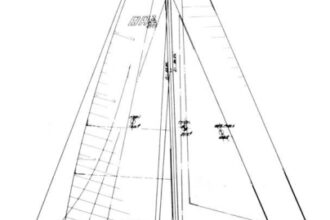
The MacGregor 26D’s aluminum mast is deck-stepped in a tabernacle. The forestay and backstay are attached at the masthead with clevis pins and cotter rings. The only standard turnbuckle provided with the boat connects the forestay to the stem fitting and is used for the final rig tension adjustment. On the shrouds, vernier-style dual-channel fittings at the deck ends can be tensioned incrementally using a cotter pin through unequally spaced holes in the two channel sections. Thebote has this stock arrangement but some owners have replaced these with standard turnbuckles. The stainless-steel chainplates for the backstay and the upper and lower shrouds are through-bolted onto the hull.
The aluminum boom mounts to a pin attached to the mast and is fitted with a cleat for the outhaul line at the aft end. Stock mainsails have no slides on the foot or luff and are attached by boltropes that fit into grooves in the mast and boom that can also accept slugs or slides. Allen modified Thebote by adding slides to the mainsail, as well as two reef points with jiffy reefing, and leading the halyards to the cockpit.
Raising the mast is a fairly simple matter for two people in reasonable physical condition. Only the forestay needs to be detached for trailering, and when the mast heel is moved back from its trailering position and pinned into the tabernacle, the mast can be raised by one person lifting it from the cockpit and walking it forward while the other walks the forestay to the bow. Once the forestay is attached to the chainplate with its clevis pin, the rig is stable. The rig tension can then be adjusted with the turnbuckle.
MacGregor also offered a simple gin pole with a block and tackle that makes it possible for almost anyone to rig the boat. A stock MacGregor 26 had a plate in the forestay for attaching the gin pole, but that prevented the jib from dropping all the way to the deck.
We watched as Allen and Ruth easily rigged and launched Thebote without a gin-pole system. They have removed the mast-raising plate from the forestay and added a tensioning lever for quick setup.
On deck
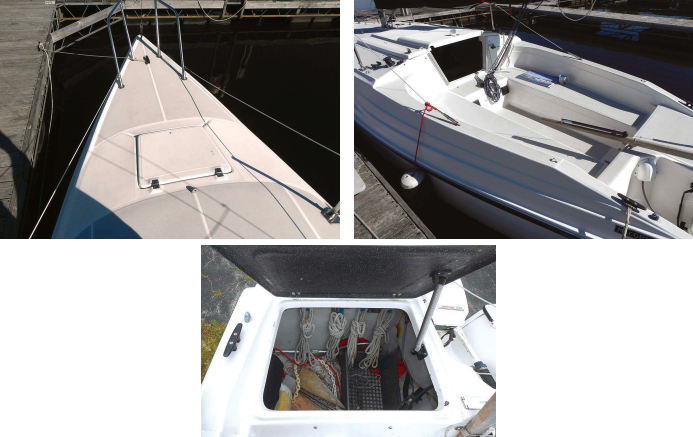
The MacGregor 26D’s cabin trunk extends across the beam of the boat, so crew going forward must step up and onto the cabintop. There are no grabrails, but the shrouds and mast are close enough to provide handholds.
The pop-top section rests in molded channels that keep water out. The companionway hatch slides in aluminum rails within the pop-top section. There is no sea hood. A one-piece fiberglass dropboard closes off the companionway. Allen has fabricated aclear dropboard and also one with a screen.
The foredeck is uncluttered, with just a single mooring cleat on the centerline. A stainless-steel pulpit provides some security at the bow but the single lifelines are attached lower down on the aft legs of the pulpit to allow a genoa to sweep the deck. This means that crew working forward must take care not to trip on the low lifeline. The molded-in nonskid on the deck and cabintop surfaces is aggressive and effective.
The cockpit is adequately sized with seats well over 6 feet long on which four can sit without obstructing the tiller. The seat surface crosses at the companionway to form a narrow bridge deck and there’s a deep lazarette on the starboard side aft opposite the motor well. High coamings sweep slightly upward to the cabin trunk and provide decent back support. (In its first production year, the 26D had lower, flat coamings topped by a stainless-steel rail.)
Jibsheets, for the standard working jib and the genoa, are routed through well-placed fairleads (there are no tracks) to Lewmar 6 winches and cam cleats mounted on the cabin trunk to port and starboard. Trimming is quick and easy, and Allen has set up Thebote so that crew can handle the cleats and winches while sitting in the companionway.
The mainsheet is attached a few feet from the aft end of the boom and leads to a stand-up swivel fiddle block and cam cleat located amidships on the bridge deck. That puts it within easy reach for the helmsman to make quick adjustments to the mainsail.
Belowdecks
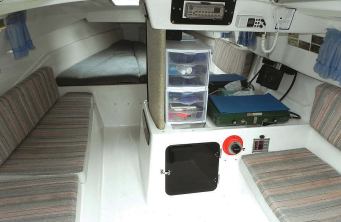
Headroom in the MacGregor 26D’s saloon is 6 feet 2 inches with the pop-top up. (MacGregor offered a pop-top enclosure for inclement weather.) To port and starboard are comfortable settees with good sitting headroom above and storage beneath. The shorter starboard settee ends at the galley, where the liner forms a small sink and a counter with space for a camp stove on top and storage beneath behind smoked-Plexiglas doors. A hand pump delivers water to the sink from a standard 5-gallon tank. Many owners augment this limited supply.
The simple electric panel is located on the cabinet front. An upholstered panel at the inboard side of the galley is actually the trunk for the daggerboard. Above the galley, the liner forms a foam-filled box beam that stiffens the deck at the mast step. This is often used for mounting auxiliary equipment such as the VHF radio.
Forward of the galley there is a compartment for a portable toilet. Allen and Ruth store onboard supplies in a clear-plastic shoe organizer mounted on the inner face of the door that encloses it. The V-berth lies forward of this enclosure and at the end of the port settee. It is more than 6 feet long and just over 5 feet wide at the entry — a tight fit for two people, especially if both are tall. A large hatch provides ventilation.
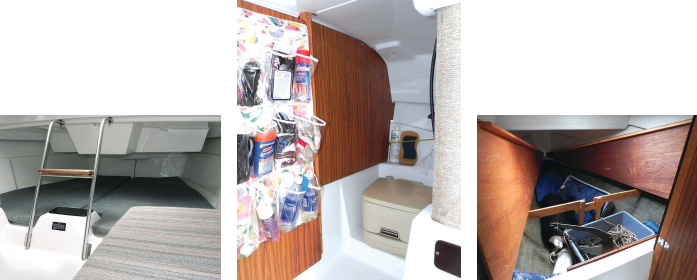
Considerable storage space is available under the berth, and Allen has enlarged the opening and installed hinged covers to make access easier. This is where they keep their primary anchor and its rode.
One of the selling points for the 26-foot water-ballasted model was increased usable space below. The entire area beneath the cockpit was designated as a wide double berth. It’s a very spacious area and could be a quite comfortable double, but in practice anyone spending much time aboard tends to use the space for storage.
Ventilation below is adequate with the pop-top up and the forward hatch open, but in inclement weather airflow is limited as there are no deck-mounted vents or opening ports. A rain cover rigged over the forward hatch would be a good investment.
Under power
Thebote has a 6-horsepower Johnson Sailmaster outboard that moves her along quite nicely. It has a longer shaft, but tilts far enough forward on its mount to keep the prop out of the water under sail. Allen and Ruth gave me little opportunity to test the performance as they much prefer to sail.
Under sail
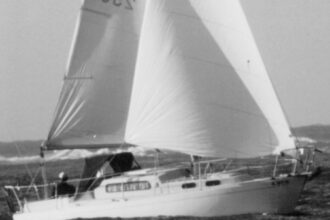
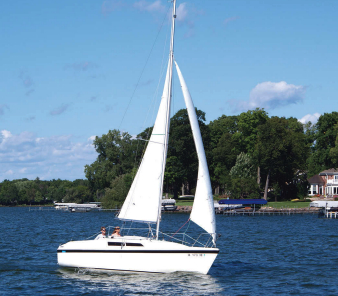
On our day on Lake Mendota, winds of varying strengths gave us a chance to experience how the MacGregor 26D handles in a number of conditions. Sandy and I owned a MacGregor 25 for a number of years, so we had some idea of what this boat might be like. When I first took the tiller, it did feel a bit like coming home to an old friend. She responded quickly to the helm and although her initial tenderness was a bit more than we had anticipated, she stiffened up once she heeled a few degrees. Her light-air performance was good, even with the standard working jib. We tacked a few times as the wind built, and sailing at 35 degrees to the apparent wind was a snap. We could have sailed closer, but footing off a bit for speed improved the ride. There was not a lot of apparent leeway.
When we eased off onto a reach, a handheld GPS showed 5.5 to 6 knots as our speed over the ground. With little current in the lake, that’s an accurate idea of speed through the water. The wind was indeed building and we saw at least one racing scow capsize, so that gave us confidence in Thebote’s stability.
On a run, the boat is stable, although it does roll a little, likely as the mainsail loads and unloads in the waves. We were always under control and, in lighter air, retracting the dagger-board on a run will add a bit of speed. Allen reports that the MacGregor 26D must be reefed early to stay under control. The rudder can stall before being overpowered, resulting in a roundup. While it sails poorly under mainsail alone, with only the genoa set it balances well and is less prone to rounding up. It even sails well under just the working jib, but only in stronger breezes.
The 26D is quick, responsive, and fun to sail. This is not by any means a boat to be taken offshore, nor was it designed for that purpose. It’s an easily trailered, easily rigged small weekender intended to get you on the water and sailing, and it does that quite well. Allen and Ruth have safely sailed Thebote thousands of miles in the 26 years they’ve owned her.
MacGregors are raced in several places. They are excellent light-air performers and if properly sailed can hold their own when the wind pipes up. The 26D’s base PHRF rating of 216 matches favorably with that of the Hunter 26, another water-ballasted boat, at 219. For comparison, the traditionally ballasted MacGregor 25 and Catalina 25 both carry a base rating of 228.
Conclusions
The common hit on MacGregor boats is that they are flimsily built. While the scantlings are somewhat light, the MacGregor 26D has proven to be a simple and sound boat. A large number are acquired by novice sailors, many of whom, as they gain experience, tend to hold onto their Macs as all the boat they’ll ever need.
At any time, a number of MacGregor 26Ds are on the market through brokerages at asking prices ranging from $5,000 to $11,000. Most listings indicate that the trailer is included. Many more boats are offered for sale by their owners. When the newer 26S is included in the search, the number of available boats doubles.
Tom Wells is a contributing editor with Good Old Boat (and he has also earned the honorary title of Troubadour through his musical contributions at boat shows). He and his wife, Sandy, have been sailing together since the 1970s and own and sail a 1979 Tartan 37, Higher Porpoise.
Thank you to Sailrite Enterprises, Inc., for providing free access to back issues of Good Old Boat through intellectual property rights. Sailrite.com