Ways to dispose of expired pyrotechnics
Issue 108: May/June 2016
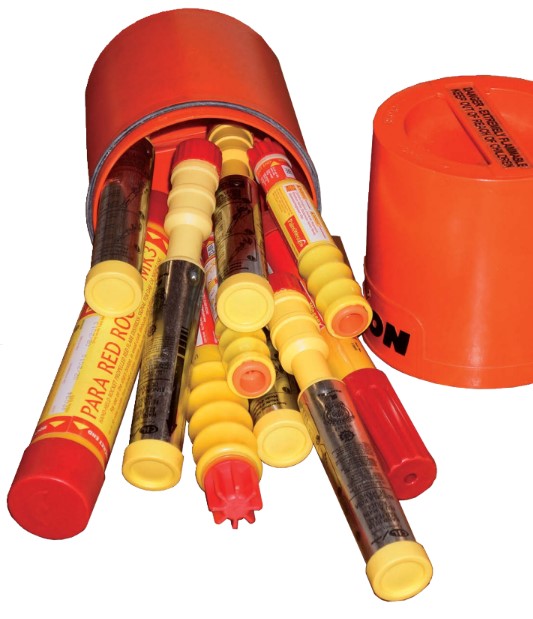
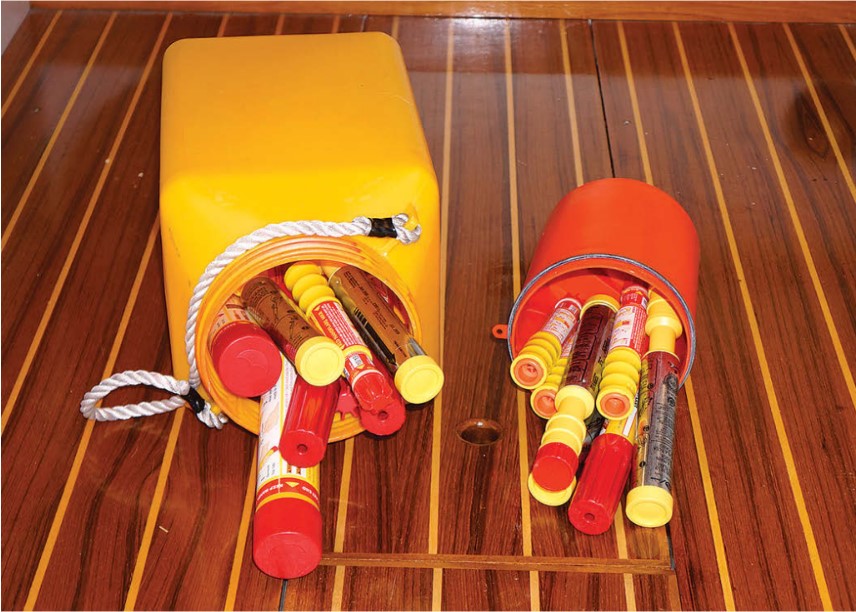
Your flare caddy was overflowing with mostly expired flares. You bought a bigger one. Now it, too, is almost filled with expired flares. If you’re thinking it’s time to find a way to responsibly dispose of those old expired flares, you’re in good company. Many boaters throughout the country are having to deal with perhaps several decades’ worth of expired flares. Our expired flares accumulated twice as fast because we carry a life raft when cruising the coast of British Columbia and its flares also need to be replaced every three years.
Fortunately, there are several good options for disposing of old flares, aka pyrotechnic visual distress signals. These options vary by geographic region, but one or more of them may work for you in your area.
Option A: Supervised training
The first choice is to find a Coast Guard-sanctioned event where you and your crew can practice igniting or launching flares. The many kinds of flares on the market mean there is a lot of variation in how they operate. Attending a practice event may eliminate the need to stop to study the instructions when you’re confronted with an emergency where you actually need to set off flares.
Participating in such events has other benefits. Several years back, our yacht club’s safety officer coordinated an afternoon of test firing marine distress signals with supervision from our local Coast Guard station. It was very informative to watch the relative performance and reliability of the many types of flares used that day. Several samples of one particular type were “fired” (all well past their use-by dates) and the failure rate was discouragingly high. It was a sunny day, which made the lower intensity flares seem rather anemic. The light breeze helped the orange smoke flares stand out as good performers for guiding in a rescue party. Observations from that day influenced my decisions on what types of flares to carry in the future.
Where should you look for Coast Guard-sanctioned marine flare training sessions? Two organizations come immediately to mind: the U.S. Power Squadron and the Coast Guard Auxiliary. On the Olympic Peninsula, where I live, the North Olympic Sail and Power Squadron (NOSPS) holds at least one, and often two, training sessions each year. The public is welcome and participants can set off as many flares as they wish. It is worthwhile checking to see if the Power Squadron unit near you also hosts training sessions with flares.
Our local Coast Guard Auxiliary flotilla has not sponsored a flare training session during the time we have lived on the Olympic Peninsula. However, the flotilla near you might be more active in this regard. It might also be worthwhile to contact yacht clubs near your home to see if any of them hold training events with flares.
Option B: Donation
Donate expired flares to organizations that use old flares for internal training exercises. This might be your local Coast Guard Auxiliary flotilla or the local Power Squadron. Other organizations, such as fire departments, conduct regular personnel training and might accept donations of expired marine flares. Near my home, the East Jefferson Fire Rescue station in Port Townsend, Washington, and the Clallam County Fire District #3 both use donated marine flares in the course of internal training.
My request for information from the Clallam County Fire District #3 found its way to Assistant Fire Chief Dan Orr. Having recently moved there from California, Dan used my request as an opportunity to do some investigation of his own. When he called back, he confirmed that his department does accept a “limited number” of flares that they use for internal training. He also said that he was surprised to discover that disposal options were very limited for boaters in our area. The fire district does have the required magazine for flare storage and they do accept some aerial flares. These are not used in training; they’re fired in a bunker for safe disposal. However, Dan emphasized that the department is not in the business of flare disposal.
I learned that the East Jefferson Fire Rescue station also accepts some aerial flares that they give to other organizations for destruction. Also, as a courtesy to customers, the West Marine store in Port Townsend will accept old flares (in good visual condition). The store then drops them off at the nearby East Jefferson Fire Rescue station. It might be worth checking with a chandlery in your area to see if it offers a similar service.
Option C: Disposal facility
Take your expired flares to your local household hazardous-waste facility. Many moderate hazardous-waste facilities will accept old road flares and some will also accept marine flares. Some facilities choose not to accept marine flares because of the added costs of storing and shipping them. The U.S. Department of Transportation classifies marine flares as “Class 1.4 explosives” and imposes extensive regulations on commercial shippers. In addition, the Bureau of Alcohol, Firearms, Tobacco, and Explosives requires that marine flares be stored in a “type 4 magazine.”
I made a quick check of some of the hazardous-waste collection facilities near me and learned that the Clallam County Moderate Hazardous Waste Facility will not accept marine flares, but three of the five hazardous-waste collection facilities in King County, Washington, (the Seattle area) do accept them. Their website lists the specific facilities that will accept them and the number of flares they will accept per visit.
Option D: Set them off
Ignite handheld flares in a safe location ashore. It is legal to burn road flares and marine handheld flares in a non-emergency situation away from navigable water. However, launching an aerial distress flare in a non-emergency situation is always a violation of U.S. Coast Guard regulations unless prior approval has been obtained.
Canadian options
Canadian boaters have another good option that is not available to U.S. boaters. I had read about an older program supported by CIL/Orion, based in Lachute, Quebec, in which boaters could purchase pre-paid mailers to ship their expired flares back to the company. Through a phone call to its headquarters, I learned that CIL/Orion now has a more convenient way for boaters to return old flares. CIL/Orion will take back old flares from the retail outlets that stock its flares. CIL/Orion’s policy is that the number of returned flares can equal the number of new flares purchased by that store. CIL/Orion is working with the Power Squadron in Canada to make boaters aware of this program.
A call to Orion’s customer service department in the U.S. confirmed that this program for returning old flares is not available within the United States (www.orionsignals.com).
Now what?
Once you have dealt with your current accumulation of expired flares, is there any way to reduce the number you accumulate in the future? Yes, there is now at least one possible solution. No doubt there will be others.
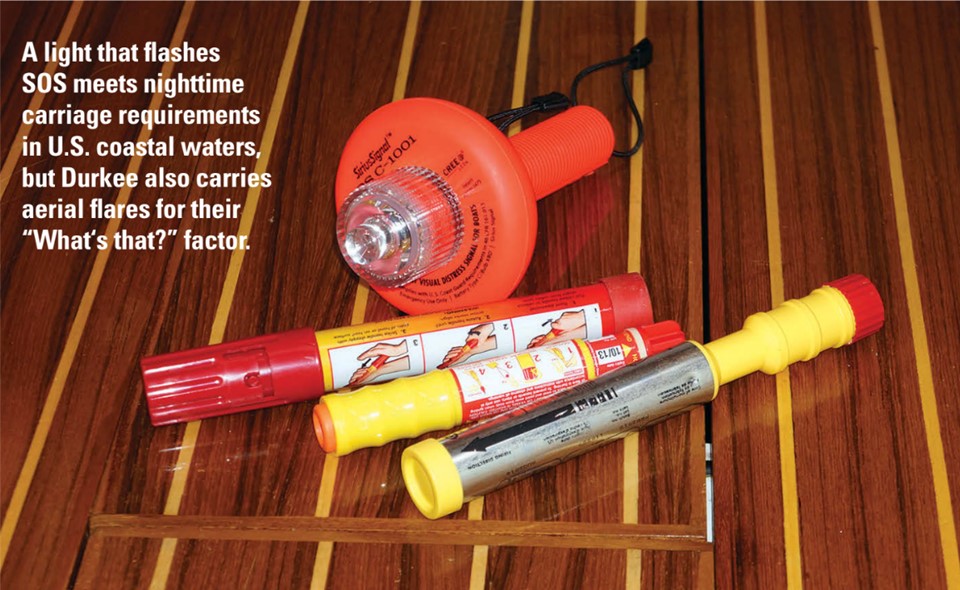
Sirius Signal introduced an electric distress signal that meets U.S. Coast Guard requirements for nighttime use (see “Product Launchings,” March 2016). It consists of a powerful LED light source inside a molded lens that resembles the Fresnel lenses used in lighthouses. The lens directs most of the light into a horizontal beam. A small portion is also directed vertically to aid final location by an overhead aircraft. The device is powered by three C cells and is said to continuously flash the Morse Code SOS signal for about 60 hours with a fresh set of batteries.
The Sirius Signal SOS Distress Light does not have an expiration date (but the batteries do have a shelf life and should be checked periodically). The U.S. Coast Guard accepts one device as fully complying with the requirement for nighttime distress signals carried aboard recreational vessels. (Note: The Sirius Signal light meets night-only requirements and needs to be elevated to be seen from any distance. A black and orange distress flag meets daytime requirements, but since it’s not distinguishable from very far away, daytime flares are still a useful backup — Editors)
I purchased one of these devices. If we ever need to take to our life raft, I will be more comfortable using it than a pyrotechnic device that might drip hot slag. However, I have decided to continue to carry some SOLAS-grade aerial flares aboard our J/32. I anticipate that a very bright flare that lofts to 1,000 feet and burns for 30 seconds will be more likely to attract attention than any handheld signal.
The USCG Auxiliary on expired pyrotechnic devices
This advice from the U.S. Coast Guard Auxiliary is available in a document that can be downloaded from its website in PDF format.
U.S. Coast Guard Auxiliary Advice for Disposal of Expired Pyrotechnic Signaling Devices (Flares)
Options for disposing of pyrotechnic signaling devices (including aerial flares and hand-held signals):
- Retain them for backup use to expand signaling time in the event of an emergency.
- Contact a local law enforcement or fire department for their advice on proper disposal.
- Ignite hand-held signal flares on land in a safe area away from any combustible material, much the same as highway flares would be ignited.
- NEVER jettison visual distress signals overboard.
- NEVER activate marine aerial flares in a non-emergency situation unless it
- is a Coast Guard-sanctioned demonstration.
- NEVER dispose of flares in household trash.
http://bdept.cgaux.org/pdf/WelcomeBoatersPDFs/dispo_of_vds.pdf
Durkee Richards’ sailing adventures began in high school with the Sea Scouts on the Columbia River. Later, he and his wife, Mary, chartered boats on Lake Superior until they bought their J/32, Sirius, and retired to the Olympic Peninsula in Washington State. They have since sailed Sirius more than 20,000 nautical miles exploring the coast of British Columbia to Haida Gwaii and the west coast of Vancouver Island.
Thank you to Sailrite Enterprises, Inc., for providing free access to back issues of Good Old Boat through intellectual property rights. Sailrite.com