From essential spar to useful accessory
Issue 113: March/April 2017
Once upon a time, all sailboats that carried headsails had bowsprits. In the days when masts were cut from trees, there was a definite limit to how long a spar could be, so larger sailplans had to be achieved with a greater number of shorter spars. If the sailplan couldn’t go any higher, a bowsprit and long booms were needed to extend it fore and aft.
In England, a fixed forestay at the stemhead carried the foresail, and a jib and jib topsail were set “flying” from the bowsprit, supported by their own luffs rather than being hanked onto stays. In the 19th century, this sail configuration set on a single mast came to define the cutter rig. In many cases, bowsprits, and even the topmasts, were retractable.
In North America in the same time period, bowsprits were just as long but were fixed, and traditionally carried only one large jib. This arrangement came to define the sloop rig. It wasn’t until the 1890s that G.L. Watson and other designers started experimenting with racing yachts without bowsprits, but these tended to be the exception. The Watson- designed Royal Yacht Britannia of 1893 was considered by many to be the “yachting ideal” of the day, and indeed for the next 40 years, and she certainly carried a bowsprit of considerable length.
On fishing schooners of that era, bowsprits were known as “widow makers” because so many men were swept off them when shortening sail in rough weather. That was the primary reason renowned Boston fishing-schooner designer Thomas McManus eliminated the bowsprit on a schooner he designed in 1902. He called the vessel a knockabout schooner, and the term “knockabout” was soon applied to any rig without a bowsprit.
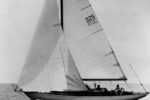
In the top racing classes, the adoption of the Universal Rule in 1906 spelled the end of the bowsprit. The Nat Herreshoff-designed P-Boat Seneca’s victory over the Payne-designed Adele in the 1907 Canada’s Cup redefined what a modern raceboat would look like, and it didn’t have a nose pole. After the introduction of the Marconi rig in the 1920s, coupled with the development of better waterproof wood glues and steel and aluminium construction that allowed masts to be made to any desired height, rigs definitely went up rather than out. The bowsprit was no longer needed on higher-performance sailing yachts and, on a number of racing yachts, the forestay attachment point even moved well aft of the bow.
A cruising advantage
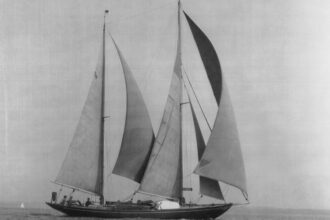
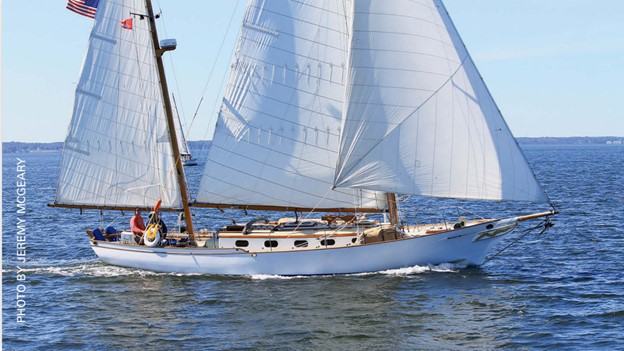
Although the bowsprit was no longer used on around-the-buoys racing yachts, it didn’t disappear from the scene entirely. Its use continued on schooners and ketches especially, rigs on which the foremast is located well forward and a bowsprit allows more options for setting headsails. A bowsprit also gives a boat a salty look and designers, L. Francis Herreshoff among them, combined the bowsprit with a clipper bow to produce boats of exceptional beauty. This same aesthetic was used in the steam yachts of the 1890s as a predominantly decorative feature to extend the sheerline and add a touch of classic elegance.
In the age of fiberglass, many designers and builders used the combination of bowsprit and clipper bow as a marketing feature, as Ted Gozzard did with great success at Bayfield Yachts and Gozzard Yachts. (See November 2016 for reviews of the Bayfield 29 and the Gozzard 31).
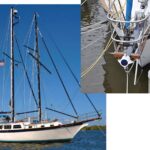
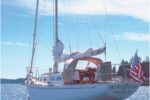
Roger Hughes’ Britannia, built by Down East Yachts, is another example of the type. When Roger decided he had to replace Britannia’s bowsprit, he was concerned about making it strong enough.
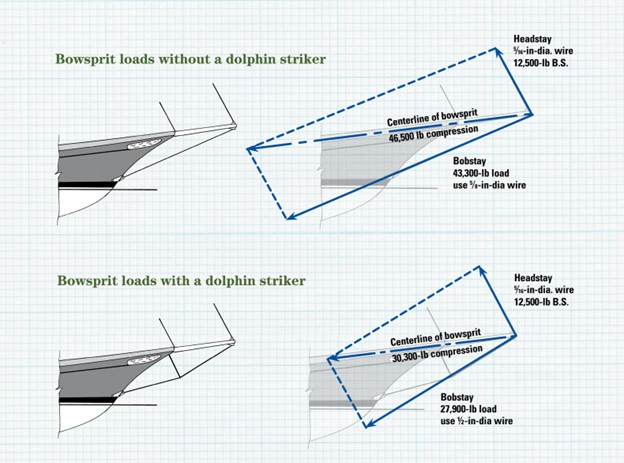
Bowsprit loading
The upward load of the headstay at the end of the bowsprit can either be absorbed entirely by the bowsprit itself acting as a cantilevered beam or it can be supported by a bobstay extending from the end of the bowsprit to a fixed point on the stem in the vicinity of the waterline.
The free-standing configuration is typically found in the retractable bowsprits of performance-oriented raceboats, such as J/Boats and Vipers. Since these tapered carbon-fiber poles are used to support the tack of an asymmetrical spinnaker, which has a loose luff to begin with, some bend in the pole is acceptable.
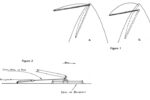
On a bowsprit that carries headsails where a slack luff is not acceptable, as on Roger’s Britannia, the end of the bowsprit is restrained by a bobstay. The result is a large tensile load on the bobstay and an almost equally large compression load on the bowsprit. In this respect, the load is identical to that on a mast, with the bobstay being analogous to a shroud, and is resolved in the same way. Just as a spreader is used to maintain and create a wider shroud angle, a dolphin striker is often introduced in the bobstay to increase the angle between the bobstay and the bowsprit and thereby reduce the tension needed to counter the tension in the headstay. The diagram on page 20 illustrating bowsprit loads is similar to the one Roger found in Skene’s Elements of Yacht Design.
Due to sag in the headstay, the jib also imposes a sideways load on the bowsprit. This load is smaller than the upward load and is often supported on longer bowsprits by shrouds, also called whisker stays, which may also be led around spreaders. On the more common shorter modern bowsprits, transverse rigging is often eliminated and the bowsprit itself is designed to absorb transverse loads. This is achieved with the hairpin configuration or by making the sprit a broad plank.
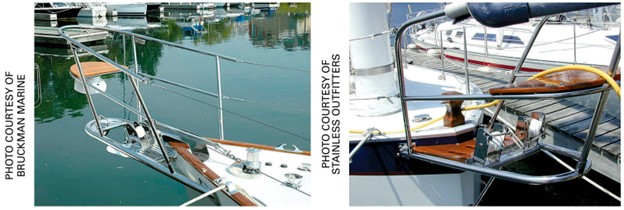
The earliest example of the hairpin bowsprit I have seen is on a model of the 53-foot 1958 George Cuthbertson-designed Inishfree. He used it again on his 40-foot SORC winner Red Jacket in 1966 and on the 1969 Canada’s Cup winner Manitou. To the best of my recollection, in my 15 years designing for C&C Yachts, as well as my more than eight years designing for Mark Ellis Design, this was the only style of bowsprit we ever used.
While a bowsprit is used on some good old boats to carry the rig farther forward, its primary purpose is often for storing anchors where they are easy to deploy and retrieve. Even the Mark Ellis-designed Nonsuch, which has no headsail at all, is sometimes fitted with a stainless-steel hairpin bowsprit for the sole purpose of deploying the anchors. In these configurations, the bobstay is actually a stainless-steel tube and is designed to act in compression, not tension.
The challenge for crew on boats with bowsprits since the beginning has been getting out to the end of the sprit to set and take down the sails. In the days of commercial sail, sailors relied on foot ropes, as on the yards aloft, or used the whisker stays and the bobstay. Modern cruising sailboats more often have wide platforms, that allow walking on top of the bowsprit, and a bow pulpit that extends to the end of the bowsprit, as is the case on Roger’s Britannia.
Roger raised the point about the load a bowsprit must absorb when the boat’s bow plunges into a head sea. In such conditions, the boards sometimes added to increase the working width of a traditional pole bowsprit might get washed off the structure, but the bowsprit itself, if properly designed and built, should not be compromised. The loads imposed by the rig and sails are arguably far more severe than those that result from sudden immersion.
Bowsprits have been around for 200 years of yachting (much longer on commercial sailing vessels), and will persist for many years to come, especially on boats of more traditional design. Modern bowsprits, if less traditional in appearance, combine two purposes. By extending the sail plan forward, they allow more headsail combinations, and their construction provides a secure location for anchor handling and storage when cruising.
Rob Mazza is a Good Old Boat contributing editor who, in his long career with C&C and in other design offices, designed many boats that are now good and old.
Thank you to Sailrite Enterprises, Inc., for providing free access to back issues of Good Old Boat through intellectual property rights. Sailrite.com