Do not poo-poo the smarts of swallows
Issue 114: May/June 2017
Birds and other wild creatures that inhabit our boating waters are tough, adaptable, and innovative — and sometimes annoying. But always they add interest to the outdoor scene and, by observing them, we who sail can learn life lessons in parenting, persistence, and courage.
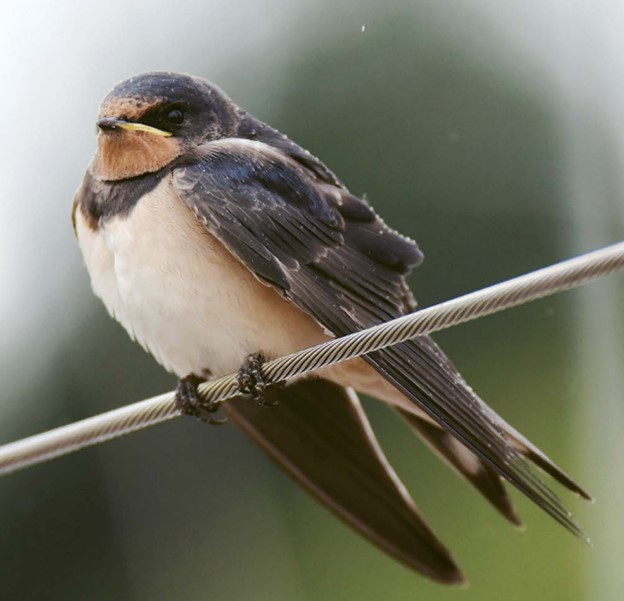
I sail on fresh water where much of the boating-associated wildlife has wings. Along with the ever-present gulls and terns, the trim, graceful barn swallows are summer regulars around the docks of our upstate New York harbor. They and their close kin, the purple martins, enjoy hanging out on moored boats. The stationary yacht serves as a secure, peaceful little island roost.
Our two-master lies at a mooring. The triatic stay that runs between the tops of her masts is a wonderful purple martin roost. All summer long, the birds perch shoulder-to-shoulder and socialize while munching on large dragonflies and cicadas. Martins are messy eaters and, before long, discarded insect parts litter the decks. Their poop stains, and eventually degrades, even the durable fabric of our dodgers and sail-covers. So we try to discourage them.
Each spring, we go aloft and stretch monofilament line between the masts, just above the stay. Last year, the birds figured out a way to slip under it. We rattled halyards to shake them off, but soon that ceased to bother them. They even rode along with us when we departed the mooring under power. I suppose we should be glad that they weren’t ospreys.
Their cousins, the barn swallows, prefer the closer-to-deck-level lifelines. As summer moves on, their children join them. Swallows often raise two broods a year, so by August we are usually hosting a pretty good crowd. Even little poops build up when you have 50 or 60 birds aboard. The best solution seems to be daily use of the boat. If our boat leaves its mooring for a few hours, the flock moves to one that’s still moored.
I grew up with barn swallows as a part of our family farm life. I loved to watch their swift, graceful flight over the fields and pastures, and I still enjoy their friendly chatter. I never thought of them as being particularly bright, as birds go. Then, one morning on the boat, I watched a parent bird arrive at regular and frequent intervals with a load of small midges to feed four youngsters, just fledged and still sporting bits of baby fuzz. With each trip, she moved down the line, stuffing food into successive hungry maws. And twice I noticed the same fluttering little guy reposition himself at the head of the line after Mom left, so as to get an extra helping!
A year or two later, I saw another example of bird individuality and parenting. We were parked at a marina dock for the night and comfortably settled in the cockpit for happy hour. Soon we noticed a barn swallow nest tucked under the anchor roller of an adjacent boat that apparently had spent the last two months tied up to the dock. Two babies teetered on the boat’s anchor. Two others clung to the nest. Over and over, the parent birds brought food to the two little fellows perched on the anchor, ignoring the frantic cries of the nestlings. One very hungry baby stretched desperately over the nest edge, begging.
No dice. “You gotta spread your wings, kid,” you could almost hear the parent say, as it brought another serving to the little ones on the anchor.
Finally he launched forth, swooped down toward the water and then, at the last moment, inches away from death, picked up enough speed to gain altitude and make the turn back to the anchor. As darkness fell, one famished baby remained in the nest. We wondered whether he’d make it. The next day, all the little birds were gone. I trust he took that leap into the unknown.
As I scrub the poop deck on a summer morning, I consider that it must take incredible courage to leave the nest and spread one’s wings for the first time. When suddenly all the swallows respond to the call of the South and vanish in late August, I wish I could follow them. As Water Rat, in The Wind in the Willows, listened to swallows chattering about their upcoming journey, he knew the days pass and never return.
Our mooring suddenly seems so quiet after they depart. But my restless urge passes. We settle in for another winter, comforted by the thought that spring, and the birds, will return next year.
Susan Peterson Gateley writes and sails on Lake Ontario. She holds an MMC to 100 tons and teaches basic sailing on Little Sodus Bay and recently completed a one-hour video on Lake Ontario. Her books and DVD are available through chimneybluff.com. She writes and blogs at susanpgately.com.
Thank you to Sailrite Enterprises, Inc., for providing free access to back issues of Good Old Boat through intellectual property rights. Sailrite.com