A clear, calm night at sea evokes awe
Issue 100: Jan/Feb 2015
For as long as I can remember I have been obsessed by the sea. As I look back, I can see where my experiences on the sea and the lessons I learned there have played a central role in my life. One particular memory was triggered when I read an article in the New Yorker by Patricia Marx, in which she described her voyage from Philadelphia to Europe on a container ship, noting, “The seven seas are, I discovered, as interesting to look at as an unplugged lava lamp.” I took exception to her observation because that has never been my experience; I have always found the visual contemplation of the sea to be both fascinating and fulfilling.
Those who go to sea in good old boats see a world that is invisible to passengers on cruise ships and large container vessels. The closest you can get to the water on a container or cruise ship is probably 100 feet or more. You’re surrounded by the sounds of engines, ventilation fans, and other shipboard machinery that block out the sound of the sea. The ship’s concessions to “comfort” (roll-and-pitch-dampening technology) further insulate you from the natural environment. From 100-plus feet above sea level, the sea itself can appear as an indistinguishable gray or blue mass without even distinct wave patterns. On our much smaller vessels we are closer to the water, perhaps as close as 2 or 3 feet, and the seven seas become much more interesting to observe and experience.
Because I’ve been close enough, I’ve seen greenish-white bioluminescence bright enough to read by, dolphins leaping around the bow wave, flying fish launching themselves and flying from wave to wave, and constantly, the water in motion. I find that photos I’ve taken of the sea are disappointingly static, because the sea’s essence and beauty are, to me, in its movement and rhythm. But the most awesome thing I have seen, in the literal sense of awesome — as inspiring awe and wonder rather than the current vernacular sense of being merely pleasing or “cool” — occurred one night several years ago when I was one of a crew of three on a Tartan 37 returning to Cape Cod from Bermuda.
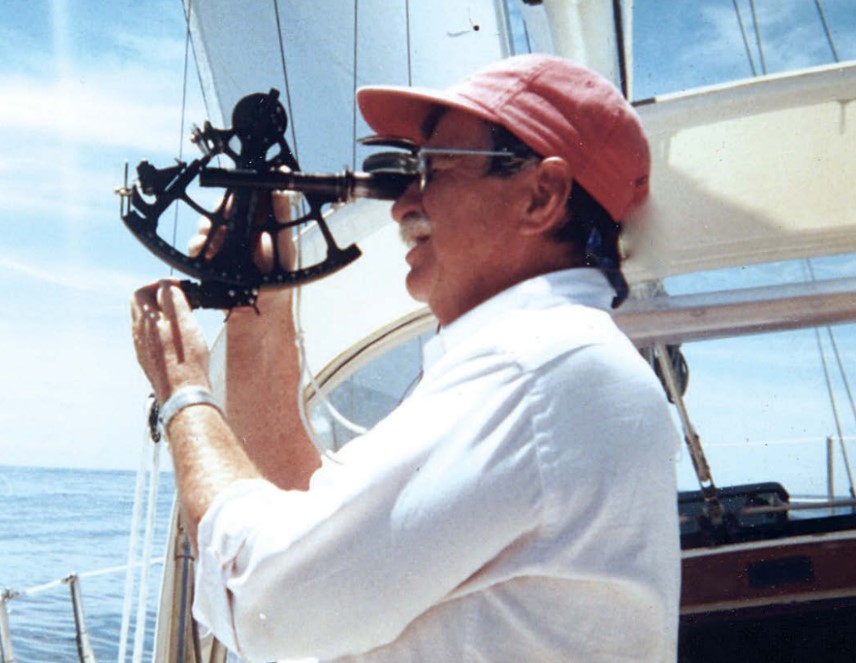
We were becalmed but content to drift. We weren’t in a hurry and didn’t want to run our engine and use up our fuel. The skies were absolutely clear, with no clouds whatsoever. Stars stretched from horizon to horizon. Ashore, we think of the stars as being overhead, when we can see them between the glare of lights. But in the dark unpopulated places with wide horizons, such as deserts and seas, stars are all around.
The sea was calmer than I had ever seen it during my time at sea. No waves, no swells, a surface as still and smooth as a black mirror, disturbed by nothing, not even our own motion. When I came on deck for my watch at midnight, I saw a sky much like some I had seen before on clear nights at sea. What took my breath away was seeing the stars, including the Milky Way, perfectly reflected in the still, dark water. We were literally surrounded by a globe of stars above and below.
In a few hours the wind returned, our sails filled, and we began to move. The surface of the sea rippled, wave motion built up, and the illusion was gone. But for a while, there was a vision of the sea that was considerably more interesting, beautiful, and wondrous than even a plugged-in lava lamp.
Jerry Richter has been messing about in boats since about the age of 5 and started solo sailing at 12. He has owned and crewed on coastal and offshore sailboats for the past 20 years. He served as a celestial navigator on an LST for two trans-Pacific crossings during seven-and-a-half years of Navy sea duty. Jerry is now reliving some of his maritime experiences in writing.
Thank you to Sailrite Enterprises, Inc., for providing free access to back issues of Good Old Boat through intellectual property rights. Sailrite.com