Issue 118: Jan/Feb 2018
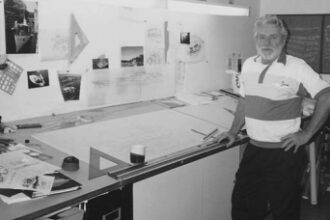
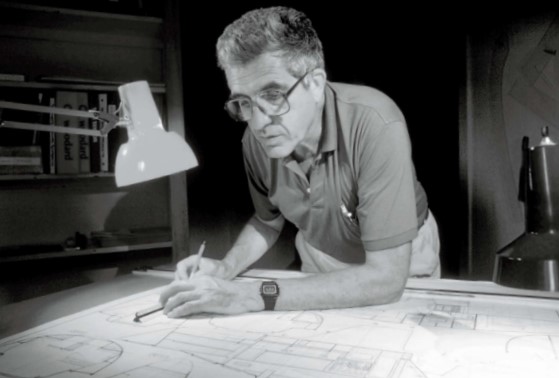
George Harding Cuthbertson passed away at the age of 88 at his home in Toronto on October 3, 2017. In the sailing world, George Cuthbertson is best known as the first “C” in C&C Yachts, a boatbuilding company formed in 1969 when the design firm Cuthbertson & Cassian amalgamated with three Canadian boatbuilders. George was the president of that company from 1973 to 1982.
Several years ago, when interviewing Erich Bruckmann about his involvement with Canadian boatbuilding, I asked him how it all started, and he replied: “It started with George, of course! Everything always started with George.” Many who were involved in the boating industry in Canada in the 1950s, ’60s, and ’70s would agree with that sentiment.
George began designing boats immediately after graduating from the University of Toronto in 1950, when he established a company called Canadian Northern with his partner Peter Davidson. Canadian Northern, an early adopter of fiberglass, built the 8 foot 6-inch Water Rat dinghy and made a number of non-marine fiberglass products. George’s design career accelerated when he became involved with Norm Walsh and the 1954 Canada’s Cup. Charged with finding a competitive 8-Metre to challenge Rochester Yacht Club (RYC) on behalf of the Royal Canadian Yacht Club (RCYC), George chose Venture II. With her rig and layout optimized, she defeated the other RCYC contenders for the right to challenge RYC, and ultimately beat the RYC defender, Iskareen, returning the Canada’s Cup to RCYC after a 50-year absence.
That victory led Norm Walsh to commission the 25-year-old George Cuthbertson to design the 54-foot centerboard racing yawl Inishfree. This was only the third Cuthbertson design to be built, the previous two being the Water Rat and a 24-foot plywood sailboat. Inishfree’s ultimate racing success led to a succession of commissions in the late ’50s and early ’60s, a number of which were built by Metro Marine in Bronte, Ontario, in strip-planked cedar, under the supervision of the young German immigrant Erich Bruckmann.
Canadian Northern also imported a series-produced steel yawl, known as the CN-35, from the German builder Beister. The owner of the first CN-35 was Ian Morch, who later established Belleville Marine.
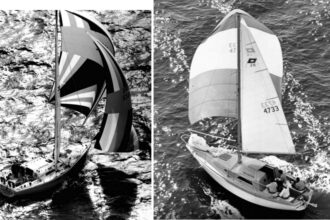
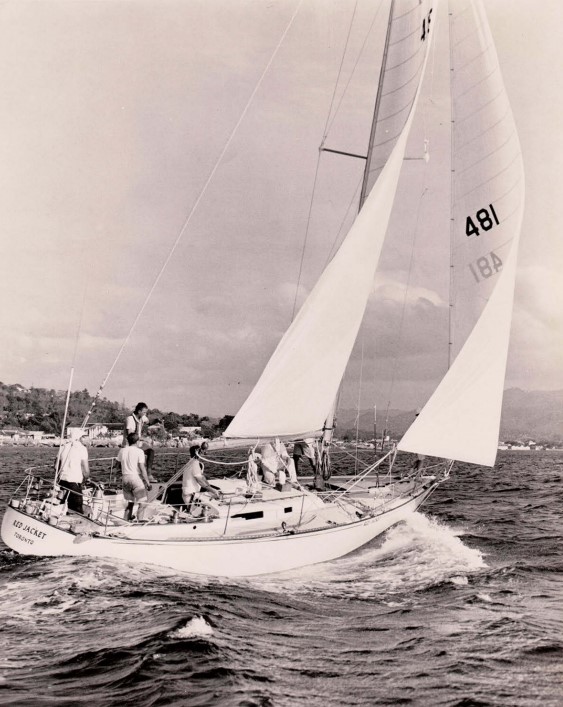
By 1961, George Cuthbertson had taken on George Cassian as a design associate and changed the company’s name to Cuthbertson & Cassian. In 1966, Perry Connolly commissioned the firm to design “the meanest, hungriest 40-footer afloat.” Erich Bruckmann built the 40-foot Red Jacket, which was the first boat in North America to have a fully cored fiberglass hull. Red Jacket swept the racecourses on Lake Ontario, won her division in the 1967 SORC, and returned to Florida the following year to win the SORC overall.
Another Canada’s Cup victory followed in 1969 with the Cuthbertson & Cassian-designed and Bruckmann-built Manitou. In the same period, up to a dozen local builders were building production boats in increasing numbers. As a way to develop some production synergy and raise money for expansion, three of those builders (Belleville Marine, Hinterhoeller Yachts, and Bruckmann Manufacturing) joined with designers Cuthbertson & Cassian to form the public company C&C Yachts.
George’s greatest year as a designer was probably 1971, when C&C designs won not only the SORC overall title but also three of the five divisions. However, after the introduction of the IOR in the early ’70s, the older Cuthbertson designs to the CCA rule did not fare well, and neither did his boats designed to the new rule. A fresh group of young designers with no CCA baggage — Doug Peterson, Ron Holland, German Frers — busily began designing boats to “beat” the new rule. This development, and the demands of guiding a multinational public company, no doubt influenced George’s decision to hand design responsibilities over to Rob Ball and assume the presidency of C&C Yachts.
George oversaw C&C’s expansion into new plants in Kiel, Germany, and Middletown, Rhode Island. C&C designs were also being built in the UK and in Italy. In 1981, an outside entity acquired C&C Yachts. In 1982, George left the company he’d helped found 13 years previously. He started a new company, Motion Designs, but the sailboat market was changing dramatically, and the magic of the late ’60s and early ’70s was gone.
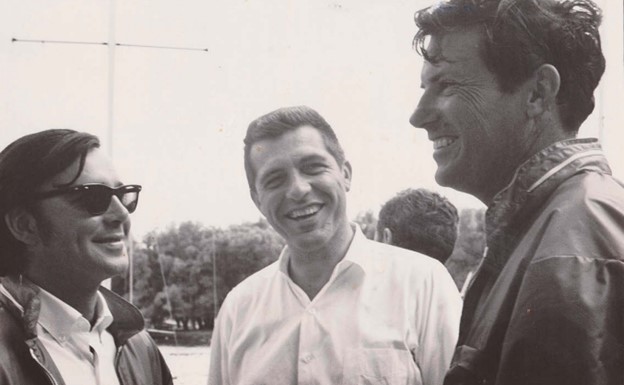
George became the official historian of the Royal Canadian Yacht Club, and he sat for many years on the board of directors of the Marine Museum of the Great Lakes at Kingston, to which he donated a majority of his design files and drawings up to 1973.
I had the pleasure of working for George Cuthbertson for 15 years. I began at Cuthbertson & Cassian during the summers of 1968 and 1969, when I was studying at Queen’s University. After receiving my master’s degree in naval architecture from the University of Michigan, I started full time at the design office of what had by then become C&C Yachts.
I parted from C&C in 1985, and it was only within the last 10 years that my wife, Za, and I reconnected with George and Helen Cuthbertson. In that period, George became a good friend, always interested in what we and the other members of his design group of 1973 were up to.
A lot of people, myself included, look back on their years with C&C as the days of their happy youth, when we could actually make a living designing, building, and racing fiberglass sailboats. We owe all of that to George Cuthbertson.
George’s death marks the end of an era. He turned a nascent fiberglass-sailboat industry in the 1960s and ’70s into a truly Canadian sailboat industry, building Canadian-designed boats that would dominate the market for many years. It really did all start with George.
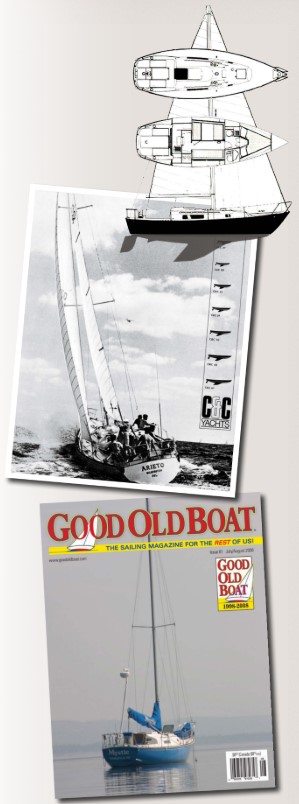
Rob Mazza is a Good Old Boat contributing editor who, in his long career with C&C and in other design offices, designed many boats that are now good and old.
Thank you to Sailrite Enterprises, Inc., for providing free access to back issues of Good Old Boat through intellectual property rights. Sailrite.com