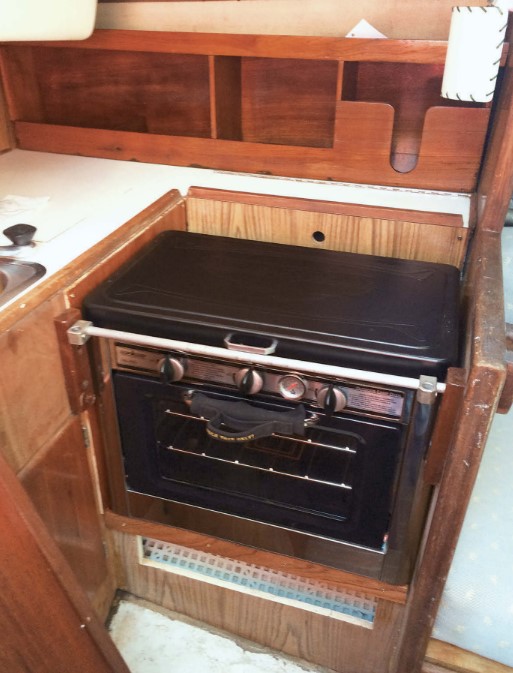
A camp stove makes the grade for a lakes-cruising family
Issue 118: Jan/Feb 2018
For the first 49 seasons after our 1965 Alberg 35 was built, a simple two-burner propane camp stove had sufficed in the galley. While the stove had served us well, a couple of long weekends with hungry teenagers aboard made us think about upgrading to something a little more versatile. Besides, the old stove was beginning to succumb to age, and corrosion was becoming more than a cosmetic issue.
Selecting a new stove
We had a very short list of requirements for a replacement stove. I didn’t want to embark on a major interior remodeling job in the galley, so the new stove had to fit within a specific space. Though an oven would require sacrificing some galley storage, we felt we really needed it. While it would have been nice to have a three-burner range, the larger size would require major surgery to the interior cabinetry. We concluded that two burners would be a practical limit.
Allocating space for a gimbaled mount would reduce storage options even more, possibly eliminating more than three-quarters of the storage volume we were using for our pots, pans, and plates. The old stove sat on a fixed shelf. Over the years, we had come up with various ways to hold pots in place under way and we were always careful not to overfill them. Gimbals would be a nice improvement, but we didn’t make that a priority.
Tomfoolery was already configured to use propane for cooking, so we decided to stay with that fuel.
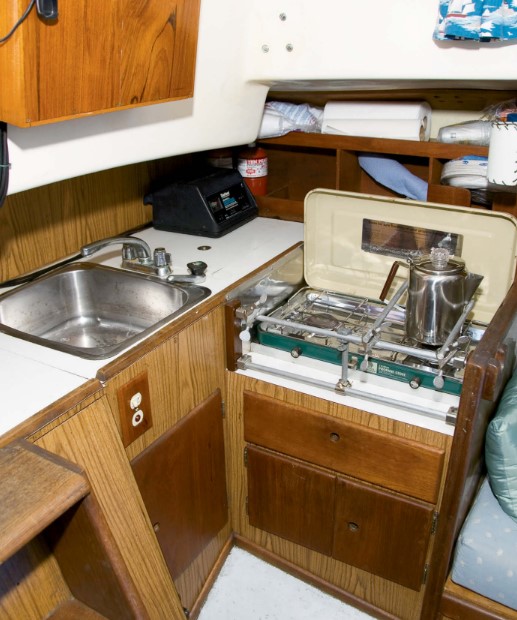
Shopping for stoves, we quickly learned that marinized stoves were outside our budget, even used ones. While an all-stainless-steel stove is warranted for saltwater boats, we sail on inland lakes, where corrosion is less of a concern. We ruled out marine stoves and started looking at replacing our camp stove with a better camp stove. As we had been living with a camp stove for so long, we didn’t see this as a major compromise, and the $1,000 price difference helped us to rationalize this decision.
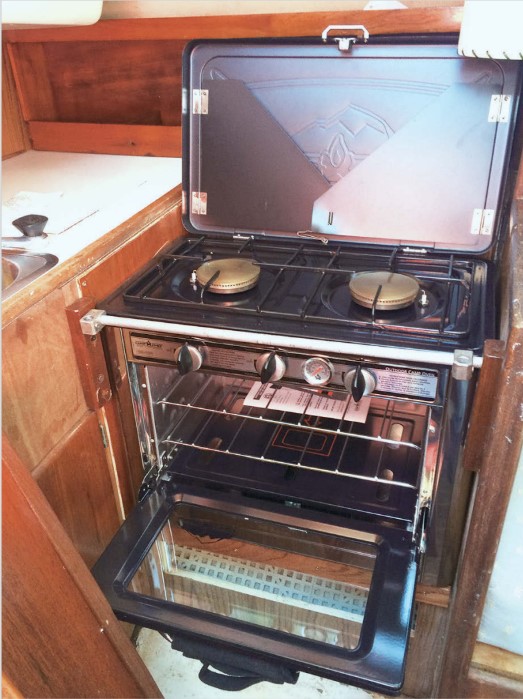
In the end, we decided on the non-gimbaled Deluxe Outdoor Camping Oven by Camp Chef. It’s a stand-alone stove with a two-burner range and an oven that accommodates a 13 x 9-inch baking pan. It was the right size, had received good reviews, and was available new and on sale for about $200.
The first thing I did when I brought the stove home was connect it to a propane bottle in my workshop and fire it up. I set all the burners on high and the oven to its maximum temperature. After half an hour, I used a thermal camera to identify hot spots on the exterior of the stove that might need special shielding and/or ventilation when it was installed on board. Fortunately, the stove’s exterior remained quite cool except for the oven vent at the top rear. As a result, when installing the stove, I allowed for a 4-inch ventilation space behind it.
Preparing the space
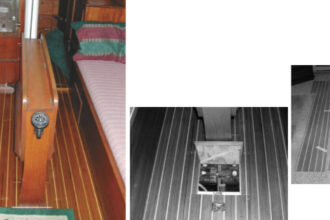
The old stove was rather small, standing less than 4 inches tall. Beneath it was a sizable drawer and a reasonable cupboard. Additional storage was immediately behind the stove in another cubby located below the shelving unit against the inside of the hull.
The new stove stands almost 18 inches high. This meant that I had to remove the shelf that supported the old stove, the drawer, and most of the cupboard below it. But because the footprint of the new stove was similar to that of the old one, the cubby behind the stove could remain.
After removing the drawer, I used an oscillating saw to remove the shelf on which the old stove sat. In doing so, I had to cut through several screws. Because of where they were, it became obvious that the galley cabinetry had been assembled prior to being installed on the boat. I had to cut through more screws when removing the drawer supports and the front trim panel.
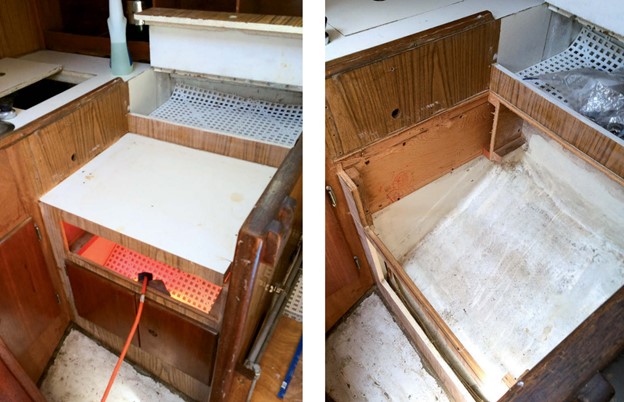
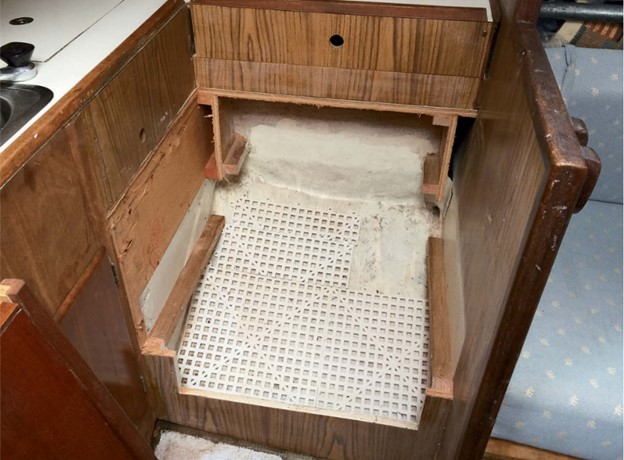
I wanted the new stove’s burner cover to be at the same height as the countertop and serve as an additional work surface when the stove was not in use. Determining where to install cleats to support this shelf was easy enough; the difficult part was ensuring they were level relative to the galley countertops.
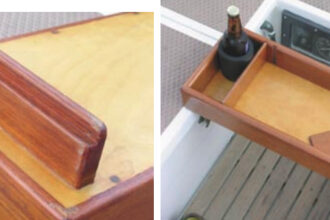
The original surfaces inside the Alberg 35 were wood-grained Formica. These are easy to clean, but not so pretty to look at. As we’ve made modifications to the interior, we’ve covered the Formica with mahogany veneer, which we then varnished. The resulting elegant finish befits a classic yacht with more than 50 years of sailing experience. To match this finish on the shelf and the side panels of the gutted space, I used plywood to which I had glued mahogany veneer.
Installing the new stove
When I’d roughed-in the new space, I test-fitted the new stove. After some minor adjustments, I screwed the new shelf and panels into place and concealed the joints and screw heads under solid mahogany trim.
Because this was a camping stove, the propane pressure regulator was located on the rear, where it attached to the stove with a proprietary fitting. Fortunately, the fitting mated with the regulator using a standard 1⁄8-inch pipe thread. This allowed us to remove the fitting from the regulator and, using an adaptor, connect it to our existing low-pressure (10 psi) propane line. This modification was necessary to avoid running a high-pressure (~350 psi) propane line through the boat from the propane locker. I used Teflon pipe tape to assemble the connections and, before putting the stove into service, tested them for leaks with soapy water. If I could have borrowed a gas sniffer, even better!
The trim piece covering the front of the shelf stands proud of the shelf surface to prevent the stove from sliding off the shelf. I fitted a metal bar in front of the stove, and the cleats that secure it prevent the stove from tipping forward when the boat heels to starboard. Cleats behind the stove constrain it when it heels to port. The metal bar also serves as an attachment point for clamps that hold pots in place.
Teenager-tested
Of course, once the stove was installed and commissioned, we had to test it under operating conditions. To do that, we set out on a six-day cruise.
A definite plus with the new stove was the piezoelectric igniters for the burners — no more fumbling around for a match or lighter. Lighting a burner is a one-hand operation, a simple twist of a knob. The younger members of our crew conducted even more thorough testing: baking chocolate chip cookies while under way. Only six cookies were produced, but the low yield was no fault of the oven . . . the cooks ate the cookie dough almost faster than it could be baked! The oven proved itself later in the voyage when we prepared a pizza.
During the first season of use, careful monitoring of the temperature around the stove assured us we’d provided adequate ventilation and spacing. After two years of use, the varnish on the surrounding woodwork, even behind the oven vent, was still intact. The only challenge so far has been correlating the actual oven temperature with the reading on the built-in oven thermometer. I’m sure we’ll figure that out over time.
Propane safety
No article about propane stoves would be complete without a reference to safety. Propane fuel demands respect and is unforgiving of complacency.
Because propane gas is heavier than air and would tend to settle in the bilge in the event of a leak, when we repowered recently, we left in place the bilge blower for the original gasoline engine.
Lacking a propane locker (it’s on the list of future projects), we store our cylinder on deck, where any gas that leaks can easily dissipate. A propane detector and shutoff solenoid are also essential items for any boat using propane.
When a fuel-burning stove is used in a confined space, good ventilation is needed to prevent oxygen deprivation and potential buildup of carbon monoxide (CO). A working CO detector is an important safety item on a boat.
Tom Alley — a charter subscriber to Good Old Boat — and his family sail their 1965 Alberg 35 sloop, Tomfoolery, and are active racers and cruisers with the Finger Lakes Yacht Club in Watkins Glen, New York. Tom has been a US Power Squadrons member since the late 1980s, and has been a Squadron Education Officer (SEO) for longer than he cares to remember. He also manages the Alberg 35 User Group website (www.Alberg35.org). When he’s not sailing, thinking about sailing, or tinkering with his boat, Tom is either scuba diving, hanging out with fellow amateur radio operators, or (as a last resort) working as an engineer to support his sailing addiction.
Thank you to Sailrite Enterprises, Inc., for providing free access to back issues of Good Old Boat through intellectual property rights. Sailrite.com